
Crypto Influencer Bias Detection: 7 Content Patterns That Correlate With Low Accuracy
Crypto Influencer Bias Detection: 7 Content Patterns That Correlate With Low Accuracy
Crypto influencer bias detection is the fastest way to stop outsourcing your conviction to someone else’s incentives. The goal isn’t to “cancel” creators or predict prices—it’s to recognize repeatable bias patterns that, historically, show up alongside lower prediction accuracy and weaker accountability.
At CryptoKrios, we analyze crypto content creators across 13 trust indicators and track prediction accuracy over time, then roll those signals into an explainable 0–10 trust score. This article breaks down seven bias patterns our research consistently sees around low accuracy, with a self-check you can run today.
1) Undisclosed sponsorship (promos without clear #ad / #sponsored)
What it looks like
Undisclosed sponsorship is when a creator strongly pushes a token, exchange, NFT mint, or “partner” product without labeling the content as #ad or #sponsored, and without disclosing a potential conflict of interest. It often appears as:
- A sudden shift in coverage toward one ticker with unusually positive framing
- Repeated calls-to-action (“use my link,” “join the presale,” “airdrops are live”) without a disclosure line
- “This is not sponsored” phrasing paired with affiliate links (which is still compensation)
- Content that reads like marketing copy: benefits-only, no risks, no scenarios
Why it correlates with worse outcomes
When money is involved, the content incentive changes. The creator’s success metric becomes conversions (sign-ups, clicks, buys), not forecast quality. That bias can lead to:
- Selection bias: only covering assets with campaigns, not the best evidence
- Asymmetric risk framing: upside emphasized, downside minimized
- Reduced falsifiability: avoiding clear invalidation rules that might hurt conversions
Even if the creator is skilled, undisclosed incentives reduce trust because you can’t separate analysis from marketing.
Concrete self-check
Run a “partnership scan”:
- Check pinned posts, video descriptions, and link hubs for affiliate programs, referral codes, or “partners.”
- List the top 3 repeated tickers from the last 30–60 days.
- Ask: are those tickers repeatedly highlighted without explicit compensation disclosure?
If you can’t map enthusiasm to transparency, crypto influencer bias detection should treat it as a credibility tax.
2) Survivorship framing (only winners highlighted; misses disappear)
What it looks like
Survivorship framing happens when a creator spotlights successful calls (“called it!” threads, victory-lap clips) while downplaying or deleting the misses. Common tells include:
- Monthly recap posts that only list green outcomes
- Screenshots of entries without exits, or exits without entries
- Deleted tweets, missing videos, or “cleaned up” timelines
- Selective time windows (“up 80% since I mentioned it”) that ignore drawdowns
Why it correlates with worse outcomes
Prediction accuracy is a measurement problem. If the record is curated, you can’t compute accuracy honestly—and the creator can’t learn from errors in public. Over time, survivorship framing tends to correlate with:
- Overconfidence (because failure signals are hidden)
- Reduced calibration (predictions aren’t adjusted when wrong)
- Audience capture (only positive reinforcement survives)
Creators who revisit wrong calls and explain why they were wrong usually develop better process. Creators who bury misses often repeat the same mistakes.
Concrete self-check
Do a 3–6 month “time travel audit”:
- Scroll to content from 90–180 days ago.
- Pick 10 claims that had an implied direction (“breakout,” “reversal,” “going to run”) or a clear thesis.
- Grade each claim as Aged Well / Mixed / Aged Poorly.
If you can’t find old content, or the ratio is heavily “Aged Poorly” while current content implies high confidence, crypto influencer bias detection should flag survivorship framing.
3) Unfalsifiable claims (no invalidation rule)
What it looks like
Unfalsifiable claims are predictions that can’t be proven wrong. They often sound reasonable but evade accountability:
- “It will go up eventually.”
- “This is a long-term play,” with no timeline or conditions.
- “Whales are accumulating,” with no referenced data.
- “You’ll thank me later,” rather than a testable thesis.
Sometimes the language is intentionally vague (“soon,” “imminent,” “massive upside”) so the claim can survive any market regime.
Why it correlates with worse outcomes
If a claim can’t be invalidated, it can’t be measured. And if it can’t be measured, it can’t be improved. This is why crypto influencer bias detection treats falsifiability as a core trust signal:
- No feedback loop: the creator never has to update beliefs
- Narrative dominance: story replaces evidence
- Infinite time horizon: “eventually” becomes a loophole
High-accuracy creators tend to define what would change their mind, because they’re optimizing for being right—not for sounding right.
Concrete self-check
Ask a simple question: “What would make this thesis wrong?”
Look for at least one of these in the original post/video:
- A price level (support breaks, invalidation point)
- A date/time window (“if X hasn’t happened by Y, thesis is wrong”)
- A condition (on-chain metric, liquidity change, funding flip)
If you can’t find any invalidation rule, treat the prediction as entertainment—not analysis.
4) Goalpost-shifting (timeframes and targets move after the fact)
What it looks like
Goalpost-shifting is when a creator changes the criteria after a call doesn’t play out. You’ll see:
- “This was always a 6–12 month trade,” after it was framed as a near-term move
- Revised targets (“first target,” “macro target,” “ultimate target”) added later
- A new thesis layered on top of the old one without closing it out
- “The setup is still valid” with no discussion of what invalidated the original idea
Goalpost-shifting can be subtle: it often hides inside “updates” that retroactively redefine the bet.
Why it correlates with worse outcomes
Markets are uncertain, so updates are normal. The problem is when updates rewrite history. That correlates with lower accuracy because:
- Error isn’t acknowledged, so process flaws persist
- Risk management disappears (if the trade never ends, it’s never wrong)
- Audience perception is manipulated (calls stay “alive” indefinitely)
Creators with stronger track records usually separate: (1) what they said, (2) what happened, (3) what they learned, (4) what they’ll do next.
Concrete self-check
Run an “original vs. later” comparison:
- Screenshot or save the original post/video timestamp with timeframe language.
- Find the next two updates.
- Compare: did the timeframe or target meaningfully change?
If the creator’s later framing consistently extends time or redefines targets, crypto influencer bias detection should downgrade credibility.
5) Hype-language density (urgency and superlatives instead of evidence)
What it looks like
Hype-language density is the ratio of emotional pressure to actual support. Typical phrases include:
- “Last chance”
- “Guaranteed”
- “Everyone is buying”
- “Send it” / “face-melting pump”
- “100x” thumbnails without a base-rate explanation
You’ll also see urgency stacking: “You have hours,” “don’t miss,” “this is the one,” repeated across many assets.
Why it correlates with worse outcomes
Hype is optimized for attention, not accuracy. It encourages impulsive behavior and discourages nuance. In practice, high hype-language density correlates with lower accuracy because:
- Claims become non-specific and non-testable
- Contradictory signals are ignored (confirmation bias)
- The creator is rewarded for engagement, not correct forecasts
A useful mental model: evidence ages well; hype ages fast.
Concrete self-check
Do a quick “claims vs. sources” count in a single video/thread:
- Count claims: directional statements, certainty language, targets, “this will happen.”
- Count sources: charts, on-chain metrics, macro data, official docs, cited research.
If claims wildly outnumber sources, treat it as a red flag. Crypto influencer bias detection often starts with this simple ratio.
6) Source-free assertions (no on-chain data, charts, or citations)
What it looks like
Source-free assertions are statements presented as facts without verifiable backing. They often rely on:
- Unlabeled screenshots (“look at this order book”) with no timestamp
- Vague references (“insiders told me,” “smart money is rotating”)
- “Trust me” credibility (“I’ve been in crypto since 2017”) instead of evidence
- Cherry-picked chart segments without context or invalidation
Not every creator needs to be a quant. But if there are no sources, you can’t distinguish insight from improvisation.
Why it correlates with worse outcomes
Accountability requires traceability. When a creator doesn’t cite data, accuracy typically suffers because:
- There’s no way to audit what informed the call
- The creator can pivot narratives without being caught goalpost-shifting
- The audience can’t learn a repeatable process
Over time, source-free content becomes vibes-driven. And vibes are notoriously bad at forecasting.
Concrete self-check
Apply a strict rule: no sources = no accountability.
When you watch a piece of content, ask:
- Can I click a link, open a dashboard, or reproduce the chart?
- Are the data windows and assumptions stated?
If the answer is “no” most of the time, crypto influencer bias detection should treat the creator as low-trust until proven otherwise.
7) Conflict-of-interest shilling (repeat promoting coins they likely hold)
What it looks like
This pattern is repeated promotion of the same tokens—especially low-cap assets—without clear disclosure of holdings, allocation size, or sell criteria. It often comes with:
- Constant “adds” and “accumulation” posts, but no exits
- Engagement-farmed replies (“still early,” “hold the line,” “we’re sending”) instead of analysis
- Defensive posture toward criticism (“FUD,” “cope”) rather than addressing evidence
- Community identity attached to a bag (“we,” “our coin,” “our community”) that blurs analysis and marketing
Why it correlates with worse outcomes
Holding an asset doesn’t automatically invalidate analysis. The issue is when holdings become the identity. That correlates with lower accuracy because:
- Motivated reasoning: evidence is interpreted to protect the position
- Information asymmetry: audience doesn’t know cost basis or risk constraints
- Exit opacity: creator can sell while publicly staying bullish
Creators who disclose holdings, outline risk, and explain exit criteria create a healthier prediction environment.
Concrete self-check
Look for “repeat-offender” patterns:
- In the last 60–90 days, how often do they mention the same 1–3 coins?
- Do they disclose wallets, allocations, or conflicts?
- Do they provide a sell/trim framework, or only accumulation narratives?
If it’s constant promotion with low transparency, crypto influencer bias detection should treat it as shilling risk.
How to use these patterns without overreacting (and how CryptoKrios helps)
Bias detection isn’t about finding a perfect creator. It’s about reducing avoidable errors by weighting voices differently. A practical approach is to build a simple scorecard:
- Transparency: sponsorships disclosed, holdings clarified
- Accountability: old calls revisited, misses acknowledged
- Falsifiability: clear invalidation rules and time windows
- Evidence: sources, data, reproducible charts
- Language discipline: less hype, more reasoning
If you want to do this manually, you can. It just takes time: watching hours of content, scrolling months of posts, and keeping receipts.
CryptoKrios is built to compress that work. We track creators using 13 trust indicators, surface bias/sponsorship signals, and measure prediction accuracy over time, producing an explainable 0–10 trust score—so you can follow creators with more confidence and less guesswork.
Quick takeaway checklist (save this)
Before you trust a creator’s next “big call,” ask:
- Is there any undisclosed sponsorship?
- Can I see their misses from months ago?
- What would prove them wrong?
- Did their timeframe/targets change after the fact?
- Are there more claims than sources?
- Are sources reproducible—or just screenshots?
- Are they repeatedly shilling a bag without disclosures?
Conclusion: Make bias visible, then decide who deserves your attention
Crypto influencer bias detection works because it turns vague discomfort into measurable signals. When you spot undisclosed incentives, survivorship framing, unfalsifiable claims, goalpost-shifting, hype density, source-free assertions, and shilling, you’re not being cynical—you’re being analytical.
If you want help doing this at scale, create a free account and explore creator trust signals, bias indicators, and tracked accuracy in one place.
Try CryptoKrios free: https://cryptokrios.com/auth/login
Discover what crypto influencers really say
Get AI-verified analysis of top crypto content creators — free.
Try CryptoKrios FreeRelated Articles
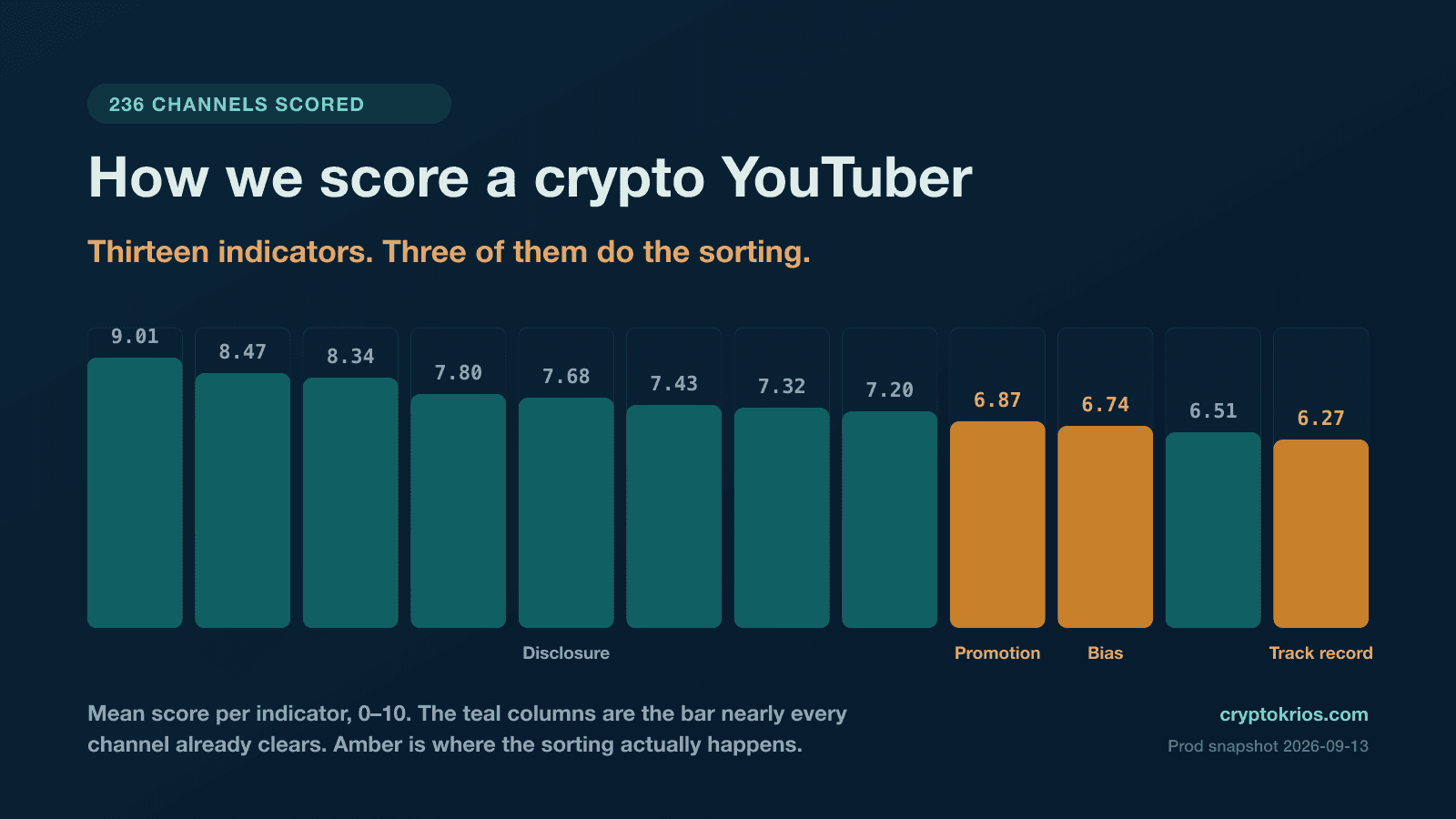
How We Score a Crypto YouTuber: The 13 Indicators Behind a Trust Score
A crypto youtuber trust score shouldn’t be a vibe check. This guide breaks down CryptoKrios’ 13 indicators (with verified platform averages) and explains what the score means, what it doesn’t, and how to use it responsibly.
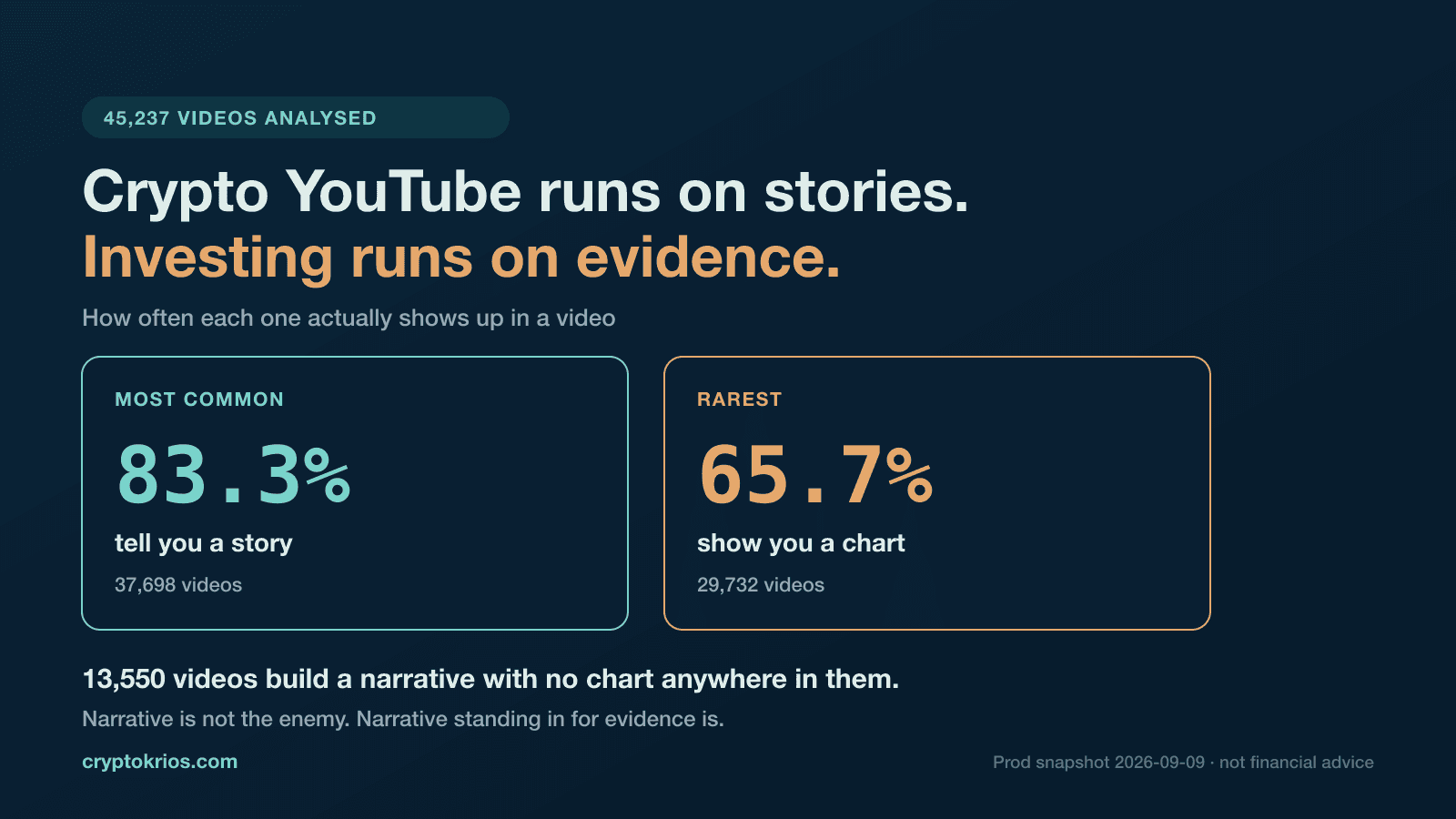
Story vs Charts in Crypto YouTube: When Narrative Helps (and When It Replaces Analysis)
CryptoKrios analyzed 45,237 crypto videos: stories appear in 83.3%, but crypto youtube technical analysis (charts) shows up in only 65.7%. Learn a simple test for when narrative supports a thesis—and when it replaces evidence.

The Partial Crypto Prediction Playbook: How Grey-Zone Calls Become “Wins” (and How to Audit Them)
A partial crypto prediction means the direction was right but the target price was wrong. Using CryptoKrios data (2026-08-24), we show how partials get marketed as wins—and a practical audit you can apply to any creator.

Crypto Influencer Sponsorship Disclosure: Sponsored vs Organic Crypto Content (A Practical Bias Checklist + Examples)
A practical, example-driven crypto influencer sponsorship disclosure checklist to spot sponsored bias fast. Includes red-flag vs responsible wording, what disclosures miss, a 2-minute verification protocol, and a before/after script rewrite.