Do Bigger Crypto YouTube Channels Make Better Videos? What Subscriber Count Tells You
Do Bigger Crypto YouTube Channels Make Better Videos? What Subscriber Count Tells You
Subscriber count is the first number you see on a crypto channel, and for most viewers it works as a shortcut for trust: two million people can't all be wrong. We wanted to know how much that shortcut is actually worth.
So we took every crypto video we scored over four weeks, 3,425 of them from 176 channels, and lined them up by the size of the channel that published them. The short answer: bigger channels score slightly higher on average, and the difference is almost useless for picking a channel. What size does buy, and what it doesn't, is more interesting than the average.
The averages
Videos published from 28 September to 25 October 2026, grouped by channel size:
| Channel size | Channels | Videos | Average video score | Videos at 9.0+ | Videos under 5.0 |
|---|---|---|---|---|---|
| 10K–100K subscribers | 62 | 908 | 7.18 | 4 | 52 (5.7%) |
| 100K–500K | 76 | 1,970 | 7.50 | 20 | 87 (4.4%) |
| 500K and up | 34 | 491 | 7.66 | 7 | 13 (2.6%) |
(Four channels under 10K subscribers published 56 videos between them. That is too few to say anything about the band, so we leave it out of the comparisons below.)
So yes, there is a gradient: about half a point between the 10K–100K band and the 500K+ band, and fewer weak videos as channels grow.
Why the gradient barely helps you
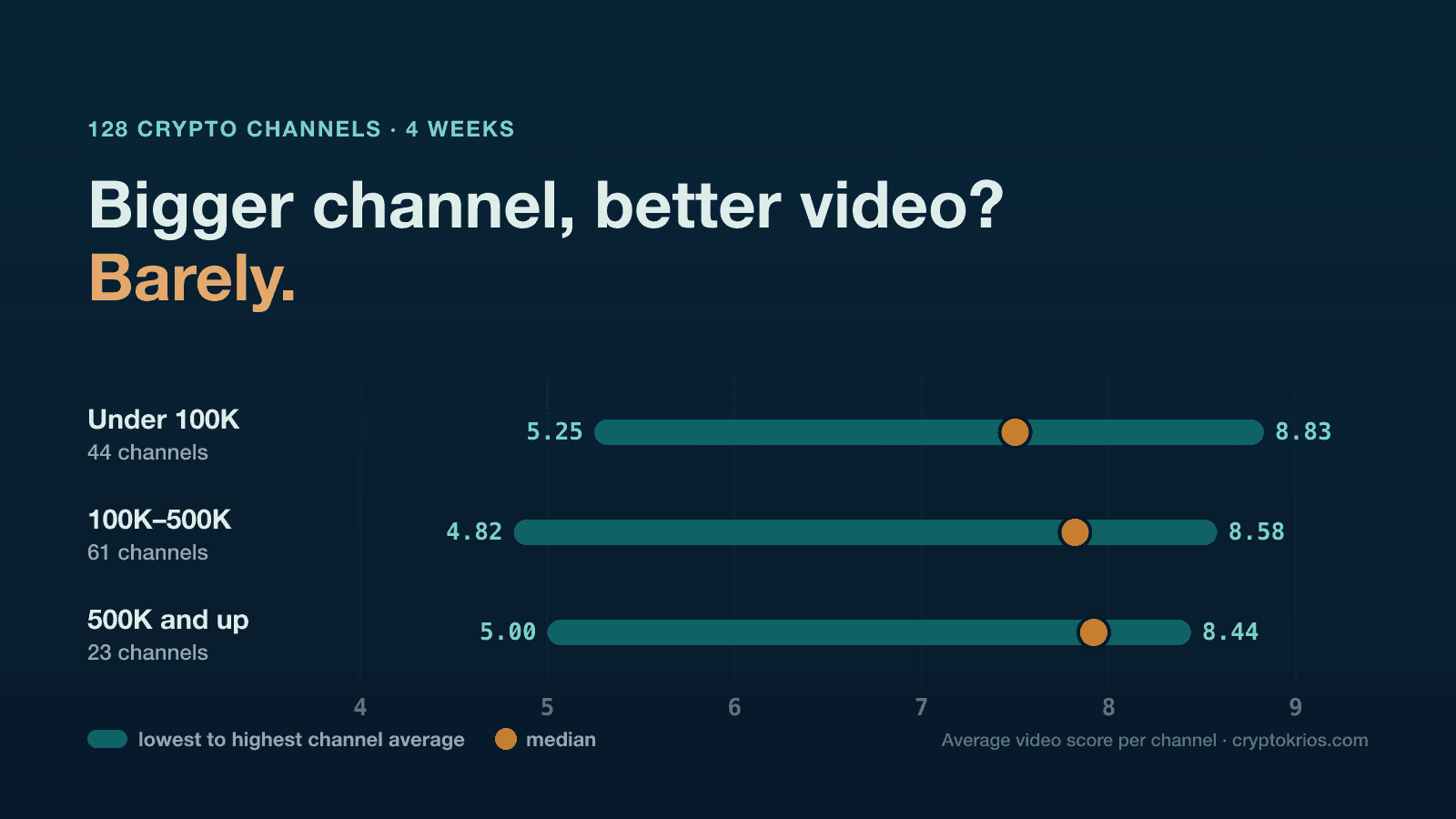
An average describes a band. You don't watch a band, you watch a channel. And inside every band, channels are spread across almost the whole scale.
Taking the 128 channels that published at least five scored videos in the period:
| Channel size | Channels | Lowest channel average | Median | Highest |
|---|---|---|---|---|
| Under 100K | 44 | 5.25 | 7.50 | 8.83 |
| 100K–500K | 61 | 4.82 | 7.82 | 8.58 |
| 500K and up | 23 | 5.00 | 7.92 | 8.44 |
The highest channel average in the whole dataset, 8.83, belongs to a channel with 10,900 subscribers. One channel with more than 700,000 subscribers averaged 5.00. The ranges overlap almost completely.
We also measured the correlation between channel size (on a log scale) and a channel's average score across those 128 channels: 0.13. On a scale where 0 means no relationship and 1 means a perfect one, that is weak. Knowing how big a channel is tells you very little about how good its next video will be.
What size does buy: polish and disclosure
The 13 indicators behind each score show where the half-point gradient comes from. Comparing the 10K–100K band with the 500K+ band (10 is best on every indicator):
| Indicator | 10K–100K | 500K+ |
|---|---|---|
| Subject knowledge | 7.79 | 8.33 |
| Clarity of explanation | 7.58 | 7.98 |
| Sponsorship transparency | 7.47 | 8.34 |
| Conflict of interest | 7.08 | 7.94 |
Big channels tend to know their subject a little better, explain it a little more clearly, and are noticeably better at saying who paid for what. That last point makes sense: a large channel has more sponsors, more scrutiny, and often a team that handles disclosure.
What size does not buy: restraint
Two things move the other way.
| 10K–100K | 500K+ | |
|---|---|---|
| FOMO (10 = none) | 8.02 | 7.84 |
| Urgency (10 = none) | 8.11 | 7.87 |
| Videos containing a price prediction | 47.0% | 66.6% |
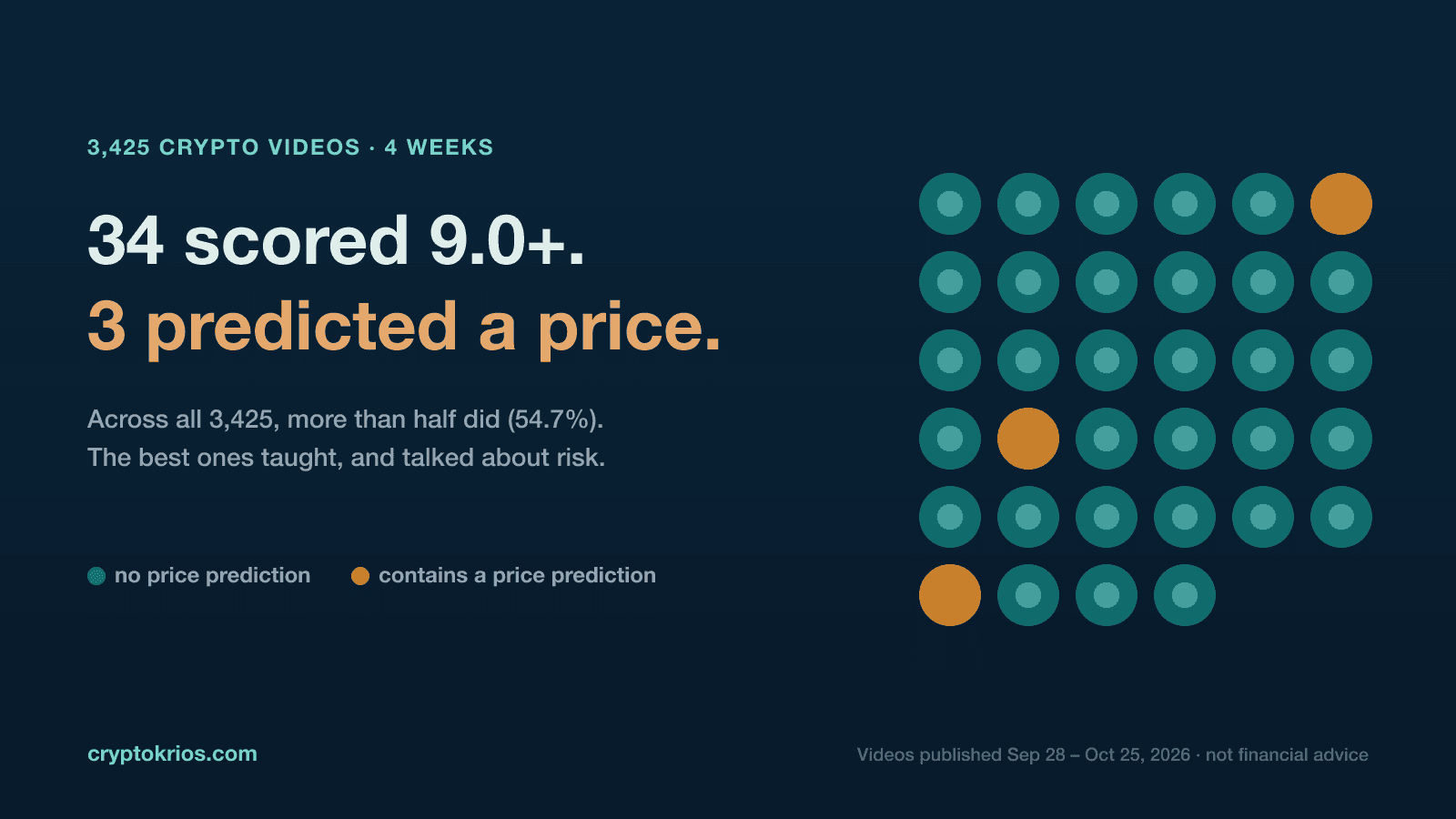
The biggest channels push slightly harder, and two in three of their videos make a price prediction, against fewer than half for the 10K–100K band. On Wednesday we showed that the best-scored crypto videos rarely predict prices, and that pressure is what separates the best from the worst. On both of those, size works against you a little, not for you.
Small channels worth knowing
If size is a weak signal, good small channels are easy to miss. Among channels under 100K subscribers with at least five scored videos in the period, these had the highest averages:
- Cryptotechtoday (10,900 subscribers), average 8.83 over 6 videos. Practical coverage of delistings and shutdowns, and how to get your tokens out: youtube.com/@Cryptotechtoday
- Crypto By Medusa (3,050 subscribers, in French), average 8.74 over 8 videos: youtube.com/@CryptoByMedusa
- Julien FLOT (61,500 subscribers, in French), average 8.37 over 11 videos: youtube.com/@JulienFlot
- CryptoLabs Research (38,400 subscribers), average 8.25 over 11 videos, on DeFi yield and when to exit a pool: youtube.com/@CryptolabsResearch
We are not naming the large channels at the bottom of the ranges. A low average over four weeks is a reason to look at the record, not a verdict, and the record is where we publish it.
How to use subscriber count
- Treat it as reach, not quality. It tells you how many people listen, which is worth knowing: a big channel moves more attention. It does not tell you whether to be one of them.
- Expect better disclosure from big channels, and check it. They do it more often. When a large channel doesn't say who sponsored a segment, that is a bigger omission, not a smaller one.
- Watch for pressure at every size. FOMO and urgency are the indicators that separate the best videos from the worst, and they don't improve as channels grow.
- Judge the channel, not the band. Look at a channel's own average and its track record over time. A 10K channel can beat a 1M channel on both.
What this does not say
- It is not a ranking of every channel. Averages over four weeks, from as few as five videos per channel, are a snapshot. A few strong or weak episodes move a small channel's average a lot.
- It is not a statement about any asset. We do not make price predictions.
- It comes from AI scoring. Each indicator is assessed by a model from the transcript. Subscriber counts are YouTube's public figures at the time of our last refresh.
Look up any channel you follow: its average video score, its trust score, and every prediction it made with the result. https://cryptokrios.com/auth/login
Trust scores, video scores and prediction extractions are AI analyses of publicly available content. They describe what was said, not what will happen next, and do not guarantee future performance. Nothing in this article is financial advice. Always do your own research.
Discover what crypto influencers really say
Get AI-verified analysis of top crypto content creators — free.
Try CryptoKrios FreeRelated Articles
The Best Crypto Videos Rarely Predict Prices: What 34 Top-Scored Videos Have in Common
Of 3,425 crypto YouTube videos we scored in four weeks, 34 scored 9.0 or above, and only 3 of those made a price prediction. What the best-scored crypto videos have in common, and how to use it as a viewer.
Crypto Influencer Prediction Updates: How to Audit Revisions Without Losing the Original Call
Crypto influencer prediction updates can blur accountability when targets and timelines shift. Learn a practical audit method: preserve the original call, timestamp revisions, log evidence triggers, keep horizons visible, and score outcomes fairly.

Hidden Incentives in Crypto Content: 8 Editorial Patterns That Shape Conviction
Hidden incentives in crypto content often come from editorial and algorithmic patterns—not sponsorships. Learn 8 patterns that shape conviction and a practical observe-measure-countercheck method for each.