What 14,330 Judged Crypto Predictions Say About Following Anyone's Calls
What 14,330 Judged Crypto Predictions Say About Following Anyone's Calls
If you’ve ever followed a “this coin will hit X by Y” call, you’ve already been part of the biggest hidden risk in crypto: crypto prediction accuracy is rarely measured, rarely checkable, and often impossible to audit.
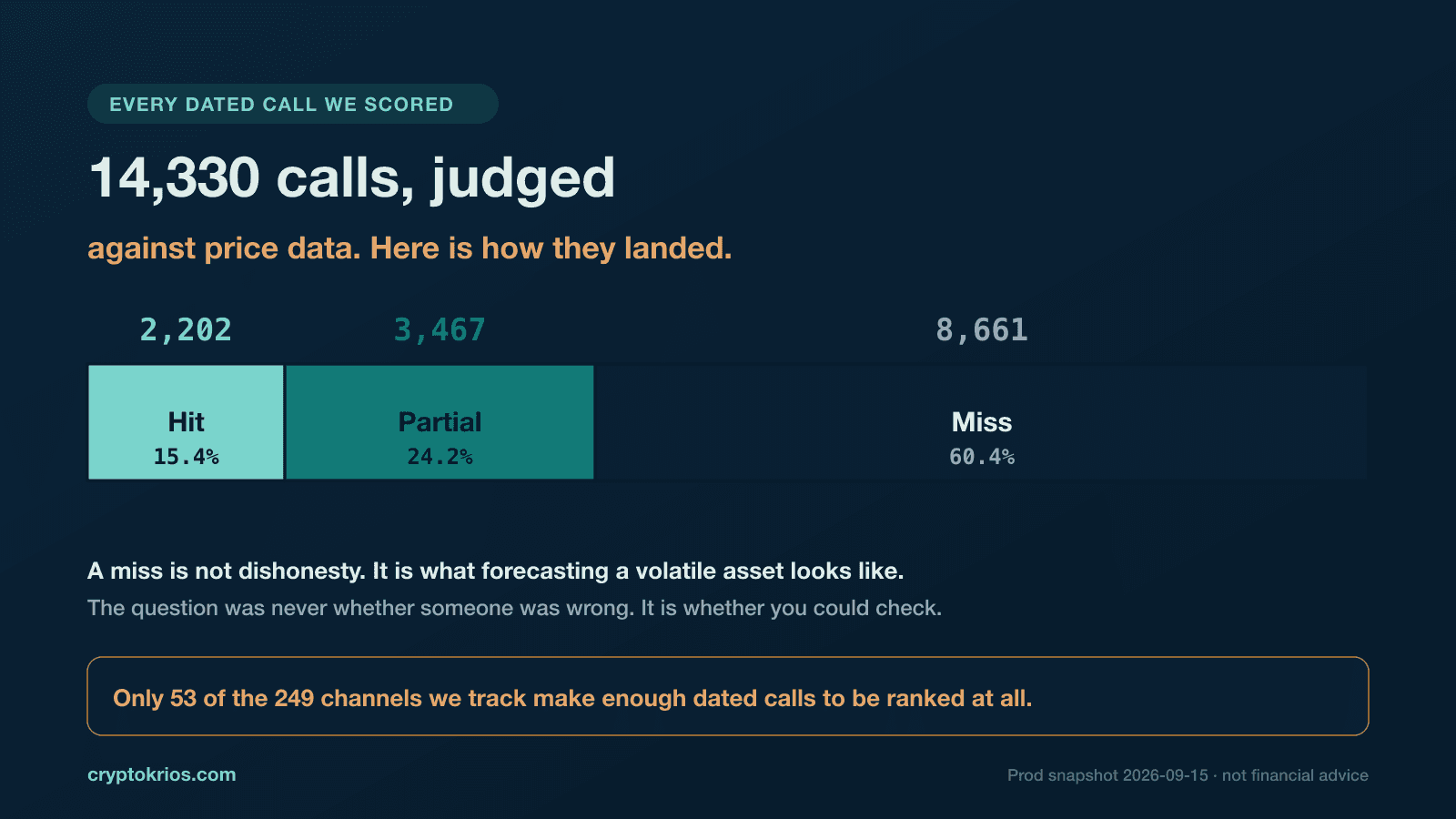
At CryptoKrios, we extracted 14,330 crypto predictions from influencer videos, timestamped them, and judged them against Financial Modeling Prep price data. The goal isn’t to shame anyone. It’s to answer a practical question: when you follow someone’s calls, what are you actually buying—signal, story, or a verifiable track record?
This article is the spine of what our dataset shows: the ceiling is lower than most people expect, being rankable is the real achievement, and the best strategy is to judge process—not vibes.
The dataset: 14,330 judged calls and what “accuracy” really looks like
Let’s start with the scoreboard that matters: not impressions, not confidence, not charisma—checkable outcomes.
The corpus (verified against CryptoKrios production 2026-09-15):
- 14,330 predictions were extracted, dated, and judged against Financial Modeling Prep price data.
- Outcome split:
- 2,202 HIT (15.4%)
- 3,467 PARTIAL (24.2%)
- 8,661 MISS (60.4%)
- Separately, predictions can also be:
- 11,149 PENDING (the target window hasn’t resolved yet)
- 12,179 EXPIRED (the target window closed without a checkable outcome)
Two implications jump out:
-
The baseline is harsh. Across a large, judged dataset, the HIT rate is 15.4%. That’s not because creators are “bad.” It’s because forecasting a volatile asset class is genuinely hard, and most calls are made under uncertainty.
-
“Crypto prediction accuracy” is not a personality trait. It’s a measurement that only exists when a claim is structured enough to be judged. If a call has no date, no number, or no falsifiable condition, it can’t become a HIT or a MISS. It becomes PENDING forever or EXPIRED.
And here’s the biggest finding—bigger than any leaderboard rank:
- CryptoKrios tracks 249 channels.
- Only 184 have at least one judged call.
- Only 53 channels have 60 or more judged calls (enough volume to rank).
That means most channels can’t be evaluated on crypto prediction accuracy in a statistically meaningful way—not because they’re malicious, but because they don’t consistently commit to dated, checkable claims.
This is why we treat the leaderboard as a ceiling of the discipline, not a wall of shame. In a domain where the average HIT rate is 15.4%, anyone consistently outperforming that baseline is doing something measurably different.
The leaderboard (60+ judged calls): what “best” looks like in practice
When you restrict the comparison to channels with enough volume (60+ judged predictions), you get a leaderboard that’s far more useful than “top influencers” lists. It’s not about who’s loudest. It’s about who leaves an audit trail.
Top channels by hit rate (60+ judged calls):
-
Lexa Moon Crypto — 32.3% hit (125 of 387), 55.0% hit-or-partial, trust score 8.23
-
Jason Pizzino — 28.1% hit (18 of 64), 48.4% hit-or-partial, trust score 8.23
-
Spy On Gems — 25.9% hit (43 of 166), 48.2% hit-or-partial, trust score 6.50
-
Bitcoin hoy — 25.4% hit (45 of 177), 66.7% hit-or-partial, trust score 8.10
-
Crypto World — 25.1% hit (77 of 307), 54.7% hit-or-partial, trust score 7.05
Now the framing that matters (and that most “accuracy” discussions miss):
- The best HIT rate in a corpus of 14,330 judged calls is 32.3%. That is not a failure. It’s remarkable against a 15.4% baseline.
- Being on the board is the achievement. Only 53 of 249 channels produce enough dated, checkable calls to be ranked at all.
- A MISS is not dishonesty. The meaningful question is whether a call was structured so it could be checked.
Also note why we show both hit rate and hit-or-partial.
- A pure HIT is strict.
- PARTIAL captures calls that meaningfully moved in the forecasted direction or partially met conditions.
That said, PARTIAL involves judgment (we’ll cover limits later). The point isn’t to pretend forecasting is binary. It’s to preserve nuance while still enforcing measurability.
Finally, one more critical distinction:
- Hit rate and trust score are different measurements and must never be conflated.
A concrete example from the leaderboard:
- Spy On Gems shows a strong hit rate: 25.9% hit (43 of 166).
- Yet the trust score is 6.50, which is meaningfully lower than others listed.
That combination is possible because trust isn’t “did you predict right.” Trust also reflects quality indicators (like clarity, consistency, bias signals, and other explainable components). In other words: you can be relatively accurate and still be lower-trust on process or context.
This is exactly why CryptoKrios separates these measurements instead of collapsing them into one opaque number.
How CryptoKrios judges a prediction (and why most calls can’t be audited)
If you want to use crypto prediction accuracy to make better decisions, you need to know what qualifies as a “prediction” in the first place.
Here’s how a prediction becomes judged inside CryptoKrios (verified process):
-
Extraction from video transcript via a RAG pipeline
- Semantic chunking
- Embedding
- LLM classifier to identify prediction-like statements
-
Normalization into a structured record
- Asset
- Direction (BULLISH / BEARISH / NEUTRAL)
- Horizon
- Optional target price
- Optional target date
-
Outcome evaluation via an hourly cron
- We check the call against Financial Modeling Prep price data.
- We write an outcome: HIT, PARTIAL, or MISS.
This is the key constraint that creates the “rankability gap” across the industry:
- A call with no number or no date cannot be judged at all.
- It goes to EXPIRED (target window closed without a checkable outcome) or stays PENDING forever.
So when investors say, “This influencer is always right,” what they often mean is, “I remember the wins and can’t falsify the misses.” That’s not a moral failure. It’s a measurement failure.
If you want to filter signal from noise, start with one rule:
If a creator doesn’t regularly make dated, checkable claims, you can’t measure their crypto prediction accuracy.
And without measurability, you’re not following “analysis.” You’re following storytelling.
This is why CryptoKrios treats checkability as a feature. The market is volatile. People will be wrong. The differentiator is whether you can audit what was said.
The practical takeaway: judge the process, not the hit rate
If the top of the leaderboard is under one in three HITs, what should you do with that reality?
You should stop asking, “Who is right?” and start asking, “Who is useful?”
Because usefulness survives misses. Usefulness is a process you can learn from, reuse, and risk-manage.
Here’s what the dataset pushes you toward—without turning crypto prediction accuracy into a religion:
1) Prefer falsifiable calls over confident calls
A useful call includes at least one of the following:
- A target price and a target date
- A time horizon (“this quarter,” “within 30 days,” etc.)
- An invalidation level (“if price loses X, thesis is wrong”)
A miss isn’t disqualifying. Unfalsifiable claims are. If it can’t be checked, it can’t teach you anything.
2) Track “revisits” and accountability
The most investor-friendly behavior is not perfection. It’s closure.
A creator who returns to a prior call and explains:
- what happened,
- what they got wrong,
- what would have invalidated the idea earlier,
…is building a usable model. That’s how you improve your own process, even if the call missed.
3) Use accuracy as calibration, not a buy/sell signal
In our corpus, the overall HIT baseline is 15.4% (2,202 of 14,330). So when you see a channel with a HIT rate around 25–32% at meaningful volume, that’s a calibration point:
- How aggressive should you be with position sizing?
- How much confirmation should you require?
- Should you demand clearer invalidation levels?
Accuracy helps you set expectations. It should not outsource your risk management.
4) Don’t confuse trust score with hit rate
The leaderboard itself proves why both exist.
- Spy On Gems: 25.9% hit (43 of 166) with a 6.50 trust score.
That’s not “good” or “bad.” It’s information. It tells you that even with relatively strong crypto prediction accuracy, other quality indicators can pull trust down. That might include consistency, clarity, or bias-related signals.
If you only follow hit rate, you risk following someone who gets outcomes but doesn’t provide an auditable, repeatable process.
5) Treat “being rankable” as a signal
Remember: only 53 of 249 channels have 60+ judged calls.
So a practical filter is simply:
- Do they consistently make checkable calls?
If yes, you can evaluate them. If not, you’re stuck in anecdote.
In a hype-driven market, rankability is accountability.
Limits and how to read these numbers like an adult investor
CryptoKrios is transparent by design, so here are the limits you should carry with you when interpreting crypto prediction accuracy.
1) The corpus is skewed toward numeric callers
Predictions are judged when they’re structured enough to judge. That naturally favors channels that make numeric, dated calls.
So the dataset is not “all crypto content.” It’s “content that produces extractable, checkable predictions.”
2) PARTIAL is a judgment call
We report HIT, PARTIAL, and MISS because reality isn’t always binary.
But PARTIAL introduces subjectivity in categorization. That’s why we also highlight HIT rates separately and encourage reading hit-or-partial as a broader usefulness proxy—not a precision score.
3) Price-data verification can’t capture context
Financial Modeling Prep price data can tell us whether price moved.
It can’t fully capture:
- whether the call assumed spot vs leverage,
- whether it relied on a specific catalyst,
- whether it required risk management rules,
- whether the creator updated the thesis mid-window.
That’s a limitation of any outcome-only evaluation.
4) Sample sizes differ massively across channels
Even on the 60+ leaderboard, the range is wide:
- Jason Pizzino: 28.1% hit (18 of 64)
- Lexa Moon Crypto: 32.3% hit (125 of 387)
Both are valuable, but they carry different statistical confidence. A larger sample generally stabilizes a rate. This is also why most channels can’t be responsibly ranked: they simply don’t commit to enough checkable calls.
5) A miss is not a lie
This is worth repeating because it’s the healthiest way to use the data.
The question is never whether someone was wrong; it is whether you could check.
Markets are uncertain. Forecasts fail. What matters is transparency and an audit trail.
Conclusion: crypto prediction accuracy is a ceiling—and checkability is the real edge
Across 14,330 judged calls, the baseline reality is clear: crypto prediction accuracy is hard, even for the best performers. The top HIT rate on the 60+ board is 32.3% (125 of 387)—a remarkable outcome against a 15.4% overall HIT baseline, not a reason to dismiss the entire craft.
The bigger lesson is structural: most channels can’t be ranked because they don’t consistently make dated, checkable calls. Only 53 of 249 have 60+ judged predictions.
So if you want to follow influencers with confidence, don’t outsource your judgment to charisma. Outsource the measurement.
Try CryptoKrios free to see verified crypto prediction accuracy, checkable call histories, and explainable trust scoring—so you can learn from the best and filter out the rest.
https://cryptokrios.com/free
Discover what crypto influencers really say
Get AI-verified analysis of top crypto content creators — free.
Try CryptoKrios Free