
Crypto Influencer Sponsorship Disclosure: Sponsored vs Organic Crypto Content (A Practical Bias Checklist + Examples)
Crypto Influencer Sponsorship Disclosure: Sponsored vs Organic Crypto Content (A Practical Bias Checklist + Examples)
If you follow crypto creators, you’ve already met the real problem: you’re not just evaluating ideas—you’re evaluating incentives. Crypto influencer sponsorship disclosure is the line between “useful research” and “marketing dressed as alpha.”
This guide is not a conceptual essay. It’s a hands-on bias checklist you can run on any video, thread, or post in minutes. Every checklist item includes (1) a red-flag phrasing (paraphrased, no real names) and (2) the responsibly disclosed version of the same sentence, so you learn to hear the difference.
We’ll also show what disclosures often miss (even when present), how to verify independently in ~2 minutes, and a worked example rewriting a biased script into a transparent one.
Quick context: In the US, the FTC and in Canada, the Competition Bureau require clear, conspicuous disclosure of material connections (paid deals, affiliate commissions, free product, token holdings). “#ad” buried at the end of a 20-hashtag block—or hidden behind a “more” fold—doesn’t cut it.
1) Read the disclosure line like an investigator (where it should be, and what “real” looks like)
Your first pass is simple: find the disclosure—fast. A proper crypto influencer sponsorship disclosure is not a scavenger hunt. It should be clear, conspicuous, and placed where you’ll see it before you absorb the pitch.
Checklist: placement and clarity
- Is it visible without clicking “more”? If the disclosure is after a fold, many viewers never see it.
- Is it near the endorsement? The disclosure should appear before or at the time the endorsement happens.
- Does it specify the connection? “Thanks to X” is vague. “Paid sponsorship,” “affiliate commission,” “free tokens,” or “I hold this token” is specific.
- Is it repeated in long content? In a 20-minute video, a single fleeting mention at minute 0:03 is weak.
Red-flag example vs responsibly disclosed version
-
Red flag (buried/unclear):
- “Massive thread on a project I’m excited about. #crypto #altcoins #DYOR #ad” (at the very end of a long hashtag block)
-
Responsible disclosure:
- “Disclosure: This post is paid by the project. I’m being compensated to cover it, so treat this as sponsored content.”
-
Red flag (ambiguous gratitude):
- “Shoutout to the team for making this possible—here’s why this token is inevitable.”
-
Responsible disclosure:
- “Disclosure: The team paid for this segment and provided early access. I’m not presenting this as unbiased research.”
-
Red flag (hidden behind ‘more’):
- “Here’s my honest review…” (disclosure appears only after expanding the caption)
-
Responsible disclosure:
- “Disclosure (shown up front): I received compensation / affiliate commission / free product for covering this.”
What “conspicuous” means in practice
Regulators focus on whether the average viewer would notice and understand the connection. If your first 10 seconds are hype, and the disclosure is a whisper later, the crypto influencer sponsorship disclosure functionally failed.
Practical rule: If you can’t spot the disclosure within 5 seconds (top of caption, first lines, on-screen, or clearly stated early), treat the content as possibly sponsored until proven otherwise.
2) Language tells of paid promotion (urgency, superlatives, and “NFA” as a shield)
Paid promotion often has a sound. Even when the creator believes the thesis, sponsorship can nudge wording toward persuasion rather than analysis. Your checklist here is about identifying sales language—especially when it’s paired with weak crypto influencer sponsorship disclosure.
Checklist: promo language patterns
- Urgency triggers: “last chance,” “you’re early,” “before it’s too late,” “this week only.”
- Superlatives without evidence: “guaranteed,” “no-brainer,” “the next 100x,” “can’t fail.”
- Certainty masking risk: “there’s no scenario where this doesn’t win.”
- “Not financial advice” used as armor: NFA is fine as a reminder. It’s a red flag when used to excuse aggressive claims.
Red-flag example vs responsibly disclosed version
-
Red flag (urgency + certainty):
- “This is your last chance to get in before the next leg up. It’s basically inevitable.”
-
Responsible disclosure + toned-down claim:
- “Disclosure: This segment is sponsored. My view is optimistic, but outcomes are uncertain. Here are the risks and what would prove me wrong.”
-
Red flag (superlatives + NFA shield):
- “This is the safest bet in crypto—NFA though.”
-
Responsible disclosure + real framing:
- “Disclosure: I may receive compensation/commission. This is a high-risk asset. NFA means you should verify the data and position size accordingly.”
-
Red flag (emotional social proof):
- “Everyone serious is already positioning. Don’t be the one who misses it.”
-
Responsible disclosure + explicit uncertainty:
- “Disclosure: I have a material connection (paid/affiliate/holdings). Popularity isn’t proof. Here are the metrics I’m using and what would change my mind.”
Why this matters
A persuasive tone isn’t automatically dishonest. But when persuasive tone appears alongside vague or buried crypto influencer sponsorship disclosure, it increases the odds that you’re watching marketing, not research.
Practical rule: If you hear certainty + urgency, demand specific disclosure + specific risks.
3) Structural tells: one-coin focus, referral/affiliate links, and launch timing
Sometimes the bias isn’t in the words—it’s in the structure of the content. Sponsored content tends to follow repeatable templates because it’s built to convert.
Checklist: structure that often correlates with incentives
- One-coin tunnel vision: The post is “analysis,” but every point bends toward a single outcome.
- Referral/affiliate link prominence: Links are front-and-center, repeated, pinned, or placed immediately after hype.
- Timing around a launch/listing: Content drops cluster right before a token launch, exchange listing, staking campaign, or big announcement.
- Call-to-action dominance: “Use my link,” “sign up,” “stake now,” “bridge here,” “buy here”—especially early.
Red-flag example vs responsibly disclosed version
-
Red flag (one-coin focus + no alternatives):
- “Forget everything else—this is the only coin you need to watch.”
-
Responsible structure:
- “Disclosure: I have a material connection (paid/affiliate/holdings). Here are 2–3 comparable projects and why I still prefer this one, plus where it could fail.”
-
Red flag (affiliate CTA disguised as education):
- “Quick tutorial: the easiest way to do this is using the link in my bio.”
-
Responsible disclosure:
- “Disclosure: The link is an affiliate link and I earn a commission if you sign up. You can also use any provider; here are non-affiliate options.”
-
Red flag (launch-timed hype):
- “I just ‘found’ this hidden gem hours before the big release.”
-
Responsible disclosure:
- “Disclosure: This is sponsored / I received early access. This content is timed around the launch, and that timing can amplify hype.”
The key structural question
Ask: Is the content optimized for understanding, or for conversion? Educational content can include links. But when links, timing, and tunnel-vision align, you should treat crypto influencer sponsorship disclosure as required context—not optional fine print.
4) What disclosure usually MISSES (even when present): allocations, advisory roles, and “bags”
Here’s the uncomfortable truth: you can see a disclosure and still not see the real incentive. Many creators disclose something—but omit the connections that matter most to interpreting the message.
Regulators focus on “material connections,” which can include paid sponsorship, affiliate commissions, free product, and token holdings. In crypto, material connections often go deeper.
Checklist: common gaps to look for
- Token allocations or equity: “Advisor” can mean tokens, equity, vesting schedules.
- Advisory/ambassador roles: Sometimes framed as “community member” or “partner.”
- Portfolio exposure (“bags”): A creator can be organic yet still biased if they hold a large position.
- Performance-based incentives: Bonuses tied to signups, volume, or TVL.
Red-flag example vs responsibly disclosed version
-
Red flag (partial disclosure):
- “Sponsored video with Project X—still my honest opinion.”
-
Responsible disclosure (complete enough to interpret):
- “Disclosure: This video is sponsored. I also hold the token, and I may benefit if price/interest increases. I’m not sharing position size, but you should assume I’m incentivized.”
-
Red flag (ambassador without clarity):
- “Proud to be working with the team—this is the next big thing.”
-
Responsible disclosure:
- “Disclosure: I’m an ambassador/advisor and receive compensation (could include tokens/equity). That relationship may bias my coverage.”
-
Red flag (affiliate missing):
- “Use my link for the best experience.”
-
Responsible disclosure:
- “Disclosure: That link is affiliate-based. I earn a commission if you use it, even if you don’t trade profitably.”
Practical rule
A good crypto influencer sponsorship disclosure explains the type of connection, not just that “something” exists. When details are missing, you don’t need to accuse anyone. You simply discount certainty, increase skepticism, and verify.
5) How to verify independently in ~2 minutes (a fast protocol you can repeat)
You don’t need private investigators or insider access. You need a repeatable process. Below is a two-minute protocol based on what readers can realistically do.
The 2-minute verification protocol
-
Check the creator’s link hub (Linktree/Beacons/site)
- Look for “partners,” “affiliates,” “ambassadors,” discount codes, or a dedicated affiliate page.
- If the call-to-action is monetized, the crypto influencer sponsorship disclosure should match that reality.
-
Search: “{creator name} + ambassador” or “{creator name} + advisor”
- Public announcements, podcasts, event pages, and partner blogs often reveal roles.
-
Scan recent posts for repetition
- Does the same coin appear repeatedly across weeks?
- Repetition isn’t proof, but repeated promotion without escalating disclosure is a pattern.
-
Look for a pinned disclosure policy
- Some creators pin a general disclosure statement. That helps—but it doesn’t replace post-level clarity.
Red-flag example vs responsibly disclosed version
- Red flag (generic pinned statement used as cover):
- “Disclosure: Some links may be affiliate.” (pinned once, never mentioned again)
- Responsible approach:
- “Disclosure (in each relevant post): This link is affiliate and I earn commission. This segment is paid. Here is my full disclosure policy.”
Where CryptoKrios fits (without telling you what to buy)
Manual checking works—but it doesn’t scale when you follow 10–50 creators. CryptoKrios exists to make this repeatable:
- We score creators across 13 trust indicators, including sponsorship/disclosure transparency.
- Trust scores are on a 0–10 scale.
- We track prediction accuracy as HIT/MISS over time.
- We detect bias and language patterns, so you can spot when content shifts from analysis to persuasion.
CryptoKrios doesn’t tell you what to buy. It helps you decide who to trust, with explainable scoring.
6) Worked example: rewrite a biased script into a transparent one (before/after)
This is the fastest way to train your ear: take a “sounds normal” promo script and rewrite it so the incentives are explicit and the analysis becomes falsifiable.
BEFORE: a biased-sounding script (paraphrased)
“Today I’m covering a project that’s about to explode. The tech is insane and the team is stacked. I’ve rarely been this confident.
If you want in early, use the link below. I’ll show you how to buy it in two minutes. Not financial advice.
I think this is easily a 50–100x from here, and the chart is basically screaming breakout. Don’t overthink it.”
What your checklist flags:
- No clear crypto influencer sponsorship disclosure up front.
- Urgency (“about to explode,” “get in early”).
- Superlatives without evidence (“insane,” “stacked”).
- Big return claim (“50–100x”).
- Affiliate CTA (“use the link below”).
- “NFA” used as a shield rather than a risk reminder.
AFTER: a transparent, responsibly disclosed version
“Disclosure: This segment is sponsored by the project, and the link below is an affiliate link. I may earn compensation if you use it.
I’m covering this because it’s getting attention, but sponsored coverage can bias tone. Treat this as a starting point, not a conclusion.
What I like: the product roadmap is clear, and there’s measurable traction. What I don’t like: launch timing can create hype spikes, and liquidity risk is real.
If you’re researching it, here are three things to verify in five minutes: token distribution, vesting schedule, and whether usage is growing beyond incentives. If those don’t check out, I would avoid it.
Not financial advice means: don’t rely on me. Verify claims, size risk accordingly, and assume I’m incentivized.”
Why the “after” is healthier:
- The crypto influencer sponsorship disclosure is explicit and early.
- The incentive is stated (sponsored + affiliate), not implied.
- Pros/cons exist, and risk is concrete.
- View is falsifiable (“verify X; if not, avoid”).
Your takeaway
You’re not trying to eliminate bias. You’re trying to see it. Transparency turns content from “trust me” into “audit me.” That’s the difference between sponsored and organic crypto content that respects the audience.
Conclusion: Use the checklist, then outsource the monitoring
You can’t watch everything, and you shouldn’t have to. Use this checklist whenever you see a hot take, a new launch, or a too-perfect narrative. Start by demanding clear crypto influencer sponsorship disclosure, then listen for language tells, structural conversion patterns, missing incentive details, and run the 2-minute verification protocol.
If you want the scalable version, CryptoKrios scores creators across 13 trust indicators (including sponsorship/disclosure transparency) on a 0–10 trust score, tracks prediction accuracy as HIT/MISS, and detects bias/language patterns—so you can follow influencers with confidence and filter out the rest.
Try CryptoKrios free → Create your free account and start validating creators before you trust their next “can’t miss” call.
Discover what crypto influencers really say
Get AI-verified analysis of top crypto content creators — free.
Try CryptoKrios FreeRelated Articles
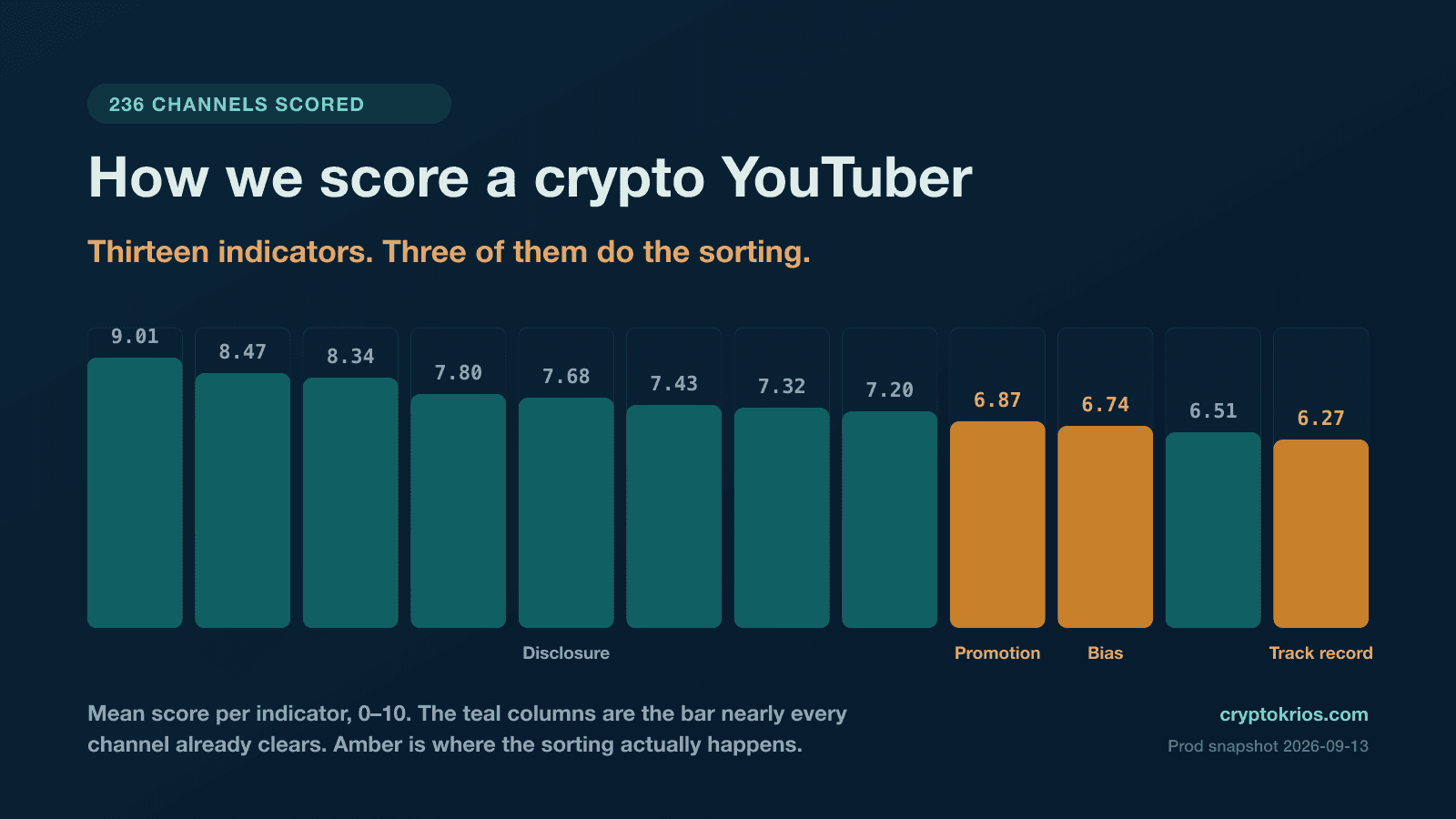
How We Score a Crypto YouTuber: The 13 Indicators Behind a Trust Score
A crypto youtuber trust score shouldn’t be a vibe check. This guide breaks down CryptoKrios’ 13 indicators (with verified platform averages) and explains what the score means, what it doesn’t, and how to use it responsibly.
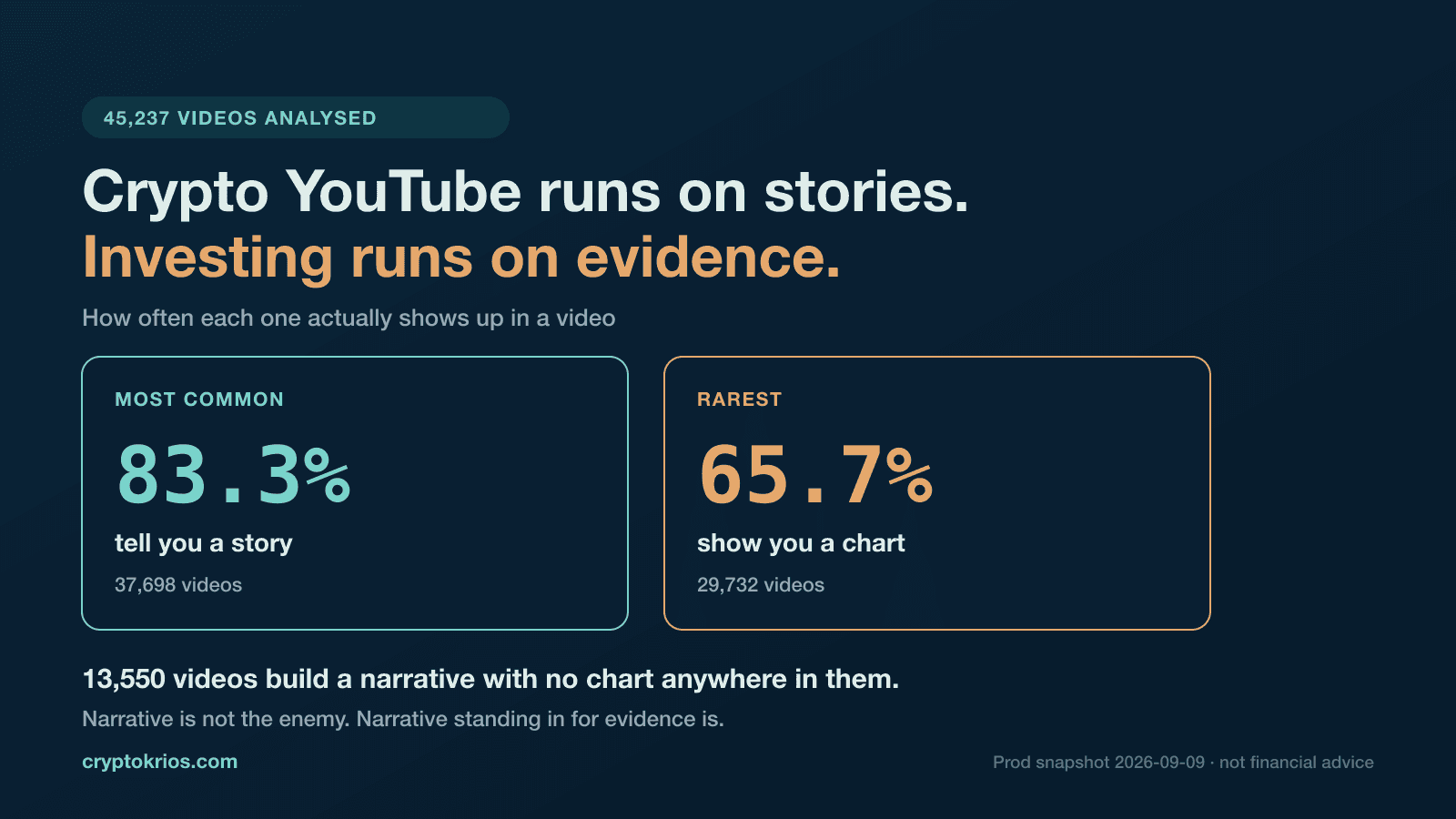
Story vs Charts in Crypto YouTube: When Narrative Helps (and When It Replaces Analysis)
CryptoKrios analyzed 45,237 crypto videos: stories appear in 83.3%, but crypto youtube technical analysis (charts) shows up in only 65.7%. Learn a simple test for when narrative supports a thesis—and when it replaces evidence.

The Partial Crypto Prediction Playbook: How Grey-Zone Calls Become “Wins” (and How to Audit Them)
A partial crypto prediction means the direction was right but the target price was wrong. Using CryptoKrios data (2026-08-24), we show how partials get marketed as wins—and a practical audit you can apply to any creator.

Crypto Influencer Bias Detection: 7 Content Patterns That Correlate With Low Accuracy
Crypto influencer bias detection helps you separate analysis from incentives. Learn 7 bias patterns that correlate with lower accuracy—and the self-checks you can run to vet any creator fast.