
Crypto Influencer Checklist: How to Audit Any Crypto Influencer in 15 Minutes (Repeatable Steps)
Crypto Influencer Checklist: How to Audit Any Crypto Influencer in 15 Minutes (Repeatable Steps)
Most investors don’t lose money because they “didn’t research a coin.” They lose money because they trusted the wrong messenger. This crypto influencer checklist gives you a fast, repeatable 15‑minute audit to separate signal from hype—without watching 6 months of content.
At CryptoKrios, our platform automates a lot of this with AI trust scoring and prediction tracking. But you can still do a high-quality manual audit in minutes if you know what to look for. Below is the exact workflow.
The 15-minute crypto influencer checklist (timer-based workflow)
This crypto influencer checklist is designed to work the same way every time. Set a timer. Don’t “vibe check.” Score what you can verify.
What you need (30 seconds)
- Their main channel (X/YouTube/TikTok)
- A content archive (YouTube videos, X feed, Substack)
- A way to search their content (X advanced search, channel search)
- Optional: a portfolio tracker link if they share one
Scoring method (simple + consistent)
Use a 0–2 scale per check:
- 0 = red flag / missing
- 1 = unclear / inconsistent
- 2 = clear / consistent
There are 10 checks below. Max score = 20.
Interpretation:
- 16–20: High trust potential (still verify)
- 11–15: Mixed signals (follow cautiously)
- 0–10: High risk (treat as entertainment)
Why this works: in social markets, a few repeated behaviors predict outcomes—overconfidence, hidden incentives, and untracked “calls” are the big three.
1) Verify identity + incentives (3 minutes)
Incentives drive content. Your first job is to learn what they get paid to say.
Checklist items (score each 0–2)
- Clear identity + continuity
- Do they have a consistent name, history, and long-lived accounts?
- Is there a clear professional footprint (podcast appearances, GitHub, previous work)?
- Transparent sponsorships + disclosures
- Do they label ads, affiliates, referral links, and paid partnerships?
- On YouTube, check: description links + “includes paid promotion.”
- Explicit conflicts of interest
- Do they disclose when they hold a token they discuss?
- Do they say when they bought it (before vs after content)?
Fast tests you can do
- YouTube description scan: if every video has 10 exchange links and no disclosures, score low.
- X search: search
from:@handle paidorfrom:@handle affiliateorfrom:@handle partnership.
What “good” looks like
A trustworthy creator doesn’t pretend incentives don’t exist. They surface them. Even better: they explain how incentives could bias their take.
Common red flags
- “Not financial advice” everywhere, but no real disclosures.
- Permanent urgency (“last chance,” “you’re early”) paired with referral links.
- Unclear entity behind the account (frequent handle changes, wiped history).
Why it matters: hidden incentives correlate with selective storytelling—only wins are shown, losses vanish, and risk gets reframed as “FUD.”
2) Audit prediction quality (without watching everything) (4 minutes)
Most “crypto calls” aren’t predictions. They’re vague narratives that can’t be scored.
Your goal is to find whether they make testable claims and whether they revisit outcomes.
Checklist items (score each 0–2)
- Specificity of calls Look for:
- clear levels (entry, invalidation, targets)
- time horizon (“weeks,” “this quarter”)
- what would prove them wrong
- Track record behavior
- Do they do post-mortems?
- Do they link old tweets/videos and grade themselves?
The 60-second “receipts” method
Pick one asset they talk about often (e.g., BTC, ETH, SOL). Then:
- On X: search
from:@handle SOL targetandfrom:@handle SOL invalidation. - On YouTube: search the channel for that asset and sort by oldest.
- Open two old pieces (3–6 months back) and see if they later revisited outcomes.
What “good” looks like
- They state conditions: “If X breaks, thesis is invalid.”
- They update when wrong.
- They separate trade idea from long-term thesis.
Red flags
- “It’s going up” style content with no levels, no timeframe.
- Outcome hijacking: “We called it” when the original post was non-committal.
- Deleting wrong calls (watch for missing threads, broken links, or “cleaned feeds”).
Data-driven note: In markets, forecast credibility comes from calibration—how often confidence matches reality. Creators who never quantify uncertainty almost always overfit narratives.
3) Check analysis depth vs. engagement bait (4 minutes)
The easiest way to manufacture engagement is to amplify certainty, fear, or tribal conflict. The easiest way to build trust is to show work.
This part of the crypto influencer checklist evaluates whether their content is structured to inform or to trigger.
Checklist items (score each 0–2)
- Evidence and sources
- Do they cite dashboards, filings, on-chain data, docs, or primary sources?
- Do they distinguish fact from interpretation?
- Balanced risk framing
- Do they mention downside scenarios?
- Do they discuss position sizing, time horizon, and invalidation?
Quick “depth scan” (2 minutes)
Open their last 5 posts/videos and look for:
- Numbers (not just arrows): supply schedule, FDV vs float, revenue, fees, active addresses, TVL breakdown.
- Comparisons: “Why this vs alternatives?”
- Constraints: liquidity, unlocks, dilution, regulatory risk.
If it’s all “next 100x,” “insiders,” and “don’t miss this,” depth is low.
What “good” looks like
- They explain why a metric matters.
- They admit what they don’t know.
- They show base rates: “Most new tokens underperform post-launch; here’s how I manage that risk.”
Red flags
- One-slide TA: random lines with no methodology.
- “Smart money is buying” with no traceable evidence.
- Overuse of absolutes (“guaranteed,” “can’t lose,” “inevitable”).
Reality check: engagement-optimized content often outperforms research content in views. That’s exactly why you need an audit process.
4) Detect bias, shilling patterns, and narrative switching (3 minutes)
Bias isn’t always malicious. But you need to know when content is shaped by bags, brand deals, or community pressure.
Checklist items (score each 0–2)
- Consistency across time
- Do they flip narratives without acknowledging the change?
- Do they update assumptions when data changes?
- Concentration risk (topic + token fixation)
- Do they endlessly promote the same small set of low-liquidity tokens?
- Is their feed unusually correlated with one ecosystem’s marketing cycle?
Two fast bias tests
Test A: “Who benefits?”
- If they push a token heavily, do they benefit via: allocations, advisory roles, referral campaigns, OTC access?
Test B: “Timing + intensity”
- Sudden spike in posts about a token right before a catalyst can be legitimate—or coordinated.
- Look for recycled phrases used by multiple accounts at once.
What “good” looks like
- Clear disclosure: holdings, sponsorships, affiliations.
- A diversity of viewpoints (they can praise and critique the same project).
Red flags
- “Community first” language used to shame critics.
- Attacking skeptics instead of addressing points.
- Constant emphasis on “we’re early” without liquidity/risk discussion.
Why it matters: in crypto, narrative momentum is real. But if a creator’s incentives reward hype, they’ll default to hype.
5) Final decision: score, classify, and set follow rules (2 minutes)
A checklist only works if it ends in a decision. Use your score to choose how you follow them.
Checklist item (score 0–2)
- Actionability without dependency
- Do they teach frameworks you can reuse?
- Or do they push you to copy trades and “turn on notifications”?
Classify the influencer
Based on your crypto influencer checklist score:
- Research-grade (16–20): Follow for frameworks, market structure, and thesis building.
- Mixed (11–15): Follow for ideas only. Verify independently.
- Entertainment (0–10): Watch for sentiment, not signals.
Set “follow rules” (write these down)
Use rules to avoid emotional copying:
- Rule 1: Never buy within 60 minutes of seeing a post.
- Rule 2: Require two independent sources (docs + data).
- Rule 3: Define invalidation before entry.
- Rule 4: Cap any influencer-originated idea to a fixed % size.
These rules create friction. Friction prevents FOMO.
Conclusion: turn this crypto influencer checklist into an always-on system
You can audit any creator in 15 minutes with this crypto influencer checklist. The edge is consistency: same process, every time, no exceptions for charisma.
If you want to scale this beyond manual spot checks, CryptoKrios does the heavy lifting—tracking influencer content, detecting bias signals, and measuring prediction quality over time so you can follow influencers with confidence and save hours of research.
Try CryptoKrios free: create a free account and start validating creators before you trust them. 👉 https://cryptokrios.com/auth/login
CryptoKrios provides analytics and insights for informational purposes only. This is not financial advice. Always do your own research before making investment decisions.
Discover what crypto influencers really say
Get AI-verified analysis of top crypto content creators — free.
Try CryptoKrios FreeRelated Articles
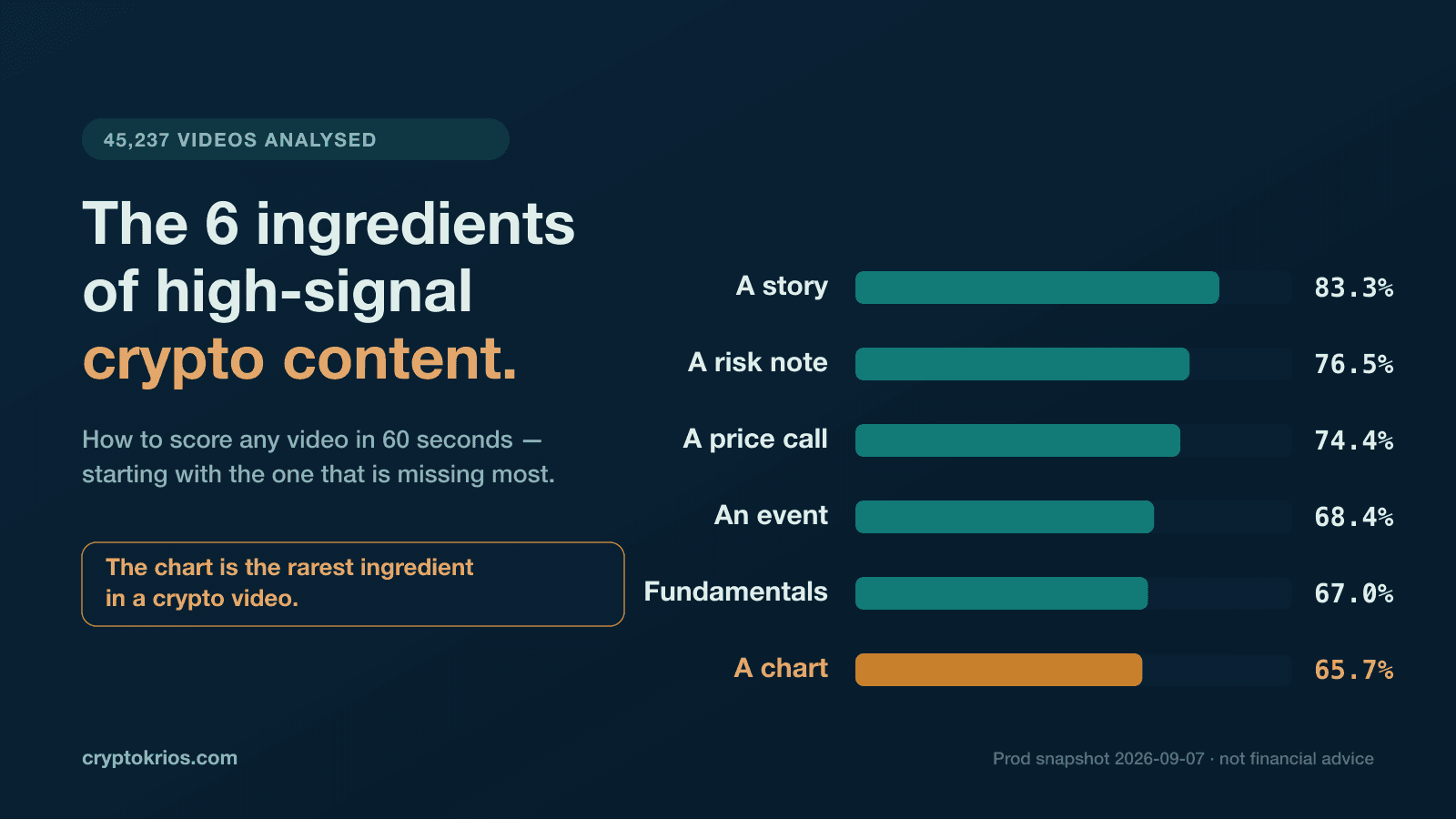
Crypto Content Checklist: The 6 Ingredients of High-Signal Crypto Content (And How to Score a Video in 60 Seconds)
A crypto content checklist you can run in 60 seconds. Learn the 6 ingredients of high-signal crypto videos, backed by analysis of 45,237 videos, plus a simple scoring framework to filter hype fast.

No Number, No Date, No Score: What a Crypto Prediction Target Date Actually Changes
Of 15,090 tracked crypto predictions with no target price, zero have ever been verified — even the ones that carried a date. Using the CryptoKrios database (2026-08-26), we measure what a target price and a target date each actually change, and give you a ten-second audit.

Crypto Creator Correction Policy: A Transparent Template for Updating Forecasts (Without Rewriting History)
A crypto creator correction policy makes forecasts auditable: preserve originals, timestamp revisions, and publish final verdicts. Use this template and checklist to separate transparent analysis from hindsight edits.

Crypto Influencer Due Diligence Checklist (2026): A Practical, Data-Driven Guide for Retail Investors
This crypto influencer due diligence checklist helps retail investors verify claims, assess track records, and spot bias in 2026. Built with real creator-claim data (33,921 tracked claims) and a repeatable scoring system you can use weekly.