
Crypto Influencer Incentives: How Sponsorships, Allocations, and Referrals Shape Narratives (and How to Detect Them)
Crypto Influencer Incentives: How Sponsorships, Allocations, and Referrals Shape Narratives (and How to Detect Them)
Crypto moves on attention. And attention is often brokered. Crypto influencer incentives—sponsorships, token allocations, affiliate referrals, and “advisory” roles—shape what gets covered, how it’s framed, and when you hear about it. The hard part isn’t that incentives exist. It’s that they’re frequently invisible, inconsistently disclosed, and easy to rationalize as “just marketing.”
This guide breaks down the most common crypto influencer incentives, the narrative patterns they create, and a practical detection checklist you can use before you trust a thread, video, or “not financial advice” call. The goal isn’t to ban influencers from your research stack. It’s to follow with confidence by understanding what could be pulling the strings.
Why crypto influencer incentives matter more than you think (the narrative mechanics)
Most investors focus on what an influencer says: target prices, catalysts, tokenomics, charts. But the bigger edge often comes from understanding why they’re saying it and why now. Crypto influencer incentives affect timing, certainty, and selectivity—three levers that can turn neutral research into persuasion.
Here’s the basic mechanic: an incentive increases the upside of coverage (payments, tokens, commissions, access) while spreading the downside across the audience (bagholding, opportunity cost). That imbalance doesn’t require malicious intent. It only requires normal human bias.
The three narrative shifts incentives create
-
Selective spotlight Influencers rarely cover all comparable projects. Incentives nudge them toward the one with budget, allocation, or a referral program—creating the illusion of “market consensus” when it’s actually coverage bias.
-
Confidence inflation Incentivized content often uses higher-conviction language (“inevitable,” “guaranteed,” “easy 10x”) and tighter timelines. The more the influencer benefits from your action (buy, bridge, stake, sign up), the more urgency shows up.
-
Narrative smoothing Real diligence includes trade-offs. Incentivized narratives minimize or reframe negatives: unlock cliffs become “healthy distribution,” low liquidity becomes “early,” weak revenue becomes “pre-PMF.”
A quick, data-minded way to think about it
When you hear a claim, ask: is this optimized for accuracy or for conversion?
- Accuracy-optimized content tends to include ranges, probabilities, invalidation levels, and comparable benchmarks.
- Conversion-optimized content tends to include directives (buy/bridge/stake), urgency, and a “simple story” that removes friction.
A simple rule: the more an influencer benefits when you act, the more you should demand measurable evidence—not just narrative.
Sponsorships: the obvious crypto influencer incentives (and the subtle ones)
Sponsorships are the most visible form of crypto influencer incentives, but they’re not always labeled cleanly. They range from explicit “Paid promotion” to softer arrangements: “partner,” “in collaboration,” or “thanks to X for supporting the channel.”
Common sponsorship types in crypto
- Fixed-fee placements: a paid segment in a video, a tweet thread, or a newsletter insertion.
- Performance bonuses: extra payment if sign-ups, deposits, or trades hit a threshold.
- Long-term retainers: monthly agreements where coverage becomes frequent and normalized.
- Sponsored research: the project funds “analysis” that looks like an objective report.
Narrative patterns to watch
Sponsored content often shows consistent markers:
- High production polish + low falsifiability: lots of visuals and certainty, few testable claims.
- Feature-first storytelling: “fast,” “cheap,” “AI,” “real-world assets,” but light on measurable adoption.
- No comparable set: no mention of competitors, alternatives, or why this one wins.
- Call-to-action density: repeated prompts to join a waitlist, deposit, bridge, stake, or claim.
Detection checklist (fast)
Before you internalize a sponsored claim, run these checks:
- Disclosure placement: is it prominent (beginning) or buried (end of description)?
- Disclosure clarity: “sponsored,” “paid,” “partnered,” or vague language like “supported by.”
- CTA linkage: are they pushing a link, code, or referral?
- Specific claims: do they provide measurable numbers you can verify (revenue, users, TVL composition, unlock schedules)?
Actionable verification steps
- Validate user/activity claims with public dashboards where possible (onchain data, Dune/Flipside, block explorers).
- Check token supply mechanics: circulating vs fully diluted valuation, emissions, and unlock cliffs.
- Compare to two competitors: if they can’t articulate trade-offs, you’re watching marketing.
Sponsorship doesn’t automatically mean “wrong.” It means raise your evidence threshold. That’s the correct response to crypto influencer incentives.
Allocations, advisory roles, and vesting: the incentive that changes timing
If sponsorships change framing, allocations change timing. Token allocations, SAFTs, advisory allocations, and “strategic” rounds are some of the strongest crypto influencer incentives because they can align an influencer’s payoff with specific market moments: TGE, listing, unlocks, or narrative seasonality.
How allocations usually work (in plain terms)
- Influencer receives tokens pre-launch or pre-listing (often at a discount).
- Tokens are subject to a vesting schedule (sometimes, sometimes not).
- The influencer gains upside from broader awareness and liquidity at or after listing.
Even if they never “dump,” they benefit from:
- Increased liquidity (more buyers)
- Higher initial valuation (more attention)
- Stronger narrative momentum (more holders)
Narrative patterns allocations create
- Early insider tone: “I’ve been following this team for months.”
- Community identity building: “We’re still early,” “this is a movement,” “diamond hands.”
- Unlock amnesia: enthusiasm spikes near listings; token unlock risk is downplayed.
- Asymmetric diligence: heavy focus on vision/team, light focus on distribution and sell pressure.
Detection checklist (deeper)
- Role language: “advisor,” “angel,” “strategic,” “consultant,” “contributor.”
- Access language: “the team reached out,” “I met them,” “private call with founders.”
- Omissions: missing token unlock schedules, market-making terms, or allocation breakdowns.
- Timeline correlation: coverage spikes around TGE, exchange listing, or major unlocks.
Actionable verification steps
- Find the tokenomics/unlock schedule (project docs, reputable listings, or analytics sites).
- Track coverage cadence: was the influencer silent pre-listing, then suddenly “conviction” appears?
- Look for conflicts in old content: did they criticize similar models but praise this one?
A practical heuristic: if a creator is consistently “early” on many launches, ask what makes that possible. In many cases, crypto influencer incentives provide the access.
Referrals, affiliate links, and revenue share: the incentive optimized for conversion
Affiliate programs are the most scalable crypto influencer incentives because they turn content into a predictable funnel. Exchanges, wallets, bridges, derivatives platforms, and trading bots often pay per sign-up, per deposit, or per trading volume.
This matters because affiliates don’t just benefit from you agreeing—they benefit from you acting repeatedly.
Common affiliate structures
- CPA (cost per acquisition): payment per verified sign-up.
- Revenue share: a percentage of trading fees over time.
- Tiered rewards: higher payouts as referred volume increases.
Narrative patterns referrals create
- Action-first content: “Here’s how to trade this,” “Use my link,” “Claim the bonus.”
- High-frequency calls: more trades, more leverage, more “opportunities.”
- Risk normalization: leverage and high-risk products framed as standard tools.
- Platform halo effect: the creator talks like a brand ambassador, not an analyst.
Detection checklist (very fast)
- Link behavior: are most links tracked (UTM, short links, redirectors)?
- Bonus framing: “free,” “risk-free,” “guaranteed rewards.”
- Product emphasis: do they highlight features that increase trading frequency?
- Risk disclosure quality: is the risk explained clearly or just legally waved away?
Actionable verification steps
- Compare fees/spreads to competitors—affiliate-driven recommendations often ignore worse pricing.
- Treat “exclusive bonuses” as marketing spend. It’s not free; it’s acquisition cost.
- If a strategy requires high churn (constant trades), assume the incentive is conversion-aligned.
Referrals aren’t inherently bad. But among crypto influencer incentives, they are the most likely to push behavior (trade more) instead of insight (understand better).
How to detect crypto influencer incentives with a repeatable scoring system (and avoid hype traps)
The real win is having a repeatable method. You don’t need perfect proof of incentives. You need enough signal to decide how much weight to give the content.
Below is a practical “Incentive Risk Score” you can run in 5–10 minutes.
Step 1: Identify the incentive surface (0–3 points each)
Score each category:
-
Sponsorship surface (0–3)
- 0: no links, no sponsor mentions
- 1: general sponsor mention, clear disclosure
- 2: sponsor mention, disclosure vague/buried
- 3: sponsor-driven content with heavy CTA
-
Allocation surface (0–3)
- 0: no access/insider language; no timing correlation
- 1: soft access language, but balanced trade-offs
- 2: “advisor/angel” hints, missing tokenomics
- 3: coverage clustered around listing/unlocks, no downside discussion
-
Referral surface (0–3)
- 0: no tracked links/codes
- 1: link present, minimal CTA
- 2: repeated CTA + bonus framing
- 3: content is primarily a funnel to sign-up/trade
Step 2: Measure narrative quality (reverse points)
Subtract points for high-quality research signals (0–2 each):
- Falsifiable claims: clear levels, timeframes, what would prove them wrong
- Comparable set: mentions alternatives and why they may be better
- Downside specificity: token unlocks, dilution, liquidity, team risk, regulatory risk
- Track record accountability: links to past calls, updates when wrong
Step 3: Interpret the result
- 0–2 (Low incentive risk): you can use as an input, still verify.
- 3–5 (Medium): treat as a lead, not a conclusion.
- 6+ (High): assume conversion intent; require external validation before acting.
What CryptoKrios does differently (the transparency layer)
At CryptoKrios, we’re building around a simple belief: you deserve confidence when following crypto influencers.
Our platform is designed to make crypto influencer incentives easier to spot by:
- Tracking creators’ historical prediction accuracy over time (not one viral win)
- Scoring quality across multiple indicators (clarity, evidence, consistency, risk framing)
- Flagging patterns that often align with incentives (sudden coverage spikes, repetitive CTAs, one-sided narratives)
- Summarizing content so you can extract value without watching everything
The point isn’t to “cancel” creators. It’s to filter signal from sales.
Conclusion: Use incentives as context, not as a verdict
Crypto influencer incentives don’t automatically make content useless. They make it contextual. Sponsorships can fund education. Allocations can reflect genuine conviction. Referrals can point to real products.
But incentives change what’s likely to be emphasized, what’s likely to be omitted, and how urgently you’re pushed to act. If you consistently apply a lightweight scoring method and verify key claims (tokenomics, adoption, unlocks, competitive set), you’ll avoid most hype traps.
If you want a faster, data-driven way to separate trustworthy creators from sales funnels, try CryptoKrios with a free account and start evaluating influencers with transparent, explainable analytics: https://cryptokrios.com/free
Discover what crypto influencers really say
Get AI-verified analysis of top crypto content creators — free.
Try CryptoKrios FreeRelated Articles
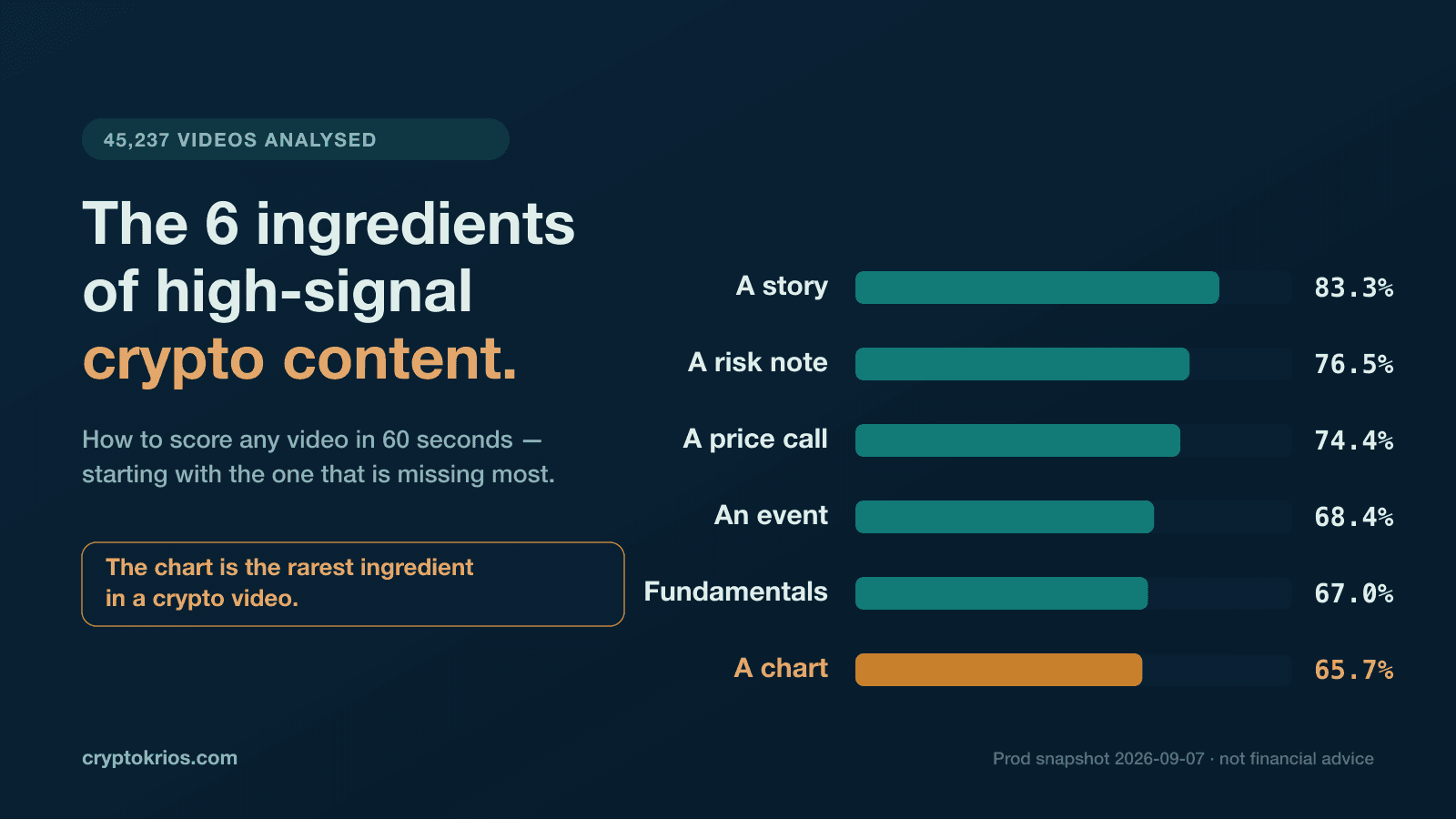
Crypto Content Checklist: The 6 Ingredients of High-Signal Crypto Content (And How to Score a Video in 60 Seconds)
A crypto content checklist you can run in 60 seconds. Learn the 6 ingredients of high-signal crypto videos, backed by analysis of 45,237 videos, plus a simple scoring framework to filter hype fast.

No Number, No Date, No Score: What a Crypto Prediction Target Date Actually Changes
Of 15,090 tracked crypto predictions with no target price, zero have ever been verified — even the ones that carried a date. Using the CryptoKrios database (2026-08-26), we measure what a target price and a target date each actually change, and give you a ten-second audit.

Crypto Creator Correction Policy: A Transparent Template for Updating Forecasts (Without Rewriting History)
A crypto creator correction policy makes forecasts auditable: preserve originals, timestamp revisions, and publish final verdicts. Use this template and checklist to separate transparent analysis from hindsight edits.

Crypto Influencer Due Diligence Checklist (2026): A Practical, Data-Driven Guide for Retail Investors
This crypto influencer due diligence checklist helps retail investors verify claims, assess track records, and spot bias in 2026. Built with real creator-claim data (33,921 tracked claims) and a repeatable scoring system you can use weekly.