
How to Evaluate a Crypto YouTuber: A 5-Step Method to Filter Hype With Evidence, Context, Incentives, Updates, and Contradictions
How to Evaluate a Crypto YouTuber: A 5-Step Method (Evidence, Context, Incentives, Updates, Contradictions)
If you’ve ever wondered how to evaluate a crypto youtuber, you’re not alone. Crypto content moves faster than markets, and creators can sound convincing even when they’re wrong—or incentivized. The result is “confidence theater”: sharp thumbnails, bold calls, and selective charts.
This guide gives you a 5-step, repeatable method to judge credibility without needing insider access. It’s not about telling you what to buy. It’s about knowing who’s worth listening to, how to spot hidden bias, and how to track whether a creator’s claims hold up over time.
We’ll cover five lenses—evidence, context, incentives, updates, and contradictions—plus practical checks you can run in minutes per video.
Step 1: Evidence — Do they show verifiable receipts, or just vibes?
The first step in how to evaluate a crypto youtuber is brutally simple: what evidence do they present, and can you verify it quickly? In crypto, anyone can narrate a chart. Trust comes from sources you can cross-check.
What “real evidence” looks like
High-quality creators consistently anchor claims in one (or more) of these:
- On-chain data: transaction volumes, active addresses, exchange inflows/outflows, holder distribution, staking metrics.
- Primary docs: whitepapers, governance proposals, audit reports, official announcements, SEC filings (if relevant).
- Transparent math: assumptions, timeframes, and sensitivity (what happens if fees drop 30%?).
- Clear references: links in description, timestamps, dashboards (Dune, Token Terminal, DeFiLlama), and reproducible steps.
A quick litmus test: if a creator says “whales are accumulating,” but doesn’t specify which wallets, which timeframe, and which method, it’s often narrative dressing.
The “evidence quality” checklist (fast)
Use this mini-scorecard while watching:
- Specificity: Do they cite numbers, dates, and sources? (“TVL up 18% WoW” beats “TVL is pumping.”)
- Reproducibility: Could you reproduce the chart or query in 5–10 minutes?
- Separation of facts vs. opinions: Do they label speculation as speculation?
- Time anchoring: Are claims tied to a timeframe? (24h, 7d, 90d)
- Error bars: Do they admit what could break the thesis?
Red flags that look like evidence (but aren’t)
- Cherry-picked zoom levels (e.g., “up only” since a local bottom).
- Unlabeled indicators: “This signal is perfect” without explaining the indicator or parameters.
- Anonymous screenshots: “Insider leak” images with no provenance.
- Overconfidence language: “Guaranteed,” “can’t lose,” “100x confirmed.”
A useful mindset: the more extreme the claim, the higher the evidence bar. If a video implies life-changing upside, you should see life-changing rigor.
Step 2: Context — Are they comparing against the right baselines?
The second step in how to evaluate a crypto youtuber is checking whether they interpret data with the right context. Crypto is full of “true but misleading” statements—numbers presented without baselines, comparisons, or market regime awareness.
Context questions that separate analysts from narrators
When a creator makes a claim, pause and ask:
- Compared to what? (BTC, ETH, sector index, prior cycle, competitors)
- Over what window? (1 day vs. 1 year tells different stories)
- In what market regime? (bull trend, chop, risk-off macro)
- What’s the counterfactual? (What if BTC dominance rises? What if liquidity dries up?)
Example: “This chain’s revenue doubled.” Good. But doubled from what—$1K/day to $2K/day, or $1M/day to $2M/day? Without scale, “growth” can be noise.
Look for proper baselines
Strong YouTubers use baselines like:
- Market cap vs. fully diluted valuation (FDV)
- Revenue/fees vs. incentives (are users paid to show up?)
- Active users vs. bots/sybil risk
- Token emissions vs. real demand
- Liquidity and slippage (can size actually exit?)
A common trap is “partnership” announcements. Context matters: Is it a signed integration, a pilot, a hackathon sponsor, or just a mutual retweet? Better creators clarify the difference.
Context red flags
- One-metric theses: a whole bull case built on a single chart.
- Ignoring dilution: praising price while emissions unlock.
- No peer comparison: “best in class” without naming competitors.
- Confusing narrative with fundamentals: hype ≠ cash flow, and vibes ≠ adoption.
A practical trick: in any bullish video, write down one bearish scenario that the creator didn’t address. If you can find three in under a minute, you’re likely watching marketing, not analysis.
Step 3: Incentives — Who pays them, what do they hold, and what do they gain?
The third step in how to evaluate a crypto youtuber is the one most investors skip: incentives. You can’t judge content quality without asking what the creator stands to gain.
Map the incentive stack
Most crypto creators monetize through some combination of:
- Sponsored videos / paid integrations
- Affiliate links (exchanges, hardware wallets, trading tools)
- Token allocations (advising, angel checks, OTC deals)
- Paid communities / courses
- Revenue from attention (sensational content drives clicks)
None of these automatically disqualify a creator. The issue is opacity.
What good disclosure looks like
Credible creators disclose:
- Sponsorships clearly and early (not buried at minute 17)
- Whether they hold the token discussed
- Whether they were paid in cash, tokens, or both
- Whether they have sell restrictions (lockups/vesting)
If a creator is “super bullish” on a microcap while running a referral link to buy it, you need to treat the content as conflicted until proven otherwise.
Practical checks you can do
- Scan the description for “sponsored”, “partner,” “affiliate,” or discount codes.
- Look for repeated coverage of the same project around funding announcements.
- Track whether their “research” consistently points to coins that are easy to promote (low float, high narrative).
- Watch how they speak about downside. Marketers minimize risk; analysts quantify it.
Incentive red flags
- “Not financial advice” paired with aggressive certainty.
- Recommending illiquid tokens without discussing exit liquidity.
- Constant “next 100x” framing (attention incentive dominates).
- Deflection when asked about holdings (“it doesn’t matter”). It does.
If you want a simple rule: conflicts don’t make someone wrong; hidden conflicts make them untrustworthy.
Step 4: Updates — Do they track outcomes, revise beliefs, and show their miss rate?
The fourth step in how to evaluate a crypto youtuber is to judge how they behave after publishing. In markets, being wrong is normal. Refusing to audit your own calls is not.
The “update discipline” test
High-trust creators:
- Revisit old theses and grade them
- Post updates when conditions change
- Explain what invalidated the original idea
- Show levels/timeframes and whether they played out
Low-trust creators:
- Delete, bury, or never mention failed calls
- Move goalposts (“it would’ve worked if…”)
- Only highlight winners (“called it!”) with no full ledger
What to look for in a creator’s track record
You don’t need a perfect spreadsheet, but you do need evidence of honesty. When you review a channel, sample the last 20–30 videos and ask:
- How many predictions were time-bound? (“within 30 days”)
- How many were measurable? (price level, on-chain metric, event)
- Did they document entries/exits or just narratives?
- Do they discuss probabilities or only certainties?
Creators who communicate in ranges—“base case / bull case / bear case”—tend to be more reliable than those who speak in absolutes.
A simple tracking method you can use
Create a small note template for any creator you follow:
- Claim:
- Timestamp/link:
- Timeframe:
- Trigger/invalidations:
- Outcome (Win/Loss/Unclear):
- Post-update behavior (Owned it / Ignored it / Reframed it):
After 10–15 logged claims, patterns become obvious. Most hype collapses under basic bookkeeping.
Update red flags
- “I was right” while the chart clearly violates the stated thesis.
- No follow-ups after major news that impacts the original claim.
- Endless new tickers with no closure on prior ones.
In short: trust grows when creators pay the price of being accountable.
Step 5: Contradictions — Do their narratives stay consistent, or do they flip without explanation?
The fifth step in how to evaluate a crypto youtuber is spotting contradictions. This isn’t about changing one’s mind; it’s about changing one’s story without acknowledging the change.
Two types of contradictions
- Analytical contradiction (normal if explained)
- “I was wrong because new data changed my view.”
- Narrative contradiction (a credibility leak)
- “I always said this could dump,” when the prior video said “can’t lose.”
Good creators evolve. The key is whether evolution is transparent.
How to detect contradictions quickly
- Compare titles/thumbnails across weeks. Is every week “THIS CHANGES EVERYTHING”?
- Check whether they use consistent definitions:
- “Adoption” (users? transactions? fees?)
- “Undervalued” (relative to what multiple?)
- “Safe” (volatility? smart contract risk? custody risk?)
- Listen for reversible claims:
- If price goes up: “See, strong fundamentals.”
- If price goes down: “Great accumulation zone.”
That’s unfalsifiable commentary. It’s designed to feel correct regardless of outcome.
The contradiction audit (5 minutes)
Pick one topic (e.g., ETH, SOL, or a sector like AI tokens) and do this:
- Open three videos from different months.
- Write the creator’s core thesis in one sentence each.
- Mark where the thesis changed.
- Check if they explain what caused the change.
If flips happen with no stated triggers, you’re not watching analysis—you’re watching trend-following packaged as conviction.
Contradiction red flags
- “Long-term hold” becomes “short-term trade” after a drawdown.
- Claiming neutrality while consistently promoting one ecosystem.
- Criticizing paid promotions while running undisclosed affiliates.
The goal isn’t to find a creator who never contradicts themselves. It’s to find creators who notice, explain, and learn.
Conclusion: A repeatable way to follow crypto creators with confidence
Now you have a practical framework for how to evaluate a crypto youtuber in five steps:
- Evidence: receipts you can verify
- Context: baselines, comparisons, and market regime
- Incentives: clear disclosures and conflicts
- Updates: tracked outcomes and honest revisions
- Contradictions: consistency, or transparent changes
If you apply this method for just a week, you’ll filter out most hype channels fast—and you’ll spend your attention on creators with real signal.
Want to save hours of manual checking? CryptoKrios analyzes crypto creators using explainable, AI-driven trust indicators—so you can validate who’s credible and spot bias before you act.
Create a free CryptoKrios account and start evaluating creators with data, not vibes: https://cryptokrios.com/
Methodology note (how to use this with CryptoKrios)
CryptoKrios is built for exactly this workflow: evidence quality, context rigor, incentive transparency, update discipline, and narrative consistency can be scored and reviewed over time. The point isn’t perfection—it’s measurable trust.
Discover what crypto influencers really say
Get AI-verified analysis of top crypto content creators — free.
Try CryptoKrios FreeRelated Articles
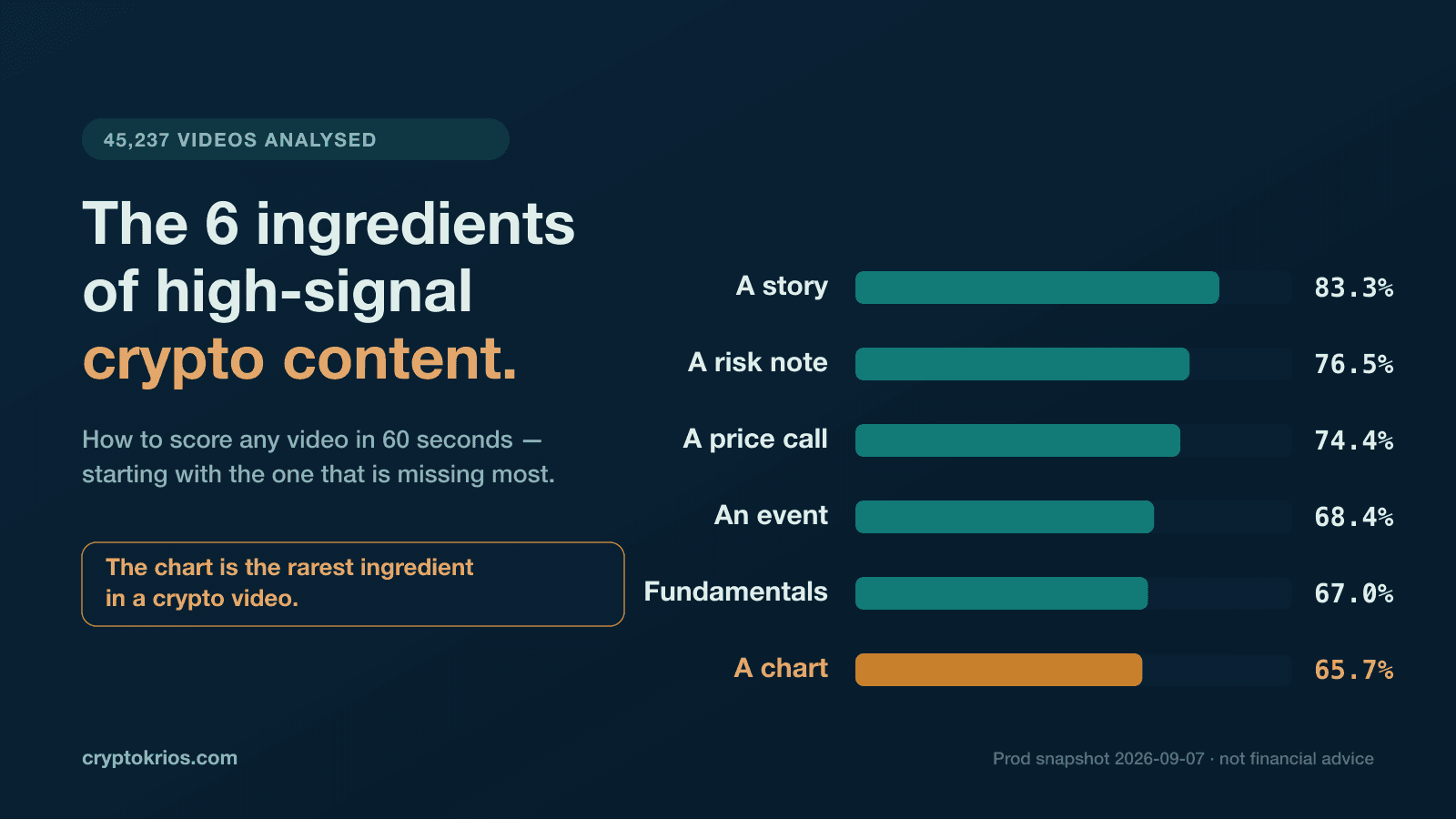
Crypto Content Checklist: The 6 Ingredients of High-Signal Crypto Content (And How to Score a Video in 60 Seconds)
A crypto content checklist you can run in 60 seconds. Learn the 6 ingredients of high-signal crypto videos, backed by analysis of 45,237 videos, plus a simple scoring framework to filter hype fast.
No Number, No Date, No Score: What a Crypto Prediction Target Date Actually Changes
Of 15,090 tracked crypto predictions with no target price, zero have ever been verified — even the ones that carried a date. Using the CryptoKrios database (2026-08-26), we measure what a target price and a target date each actually change, and give you a ten-second audit.

Crypto Creator Correction Policy: A Transparent Template for Updating Forecasts (Without Rewriting History)
A crypto creator correction policy makes forecasts auditable: preserve originals, timestamp revisions, and publish final verdicts. Use this template and checklist to separate transparent analysis from hindsight edits.

Crypto Influencer Due Diligence Checklist (2026): A Practical, Data-Driven Guide for Retail Investors
This crypto influencer due diligence checklist helps retail investors verify claims, assess track records, and spot bias in 2026. Built with real creator-claim data (33,921 tracked claims) and a repeatable scoring system you can use weekly.