The Checkability Gap: Why Most Crypto Calls Can Never Be Graded
The Checkability Gap: Why Most Crypto Calls Can Never Be Graded
Watch enough crypto YouTube and you'll hear hundreds of calls a month. Some feel confident, some feel careful, some feel like a guess dressed up as conviction. Almost none of them come with a way to tell which is which — until you ask two specific questions.
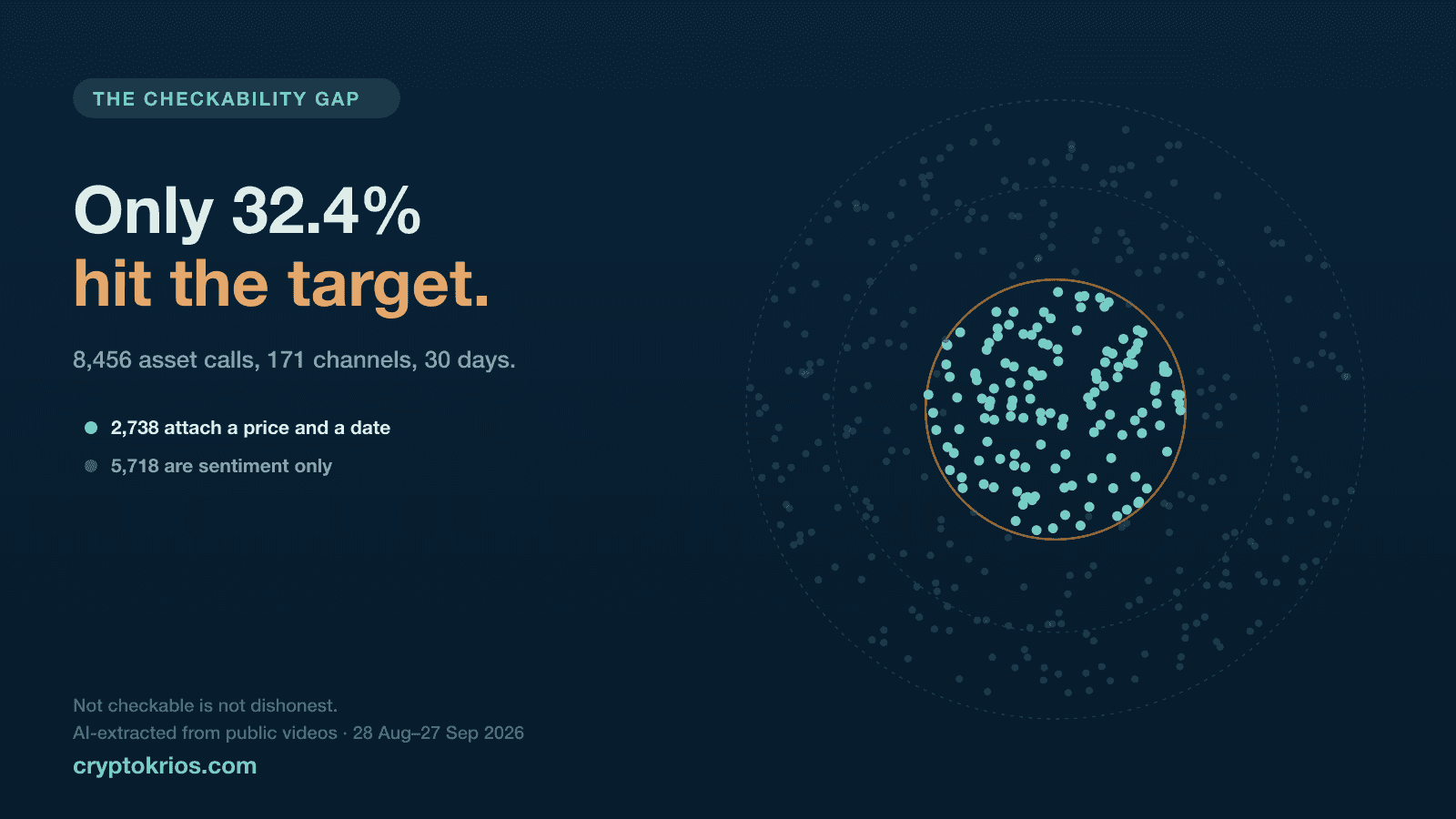
We asked them of everything our pipeline extracted over 30 days: 8,456 asset recommendations from 171 channels. For each one, we checked whether it attached a target price and a target date — the two things that turn a claim into something that can, eventually, be marked right or wrong. This article is about what we found, why it matters, and what it does not mean.
The headline number: 32.4%. Roughly one in three calls is checkable. The other two in three are sentiment with nothing to hold them against. That is not an accusation. It is a measurement, and it changes how much weight a single call should carry.
How this was built
Every video our pipeline analyzes goes through an AI reading of its content. When a creator recommends or discusses an asset, that mention becomes a record with an asset, a sentiment, and a confidence score — the same process behind last week's consensus map. Separately, when that mention includes enough specificity — a number, a timeframe — a second extraction pass creates a Prediction record linked back to it, carrying the target price, the target date, and eventually a verified outcome once that date arrives.
The gap this article measures is simply the difference between those two counts: how many recommendations exist, versus how many of them also produced a linked prediction. It's a structural measurement of the corpus, not a judgment about any single video, and it inherits the same limits as any AI-extraction pipeline — covered below.
What "checkable" actually means
A recommendation becomes checkable in our system when it generates a Prediction record: a specific asset, a specific target price, and a specific target date, extracted directly from what the creator said. Everything else — direction without a number, conviction without a date — stays a sentiment record with no way to ever be resolved.
Two examples, paraphrased from the kind of thing that shows up constantly:
- "This looks strong long-term, I'm bullish here." No price. No date. Not checkable — however confident it sounds, there is nothing to compare the outcome to later.
- "I expect $X by the end of Q4." A number and a window. Checkable — it will eventually be HIT, MISS, or somewhere in between, and that outcome can be looked up.
Both are legitimate things to say on camera. Only one of them can ever be scored.
The numbers, over 30 days
Verified against prod, AssetRecommendation joined to Prediction via assetRecommendationId, publishedAt in a fixed 30-day window (28 August to 27 September 2026):
- 8,456 total asset recommendations, from 171 channels, across 864 distinct assets.
- 2,738 (32.4%) attach both a target price and a target date — checkable.
- 5,718 (67.6%) do not — sentiment only.
- 148 of 171 channels (86.5%) made at least one checkable call somewhere in the window.
That last figure is worth sitting with. Making one checkable call in a month is common — most channels do it at least once. Making one most of the time is rare. When we looked at channels with 20 or more calls in the window and ranked them by the share that were checkable, the top of that list tops out around 60-65%. Nobody is close to making every call scoreable, and the two channels who come closest — More Crypto Online (64.3% of 70 calls) and Bitcoin Magazine (59.7% of 72 calls) — are the exception, not the norm.
To be fair about it: not checkable is not dishonest
This is the part that has to be said plainly, because the data alone can read as an accusation if it isn't.
Most market commentary is legitimately a read, not a forecast. "I think this looks constructive here" is a normal, honest thing to say about a market you follow closely. It is also, by construction, a sentence that can never be marked wrong — there is no number to miss and no date by which to miss it. Plenty of thoughtful, well-informed creators spend most of their airtime in this mode, and nothing about that is deceptive.
The problem isn't that unscoreable commentary exists. It's what happens when a viewer weighs it the same way they'd weigh a scoreable one. A number with a date carries information that can be checked against reality. A read carries the confidence of whoever said it, and confidence is not evidence. Both are worth listening to. They should not move you by the same amount.
Even the checkable third mostly still misses
Being checkable is not the same as being right, and it's worth showing that plainly so the 32.4% doesn't read as a stamp of quality.
All-time, once a checkable prediction resolves, our verification pipeline (which compares the target against actual price data) has judged 15,135 predictions:
- HIT: 2,415 (16.0%)
- PARTIAL: 3,608 (23.8%)
- MISS: 9,112 (60.2%)
One in six checkable calls hits outright. Most miss. That is not a reason to ignore checkable calls — it's the entire point of them existing. A call that can be wrong, and usually is, still tells you more than a call that can never be wrong at all, because at least you can build a track record around it. A creator's checkable-call history is something you can actually audit. Their vibes are not.
Checkability and taking a side tend to travel together
We split the channels with 20 or more calls in the window into two groups: the 22 whose checkable rate is 40% or higher, and the 74 below that line. The first group's calls are bearish 6.4% of the time, on average. The second group's are bearish 3.1% of the time — roughly half as often.
We would not lean hard on this from one 30-day window, and it is a correlation, not a mechanism we've tested. But it fits a simple explanation: both behaviors are versions of the same thing — putting something on the record that can turn out to be wrong. A channel willing to name a number and a date is, on this evidence, also somewhat more willing to say "I think this goes down," and a channel that avoids one may avoid the other for the same underlying reason. Neither correlation makes a channel more or less trustworthy on its own. It's one more thing worth noticing when you're deciding how much weight to give a call.
What this can't tell you
It says nothing about which assets or channels to trust. This is a structural measurement — how much of the corpus is checkable at all — not a ranking. The channels named above are named for a narrow, specific behavior (committing to a number and a date more often than most), not for accuracy or overall quality.
It's a 30-day snapshot. Checkability rates likely move with market conditions — a trending market probably produces more confident, specific calls than a choppy one. We have not tested that yet.
Extraction isn't perfect. An AI reading of a video can miss a price target buried in a chart overlay, or misread a hedge as a firm number. Aggregates are far more reliable than any single record, and no individual creator should be judged from this dataset alone.
Checkable calls still resolve slowly. A prediction with a target date next year sits as PENDING for a long time before it can be judged at all. The 15,135 judged predictions above are the ones that have had time to resolve; many more are still waiting.
Three questions, one video
You don't need our data to use this. Run these on the next call you hear:
- Is there a number? A target price, not a direction. "Higher" is not a price.
- Is there a date? A window, not "soon." "Soon" can never be wrong.
- Would they say what proves them wrong? The rarest one — a stated invalidation level hands you the yardstick before you need it.
Two out of three is unusual. All three is rarer still, and it's the closest thing to a track record a viewer can build in real time. Zero out of three doesn't mean the creator is dishonest. It means you're listening to a read, and a read should be weighted like one.
Try CryptoKrios free to see checkable-call rates, verified prediction histories, and trust scores for the channels you actually watch — built from data like this, not from a hunch. https://cryptokrios.com/free
Trust scores, checkability rates, and prediction verification are AI analyses of public content and price data. They describe what was said and what happened, not what will happen next. Nothing in this article is financial advice. Always do your own research.
Discover what crypto influencers really say
Get AI-verified analysis of top crypto content creators — free.
Try CryptoKrios FreeRelated Articles
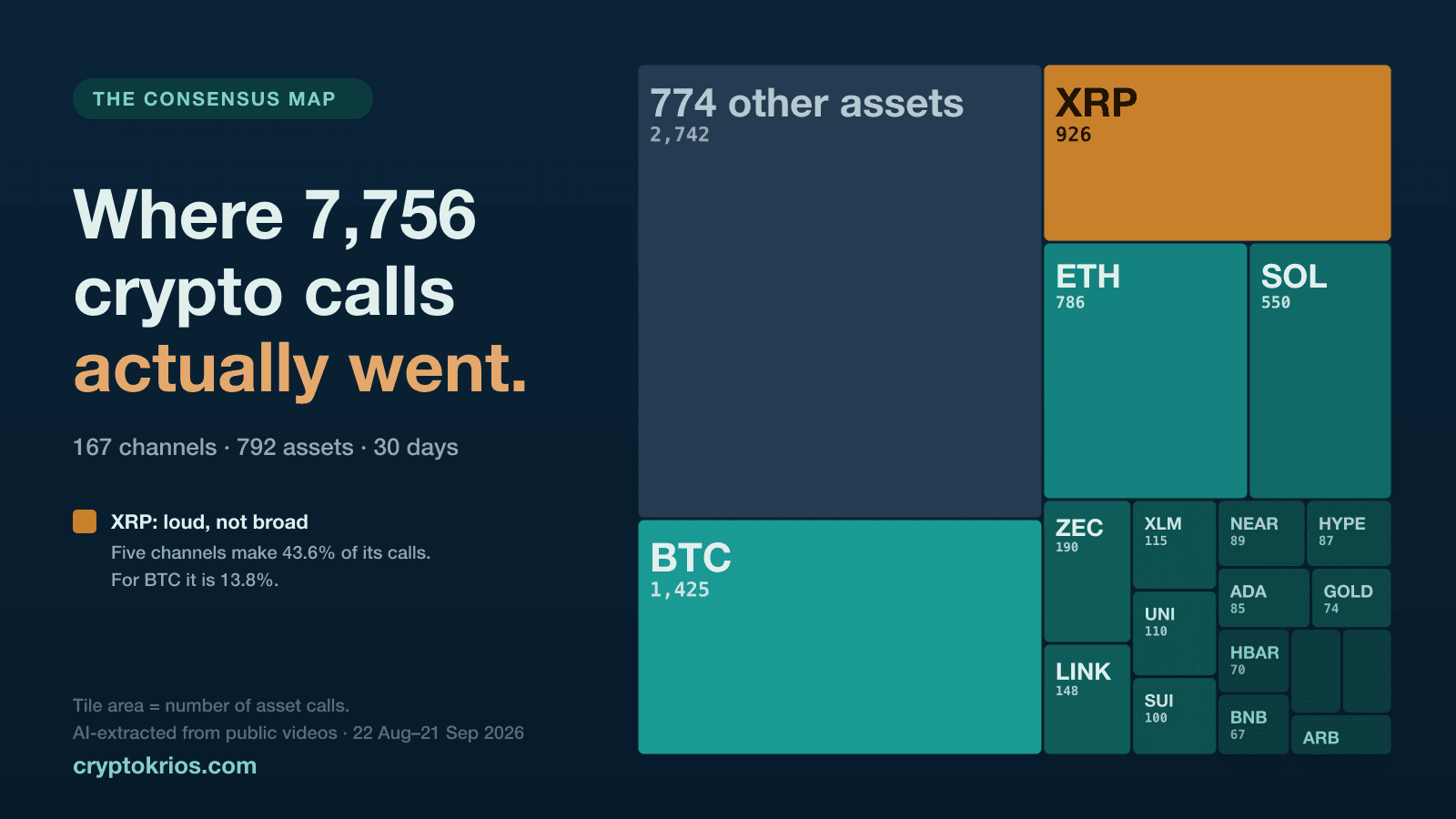
The Consensus Map: What 167 Crypto Channels Actually Recommended in 30 Days
We extracted 7,756 asset recommendations from 167 crypto YouTube channels in 30 days. Four assets take 47.5% of the calls, 478 were named once, and bullish outnumbers bearish 15.7 to 1.
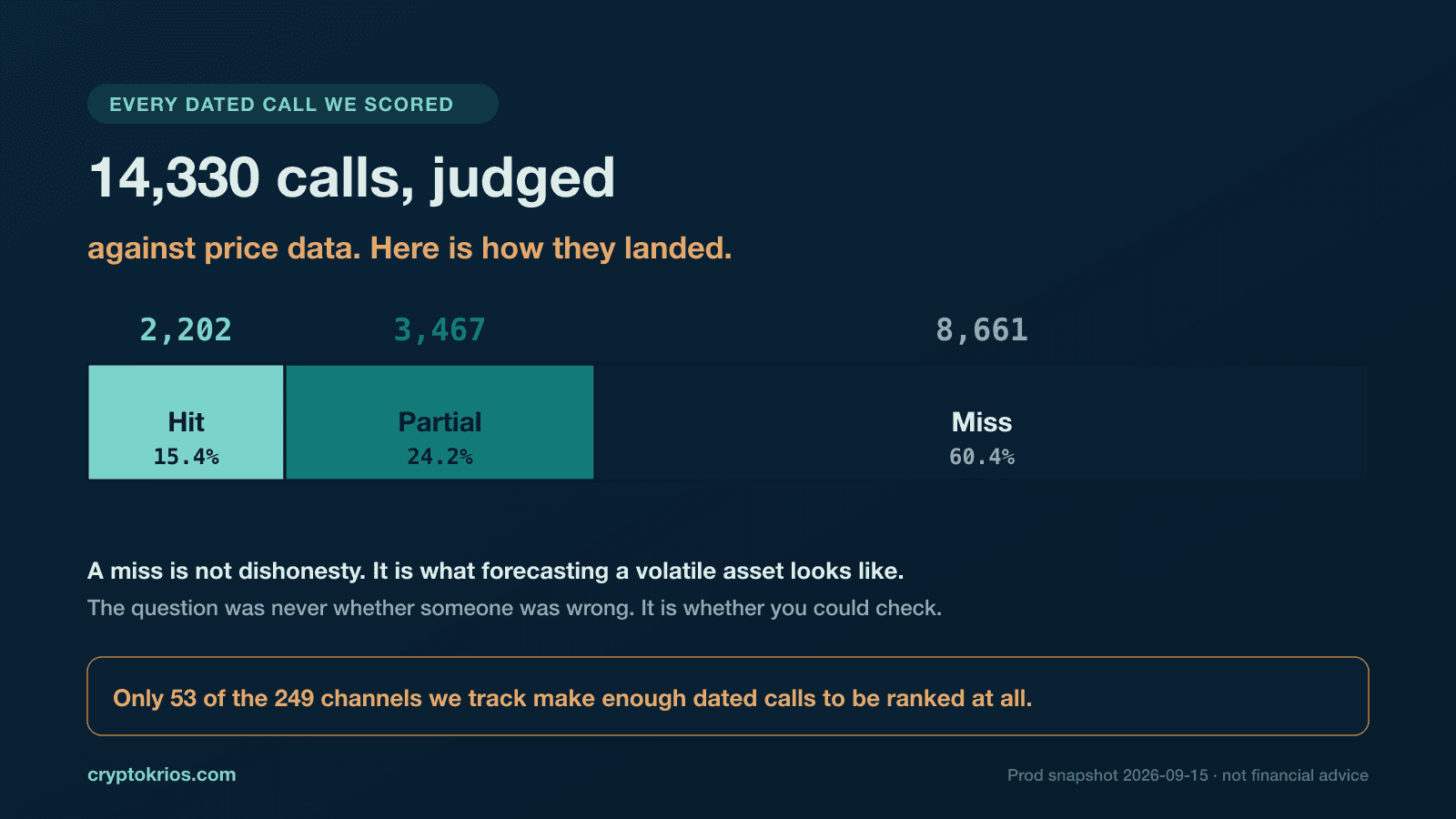
What 14,330 Judged Crypto Predictions Say About Following Anyone's Calls
We judged 14,330 crypto predictions against price data. The best creator hits 32.3%—remarkable vs a 15.4% baseline. The real finding: only 53 of 249 channels make enough dated calls to be rankable.