Crypto Content Checklist: The 6 Ingredients of High-Signal Crypto Content (And How to Score a Video in 60 Seconds)
Crypto Content Checklist: The 6 Ingredients of High-Signal Crypto Content (And How to Score a Video in 60 Seconds)
If you’ve ever finished a crypto video feeling informed and slightly manipulated, you’re not alone. The fastest way to filter signal from hype is a crypto content checklist—a simple framework you can run in under a minute to judge whether a video deserves your attention.
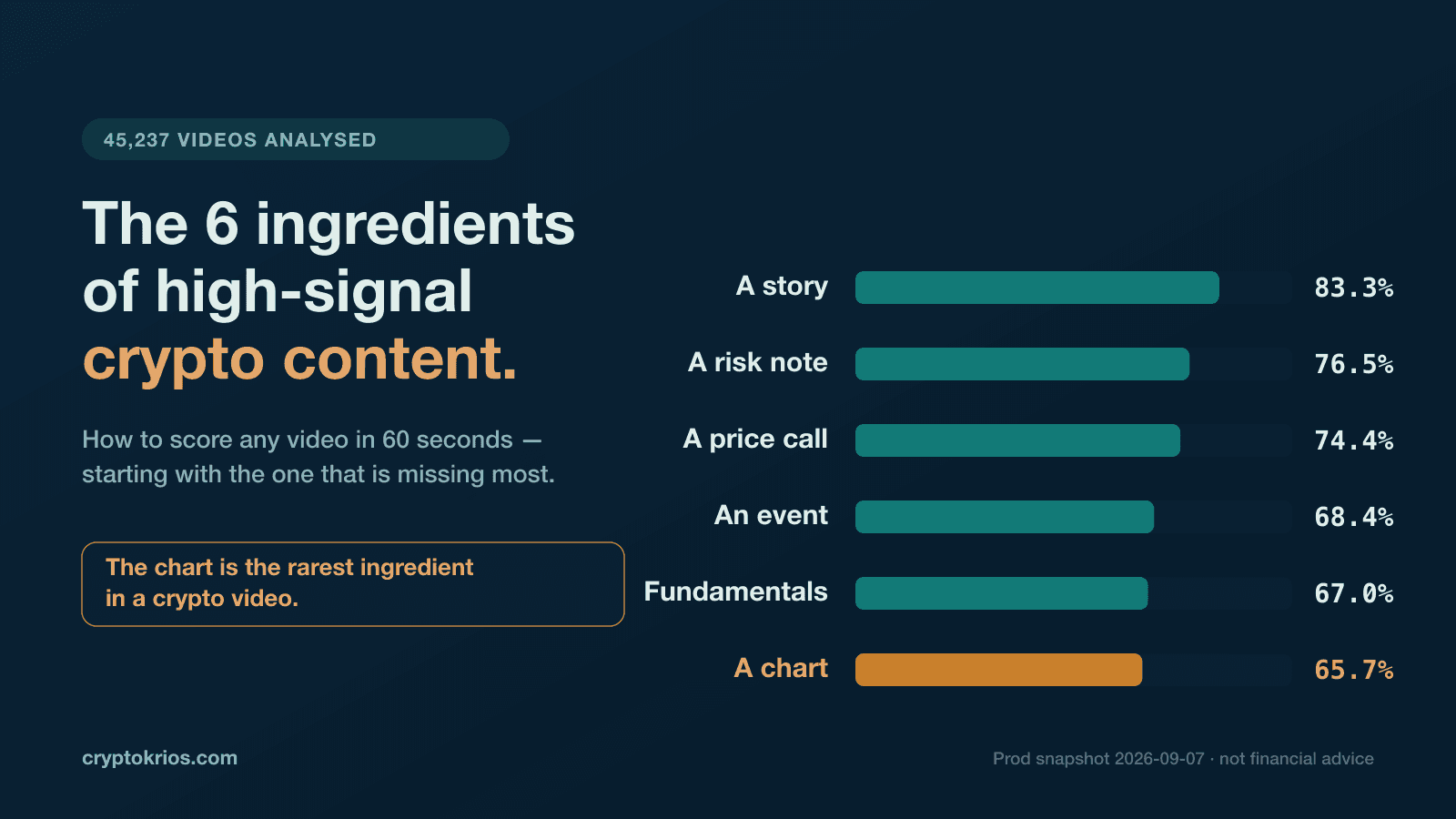
At CryptoKrios, we analyzed 45,237 YouTube videos with completed AI analysis (prod snapshot 2026-09-07). The data shows a clear pattern: most creators can tell a story, many mention risk, but the ingredient that’s most often missing is the one that forces specificity.
This article gives you a crypto content checklist built around 6 ingredients of high-signal crypto content, plus a 60-second scoring method you can apply while the video is still playing.
The Crypto Content Checklist: The 6 Ingredients That Separate Signal From Noise
Here are the six ingredients we see repeated in the highest-signal crypto content. Importantly, “high-signal” doesn’t mean “correct.” It means the content is auditable, falsifiable, and decision-useful.
We’ll reference platform-wide frequencies from our 45,237-video dataset:
- Narrative/story appears in 37,698 videos (83.3%) — most common.
- Risk section appears in 34,617 (76.5%).
- Price/direction call appears in 33,644 (74.4%).
- Event angle appears in 30,937 (68.4%).
- Fundamental analysis appears in 30,326 (67.0%).
- Technical analysis (a chart) appears in 29,732 (65.7%) — rarest ingredient.
A practical takeaway: risk talk is the norm; charts are what’s missing.
To make this actionable, we’ll treat each ingredient as a “checkbox” in your crypto content checklist. The more boxes checked (and the more specific each one is), the more likely you’re watching content that can be evaluated later.
Ingredient 1–2: Narrative + Event Angle (The Context Layer)
1) Narrative/story (83.3%) is the most common ingredient for a reason: stories keep attention. A strong narrative can be a good sign—if it’s paired with evidence and constraints. A weak narrative is a red flag when it replaces analysis.
How to grade it (fast):
- High-signal narrative = clear thesis + what would change the thesis.
- Low-signal narrative = vibes + identity (“smart money is rotating”) with no falsifiable claims.
But the more useful “context layer” is story plus an event angle (68.4%)—a catalyst that explains why now.
2) Event angle means the video anchors the thesis to something observable:
- A protocol upgrade, token unlock, a macro print, ETF flow narratives, governance vote, regulatory deadline, earnings-style report, etc.
What to look for in your crypto content checklist:
- Does the creator name a specific event and timeframe?
- Do they explain the mechanism (how the event could affect price, demand, liquidity, or sentiment)?
- Do they distinguish between “scheduled and known” vs “speculative and rumored” events?
Common failure mode: creators use events as a drama engine rather than an analytical input. If the event is mentioned but not connected to a measurable impact, it’s usually just a hook.
60-second scoring tip:
- If you can’t write the thesis as one sentence with a time anchor (“Because X happens by Y, Z could happen”), score narrative/event lower.
Your crypto content checklist should treat narrative as necessary but not sufficient. It gets attention. It doesn’t earn trust by itself.
Ingredient 3–4: Fundamentals + Technicals (The Evidence Layer)
High-signal content shows its work. In our dataset, fundamental analysis appears in 30,326 videos (67.0%), and technical analysis (a chart) appears in 29,732 (65.7%). The chart is the rarest of the six ingredients.
That’s important because charts force a creator to be specific: levels, invalidation zones, timeframes, and scenarios. Fundamentals can also be specific, but they’re easier to keep vague.
3) Fundamentals (67.0%)
Fundamentals are the “why this asset matters” argument:
- Users, revenue/fees, token supply mechanics, demand drivers, competitive positioning, product milestones, ecosystem growth, security assumptions.
High-signal fundamentals look like:
- A concrete metric (fees, TVL, active users, supply schedule) and why it matters.
- A comparison (“relative to peers”) rather than a standalone claim.
Low-signal fundamentals look like:
- “Strong community,” “institutional interest,” “partnerships,” without numbers or a causal path.
4) Technical analysis / chart (65.7%) — and why missing charts matter
Even if you don’t trade off charts, a chart often creates:
- Entry/exit frameworks
- Time horizon clarity
- Invalidation conditions
Yet, 13,550 videos (29.9%) build a narrative with no technical analysis at all. That’s nearly a third of all analyzed videos. Those videos can still be valuable (education, long-term views), but they are harder to audit on timing and risk.
Outcomes (verified calls only): charts correlate with higher hit rates—but still lose
CryptoKrios tracks outcomes on verified calls. When we look strictly at verified calls:
- With a chart: 15.7% land (1,615 of 10,294).
- With no chart: 7.3% land (37 of 504).
Two critical interpretations for your crypto content checklist:
- Do not claim causation. A chart doesn’t “cause” a better outcome. It may be a proxy for specificity, discipline, or the kinds of calls creators choose to make.
- 15.7% is still a losing number. A chart can raise the floor, but it does not buy you a win.
60-second scoring tip:
- If there’s no chart and no measurable fundamental metric, you’re watching a thesis that can’t easily be audited. That’s not automatically bad—but it should score lower for decision-making.
Ingredient 5: The Price/Direction Call (The Falsifiability Layer)
A “call” is a prediction with direction, level, or expectation. In our dataset, 33,644 videos (74.4%) make a price/direction call.
Calls are useful because they’re falsifiable. But they also invite overconfidence. Your crypto content checklist should grade calls on precision and conditions.
What a high-signal call looks like
A call becomes high-signal when it includes at least two of these:
- Time horizon (hours, days, weeks, months)
- Level/zone (breakout level, support zone, invalidation)
- Conditions (“if BTC holds X,” “if liquidity remains Y,” “if event Z goes through”)
- Scenario split (base case / bull case / bear case)
What a low-signal call looks like
- “This will pump soon.”
- “I’m bullish here.”
- “Next leg up incoming.”
Low-signal calls can’t be evaluated, so they can’t be improved.
Why call-quality matters given real hit rates
Crypto is hard. Even across roughly 36,500 tracked calls, the overall strict hit rate is ~15.3%.
That number alone is a reality check: most calls won’t land under strict evaluation. So the point of your crypto content checklist isn’t to find “perfect predictors.” It’s to find creators who:
- Make calls that are testable
- Document the reasoning
- Include risk and invalidation
- Improve over time
60-second scoring tip:
- If the video makes a call, ask: “Could I write down what would prove this wrong?” If not, downgrade it.
Ingredient 6: Risk Section (The Integrity Layer) + The 60-Second Scorecard
Risk is where content either earns trust—or exposes itself.
In our dataset, 34,617 videos (76.5%) include a risk section. That means risk talk is the norm. The real differentiator is how specific the risk is, and whether it meaningfully constrains the thesis.
Risk done right
High-signal risk sections include:
- Specific invalidation triggers (what breaks the thesis)
- Liquidity/volatility warnings aligned with the asset’s profile
- Catalyst risks (event delay, vote failure, unlock overhang)
- Position sizing logic (even if generic)
Risk done wrong (or missing)
Some videos make bold calls with no risk named. In fact:
- 7,739 videos make a price call and name no risk.
- That’s 23.0% of the 33,644 videos that make a call.
- Meaning the other 77% do name at least one risk.
So missing risk isn’t “normal creator behavior.” It’s an outlier—and your crypto content checklist should penalize it heavily.
The “complete package” is less common than you think
Only 14,206 videos (31.4%) include all four of these together:
- Chart + fundamentals + risk + a call
That bundle is where content becomes most decision-useful: evidence + prediction + constraints.
The 60-Second Crypto Content Checklist (0–12 Points)
Use this scorecard while the video plays. You’re not judging “whether it will go up.” You’re judging whether the content is high-signal.
Give 0, 1, or 2 points for each ingredient:
- Narrative (0–2)
- 0: pure vibes
- 1: thesis stated, but vague
- 2: thesis + what would change it
- Event angle (0–2)
- 0: no catalyst
- 1: catalyst mentioned, unclear mechanism
- 2: catalyst + timeframe + mechanism
- Fundamentals (0–2)
- 0: buzzwords
- 1: one metric, limited context
- 2: metrics + comparison + token mechanics or demand driver
- Technical analysis / chart (0–2)
- 0: no chart/levels at all
- 1: chart shown, vague levels
- 2: levels + timeframe + invalidation or scenario split
- Price/direction call (0–2)
- 0: no call
- 1: direction only
- 2: direction + level/timeframe + conditions
- Risk section (0–2)
- 0: none
- 1: generic risk (“crypto is risky”)
- 2: specific invalidation + key risks tied to thesis
How to interpret your score
- 0–4: Entertainment or narrative-first. Watch for learning, not decisions.
- 5–8: Mixed. Some signal, some gaps. Validate with other sources.
- 9–12: High-signal structure. Still not “correct,” but auditable and worth tracking.
A final sanity check before you act
Even the better-structured content lives inside a tough reality:
- Overall strict hit rate across ~36,500 tracked calls is ~15.3%.
- Verified calls with a chart land 15.7% (1,615 of 10,294).
- Verified calls with no chart land 7.3% (37 of 504).
So use the crypto content checklist to choose who to learn from and which ideas are testable—not as permission to YOLO.
Conclusion: Use the Checklist, Then Track What Actually Lands
The easiest way to get misled in crypto is to confuse confidence with quality. A crypto content checklist helps you reward structure: evidence, specificity, and risk—so you can filter creators and claims without watching 20 videos a day.
If you want to go beyond manual scoring, CryptoKrios automates this: we analyze videos at scale, surface the presence of these ingredients, and track outcomes over time so you can follow influencers with confidence.
Create your free CryptoKrios account: https://cryptokrios.com/auth/login
Discover what crypto influencers really say
Get AI-verified analysis of top crypto content creators — free.
Try CryptoKrios FreeRelated Articles
No Number, No Date, No Score: What a Crypto Prediction Target Date Actually Changes
Of 15,090 tracked crypto predictions with no target price, zero have ever been verified — even the ones that carried a date. Using the CryptoKrios database (2026-08-26), we measure what a target price and a target date each actually change, and give you a ten-second audit.

Crypto Creator Correction Policy: A Transparent Template for Updating Forecasts (Without Rewriting History)
A crypto creator correction policy makes forecasts auditable: preserve originals, timestamp revisions, and publish final verdicts. Use this template and checklist to separate transparent analysis from hindsight edits.

Crypto Influencer Due Diligence Checklist (2026): A Practical, Data-Driven Guide for Retail Investors
This crypto influencer due diligence checklist helps retail investors verify claims, assess track records, and spot bias in 2026. Built with real creator-claim data (33,921 tracked claims) and a repeatable scoring system you can use weekly.
Crypto Influencer Conflict of Interest Beyond #ad: 6 Structural Incentives That Aren’t Sponsorships
A crypto influencer conflict of interest often exists without #ad. Here are 6 non-sponsored structural incentives—plus simple public-info checks—to spot bias and predict which claims may disappear.