
Crypto Creator Correction Policy: A Transparent Template for Updating Forecasts (Without Rewriting History)
Crypto Creator Correction Policy: A Transparent Template for Updating Forecasts (Without Rewriting History)
A crypto creator correction policy is the simplest way to separate honest analysis from hindsight marketing. In crypto, narratives change fast, but credibility compounds slowly.
At CryptoKrios, we track prediction-style claims across creators because investors deserve data, not vibes. In our latest production snapshot (2026-08-20), we’ve tracked 35,036 predictions across 199 channels—and verified 10,798 outcomes so far. Those outcomes include 1,652 strict hits, 2,634 partials, and 6,512 misses. That distribution is exactly why a public, consistent correction process matters: everyone gets it wrong sometimes. The question is whether they correct it transparently.
This article gives you a practical, copy-paste crypto creator correction policy template. It’s designed for creators who publish forecasts, and for viewers who want a checklist to evaluate whether a creator deserves trust.
Why a crypto creator correction policy is the missing layer of trust
Crypto creators rarely intend to mislead. The bigger problem is structural: timelines are messy, posts are editable, and “being right” is often defined after the fact.
A strong crypto creator correction policy solves a specific trust gap: it creates a public standard for how forecasts are updated when conditions change. That sounds basic, but the numbers show why it’s not optional.
In our production snapshot (2026-08-20), we’ve tracked 35,036 prediction-like claims. Only 1,361 include both a target price and a target date. Meanwhile, 13,898 include neither. That’s not a moral judgment—it’s a measurement issue.
When a forecast lacks a price and a date, you can’t cleanly answer:
- What does “right” mean?
- When does the claim expire?
- What counts as a correction versus a new idea?
Even when a prediction is measurable, outcomes still vary. Out of 10,798 verified outcomes, we observed 1,652 strict hits, 2,634 partials, and 6,512 misses. That’s the normal distribution of real forecasting in a high-volatility market. It also means reputation can be manipulated if creators quietly edit posts, delete old takes, or “roll” targets forward indefinitely.
A correction policy prevents that by forcing four things:
- Preservation (the original claim remains visible)
- Timestamps (so context is provable)
- Measurable revisions (what changed, and why)
- Final verdicts (when the claim is graded, it stays graded)
There’s another practical reason: predictions age out. We also see 13,419 expired claims in our snapshot. Expiration is healthy—it’s how analysis stays accountable. A policy formalizes when a forecast stops being “active,” and when it becomes part of the creator’s track record.
If you’re a creator, a policy protects you from bad-faith clipping. If you’re a viewer, it protects you from quiet narrative edits. Either way, it’s a net upgrade for the whole info layer.
The transparent template: a crypto creator correction policy you can publish today
Below is a crypto creator correction policy template designed to be creator-friendly and viewer-auditable. It’s intentionally specific, because ambiguity is where trust leaks.
1) Scope: what counts as a forecast?
Define “forecast” broadly so you can’t dodge accountability later.
Include:
- Price direction claims (“up-only,” “breakdown incoming”)
- Range claims (“between X and Y”)
- Level claims (“will reclaim $X”)
- Timing claims (“by end of month”)
- Conditional claims (“if BTC holds X, then…”)
Clarify exclusions:
- Educational explanations without forward claims
- Pure sentiment reactions (“feels strong”) unless tied to a level/time
2) Format standard (the measurability rule)
Set a minimum format for publishable forecasts.
Required fields (best practice):
- Asset/topic (e.g., BTC, ETH, “L2 sector”)
- Direction and thesis (1–3 sentences)
- Invalidation level or condition (what would prove it wrong)
- Time horizon: a date or a window (e.g., “within 14 days”)
- (Optional) Target level(s): price/market cap/range
If you don’t include a target price/date, state that explicitly:
- “No target price. This is a directional thesis only.”
- “No target date. This is a multi-month view.”
Why this matters: when large volumes of claims include neither target nor date (like the 13,898 we’ve observed in tracking), audiences can’t fairly grade them. The policy fixes that by making “non-measurable” a declared category, not a loophole.
3) Preservation rule (no silent edits)
State your immovable rule:
- Never delete a forecast post because it looks wrong.
- Never edit the original forecast text in a way that changes meaning.
If you must correct a typo, do it with:
- “Edit: typo fixed at [timestamp]. Meaning unchanged.”
If a platform allows edits (threads, captions, pinned comments), require a change log. The change log should be visible and timestamped.
4) Correction types (what’s allowed to change)
Corrections are normal. Define what kinds exist.
- Clarification: No change to thesis. Adds detail.
- Revision: Changes targets, timing, or invalidation.
- Retraction: Thesis no longer stands.
For each type, require:
- What changed (quote the original line)
- Why it changed (new data, invalidation hit, macro shift)
- What stays the same (if anything)
- When it changed (timestamp)
5) “One forecast, one ID” rule
This is a small operational step that drives massive transparency.
Assign an ID to each forecast:
- Example:
2026-08-20-BTC-01
When you correct it, you reference the same ID. That prevents “new post = new reality” behavior.
6) Expiration and verdicts (no infinite rolling)
Set explicit rules for when a forecast ends.
- If a forecast has a date: verdict is posted within 24–72 hours after that date.
- If it has a time window: verdict after window closes.
- If it’s conditional: verdict when the condition is met or invalidated.
- If it’s open-ended: require a maximum review interval (e.g., every 30 days).
Then define verdict labels in plain English:
- Hit (strict): target and timing met as stated
- Partial: direction correct but timing/level off, or range partially met
- Miss: invalidation hit, or target not met by expiration
We use categories like these because they reflect reality: in verified outcomes, we see mixes of strict hits, partials, and misses. A policy makes those outcomes trackable instead of debateable.
How to update a forecast without “rewriting history” (rules + examples)
A crypto creator correction policy isn’t about never changing your mind. It’s about changing your mind in a way that preserves accountability.
Here are correction rules that keep your timeline clean and your audience informed.
Rule 1: Corrections must reference the original claim
Bad: “New take: actually I think it’s bearish.”
Good: “Correction to 2026-08-20-BTC-01: I’m revising the target window from 14 days to 30 days due to [reason]. Original thesis unchanged.”
This creates a visible chain of custody: forecast → correction → verdict.
Rule 2: Always state the trigger for the correction
Corrections without triggers feel like narrative management.
Examples of valid triggers:
- Invalidation level hit
- New macro data (rates, liquidity)
- Structural market change (volatility regime shift)
- New on-chain/derivatives signals
- News with direct causal link
Write it like a lab notebook:
- “Trigger: invalidation level lost on daily close.”
Rule 3: Don’t move targets without acknowledging probability
If you revise a target, you should also update confidence.
Add one line:
- “Confidence decreased from medium → low.”
You don’t need a complex scoring system. You need consistency.
Rule 4: Split “new information” from “new forecast”
If your worldview truly changes, retire the old forecast and create a new one.
- Post a verdict on the old ID
- Start a new ID for the new thesis
This avoids the common pitfall where one forecast morphs into five different forecasts over time.
Rule 5: Publish a final verdict even if it’s uncomfortable
A policy without verdicts is just PR.
In large-scale tracking, a meaningful portion of claims end up expiring or missing. That’s expected. What matters is whether the creator treats misses as data.
A high-integrity verdict post includes:
- Outcome (hit/partial/miss)
- Evidence (price level, chart timestamp, condition result)
- What you learned (1–2 bullets)
- Whether you’ll reuse the model or adjust it
Practical example (generic, not investment advice)
Here’s a neutral template you can reuse:
- Forecast ID:
YYYY-MM-DD-ASSET-## - Original post: link/screenshot reference
- Original thesis (unchanged text): “…”
- Original invalidation: “…”
- Original horizon: “…”
- Correction type: Revision
- What changed: target window 14d → 30d
- Why: volatility expanded; invalidation not hit; condition not resolved
- Timestamp: 2026-08-20 15:40 UTC
- Next review date: 2026-09-19
This is what “transparent” looks like operationally.
How audiences can evaluate a creator’s correction policy (a 10-point checklist)
If you’re trying to decide who to listen to, you’re not looking for perfection—you’re looking for process.
Use this checklist to evaluate whether a creator’s crypto creator correction policy is real or performative.
The CryptoKrios viewer checklist
- Do they keep originals visible? No mass deletions when wrong.
- Do they timestamp edits and corrections? If not, context can be rewritten.
- Do forecasts include measurable fields? At least a horizon and invalidation.
- Do they label corrections clearly? Clarification vs revision vs retraction.
- Do they reference the original claim explicitly? Links, IDs, or quoted lines.
- Do they define what counts as a “hit”? Without this, “wins” are flexible.
- Do they post verdicts after expiration? No infinite “soon.”
- Do they distinguish partials from strict hits? This is where honesty shows.
- Do they explain misses with evidence, not excuses? Misses are data.
- Do they summarize track record periodically? Monthly/quarterly recaps.
Why this matters at scale: when thousands of claims exist in a content ecosystem, ambiguity becomes an exploit. In our tracking snapshot, only a small subset include both date and price targets (1,361). Many include neither (13,898). The gap between those two numbers is basically the accountability gap.
A creator with a real correction policy closes that gap by making even non-price calls reviewable.
Red flags (common patterns)
- “I called it” posts without linking the original timestamp
- Deleting old threads/videos without archives
- Rolling time horizons forward repeatedly without labeling revisions
- Victory laps on partials while ignoring misses
This is not about “gotchas.” It’s about choosing information sources that behave like analysts, not marketers.
Implementing a crypto creator correction policy: tools, workflow, and minimum viable transparency
You don’t need a compliance team to implement a crypto creator correction policy. You need a workflow that makes transparency automatic.
The minimum viable workflow (creators)
Step 1: Standardize your forecast format Create a saved template you paste into posts.
Step 2: Assign an ID Use date + asset + counter.
Step 3: Maintain a public ledger Options:
- A pinned thread with links to forecast IDs
- A Notion page or Google Sheet
- A GitHub gist (simple and timestamped)
Step 4: Schedule reviews Put review dates on your calendar. If you publish frequently, do a weekly “verdict sweep.”
Step 5: Publish verdicts consistently
Even if it’s just: “ID X = Miss. Invalidation hit. Lesson: don’t fight trend.”
The minimum viable workflow (audiences)
If you’re evaluating creators, build your own lightweight record:
- Screenshot the forecast with timestamp
- Record: claim, horizon, invalidation
- Check back on expiration
This is exactly why platforms like CryptoKrios exist: manual tracking doesn’t scale when the ecosystem produces tens of thousands of claims.
How CryptoKrios fits in (no black box)
CryptoKrios is built around a simple belief: transparency is the product.
We track prediction-style claims so you can validate patterns like:
- Do outcomes get graded, or do they disappear?
- Are revisions measurable and timestamped?
- Do creators separate strict hits from partials?
At scale, this matters. When you’re dealing with tens of thousands of predictions (like our 35,036 tracked snapshot), the only way to keep the info layer honest is to make corrections auditable.
A strong correction policy is how creators earn trust. Analytics is how audiences verify it.
Conclusion: publish a crypto creator correction policy, then let the receipts speak
A crypto creator correction policy is not about being right all the time. It’s about being accountable all the time.
When forecasts are preserved, timestamped, revised measurably, and closed with final verdicts, trust becomes trackable. And in crypto, trackable trust is alpha.
If you want to follow creators with confidence—and save hours of manual verification—create a free CryptoKrios account and use our analytics to validate the process behind the predictions.
Try CryptoKrios free: https://cryptokrios.com/free
Discover what crypto influencers really say
Get AI-verified analysis of top crypto content creators — free.
Try CryptoKrios FreeRelated Articles
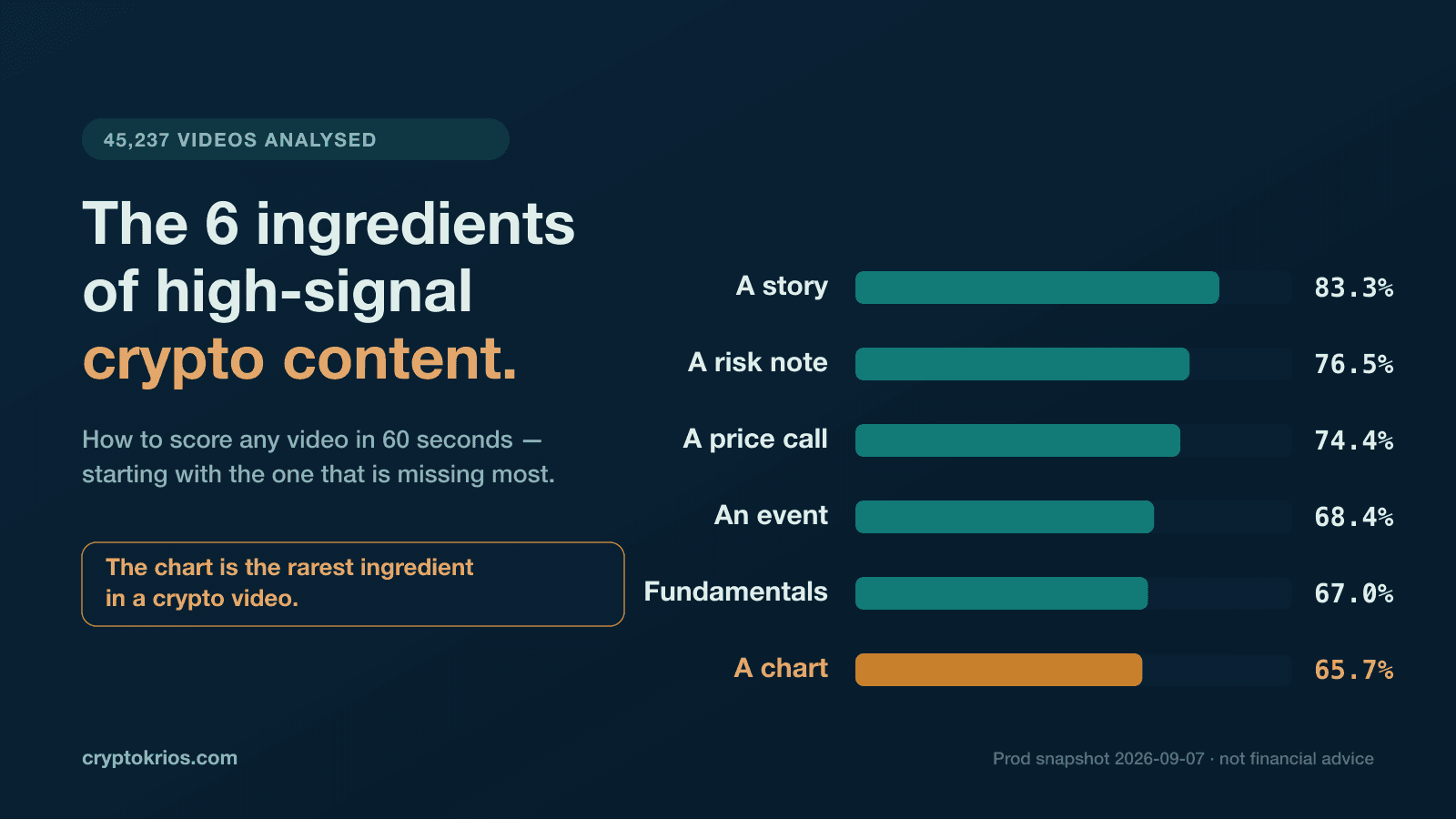
Crypto Content Checklist: The 6 Ingredients of High-Signal Crypto Content (And How to Score a Video in 60 Seconds)
A crypto content checklist you can run in 60 seconds. Learn the 6 ingredients of high-signal crypto videos, backed by analysis of 45,237 videos, plus a simple scoring framework to filter hype fast.

No Number, No Date, No Score: What a Crypto Prediction Target Date Actually Changes
Of 15,090 tracked crypto predictions with no target price, zero have ever been verified — even the ones that carried a date. Using the CryptoKrios database (2026-08-26), we measure what a target price and a target date each actually change, and give you a ten-second audit.

Crypto Influencer Due Diligence Checklist (2026): A Practical, Data-Driven Guide for Retail Investors
This crypto influencer due diligence checklist helps retail investors verify claims, assess track records, and spot bias in 2026. Built with real creator-claim data (33,921 tracked claims) and a repeatable scoring system you can use weekly.

Crypto Influencer Conflict of Interest Beyond #ad: 6 Structural Incentives That Aren’t Sponsorships
A crypto influencer conflict of interest often exists without #ad. Here are 6 non-sponsored structural incentives—plus simple public-info checks—to spot bias and predict which claims may disappear.