
Crypto Influencer Due Diligence Checklist (2026): A Practical, Data-Driven Guide for Retail Investors
Crypto Creator Due Diligence: A Practical Checklist for Retail Investors (2026)
Using a crypto influencer due diligence checklist isn’t “being paranoid” in 2026—it’s basic risk management. Retail investors are exposed to more content than ever, but most creator “calls” are not structured to be verifiable, trackable, or accountable.
At CryptoKrios, we track claims across creators and score them on explainable quality signals, so you can decide who to listen to—not what to buy. In this guide, you’ll get a practical checklist you can run in 10–20 minutes per creator, plus the exact data points that separate signal from noise.
Why a Crypto Influencer Due Diligence Checklist Matters (What the Data Shows)
If you only remember one thing: most crypto content isn’t written to be checked later. That’s not always malicious—sometimes it’s just incentives. Creators are rewarded for attention, not accuracy.
Here’s what our current production snapshot (2026-08-06) says about how “trackable” and accurate creator claims are at scale:
- 33,921 tracked claims across 199 channels (242 accounts total).
- 10,798 verified claims (claims with enough structure to score).
- Strict global hit rate: 15.3% (1,652 hits).
- 235 channels have a rated overall score (average 7.60/10); 2 are flagged as scammers.
- Depth exists, but it’s rare: 74 channels have 25+ verified claims; 47 have 50+.
- Most important: among channels with 10+ verified claims, ZERO sit above a 50% hit rate.
That “zero above 50%” point is the gut-check. If you’re following a creator like they’re reliably right, the base-rate data says you’re likely overestimating them.
The Evidence Ladder: Why Most “Predictions” Can’t Be Scored
A due diligence checklist starts with a simple question: can the creator be evaluated at all? Our evidence ladder shows why accountability is often impossible:
- Claims with a price AND a date verify at 5.3% (701 verified).
- Claims with price-only verify at 16.0% (10,097 verified).
- Claims with neither price nor date are never scored: 0 verdicts across 14,816 such claims—44% of the database.
Interpretation: vague claims (“soon,” “big pump,” “next leg,” “going to rip”) dominate. And vague claims can’t be judged fairly—so they also can’t be used to earn trust.
A crypto influencer due diligence checklist protects you from two traps:
- Hype without accountability (claims you cannot verify).
- Selective memory (remembering wins, forgetting misses).
Crypto Influencer Due Diligence Checklist: The 5-Minute Accountability Screen
This first section of your crypto influencer due diligence checklist is a fast filter. You’re not trying to “prove” the creator is good. You’re checking whether they operate in a way that can be evaluated.
1) Do they make claims that are measurable?
Look for predictions that include at least one of these:
- Price level (entry, target, invalidation)
- Timeframe/date (by end of week, by Q4, within 30 days)
- Condition ("if BTC loses 60k, thesis invalid")
Why it matters: in our dataset, 44% of tracked claims have neither price nor date and therefore receive no verdict. If a creator lives in that zone, you cannot verify them.
Quick test: open their last 10 posts/videos and count how many include at least one measurable element. If it’s under 3/10, downgrade their credibility.
2) Do they document invalidation (how they can be wrong)?
High-integrity analysis includes a way to fail.
Green flags:
- “If X happens, I’m wrong.”
- “Stop level / thesis invalidation.”
- “Here’s what would change my mind.”
Red flags:
- “Can’t lose.”
- “Guaranteed.”
- “No downside.”
3) Do they distinguish between trading and investing?
A creator can be a great trader and a terrible long-term investor (and vice versa). Your checklist should capture:
- Time horizon: scalps vs weeks vs multi-year
- Risk language: position sizing, downside, volatility
- Execution realism: liquidity, slippage, fees
If they push high-frequency execution to a retail audience without discussing these constraints, that’s a structural mismatch.
4) Do they show their work—or just conclusions?
You’re checking for a repeatable reasoning process:
- Data sources linked?
- On-chain metrics cited?
- Macro assumptions stated?
- Prior predictions referenced?
A creator who never links sources is asking you for blind trust.
5) Do they correct the record publicly?
The most reliable creators treat mistakes as part of the process.
Look for:
- Post-mortems (“Here’s why this failed”)
- Updated views with timestamps
- Visible edits or pinned follow-ups
Avoid:
- Deleting misses without comment
- Only reposting wins
- Constant narrative shifts with no accountability
This is the checklist step that stops you from “vibes-based” trust.
Crypto Influencer Due Diligence Checklist: Accuracy, Track Record, and How to Read the Numbers
Once the creator passes the accountability screen, you move to the core of the crypto influencer due diligence checklist: track record quality. Not “are they right sometimes,” but “do they outperform randomness in a way that’s consistent and verifiable?”
1) Demand sample size before you trust accuracy
Accuracy without volume is marketing.
From our snapshot:
- Only 74 channels have 25+ verified claims.
- Only 47 channels have 50+ verified claims.
That means most creators don’t have enough verified history to justify strong confidence.
Checklist rule:
- Under 10 verified claims: treat as unknown.
- 10–24: tentative, require stronger transparency.
- 25–49: usable, start comparing.
- 50+: meaningful for trend analysis.
2) Understand why “hit rate” is usually lower than you expect
Our strict global hit rate across verified claims is 15.3%.
Also: among channels with 10+ verified claims, none exceed 50% hit rate.
This doesn’t mean creators are “all bad.” It means:
- Many claims are too specific (price+date is hardest to verify; it verifies at 5.3% in our dataset).
- Market regimes change fast.
- Creators often overfit narratives.
How to use this in due diligence:
- Be suspicious of anyone implying they’re right “most of the time.”
- Focus on creators who are transparent about uncertainty and risk.
3) Separate “price calls” from “analysis quality”
A creator can have mediocre hit rate but still provide useful frameworks (risk management, macro read, on-chain interpretation). That’s why CryptoKrios rates channels beyond just outcomes.
In our dataset:
- 235 channels have a rated overall score.
- Average score: 7.60/10.
- 2 channels are flagged as scammers.
Checklist practice: Track two scores in your notes:
- Outcome score: did their measurable calls hit?
- Process score: is their reasoning consistent, sourced, and falsifiable?
You should follow creators for process—not just for targets.
4) Watch for survivorship and cherry-picking
Creators can “win” by:
- Posting many predictions (you remember the hits)
- Deleting misses
- Reframing time horizons (“not now, but later”) without admitting the miss
Checklist trick: screenshot or bookmark 3–5 concrete calls and check them later. If you can’t do this, use a tool (like CryptoKrios) that tracks claims systematically.
5) Verify claim structure: price+date vs price-only
Our evidence ladder is a practical scoring lens:
- Price + date claims are the most accountable but verify at 5.3%.
- Price-only claims verify at 16.0%.
- No price/no date claims are unscorable and dominate content.
Checklist takeaway: A creator who occasionally makes price+date calls and then reviews outcomes is operating in the “accountability zone,” even if the market is tough.
Crypto Influencer Due Diligence Checklist: Bias, Incentives, and Hidden Conflicts (The Real Alpha)
Accuracy is only half the game. The other half is incentives. This part of the crypto influencer due diligence checklist is where retail investors usually get hurt—because bias can produce great content that still leads you into bad decisions.
1) Identify the creator’s business model
Ask: how do they get paid?
Common models:
- Ads (YouTube, sponsors)
- Affiliate links (exchanges, wallets)
- Paid groups / “signals”
- Token allocations / advisory
- Launchpad or OTC deals
Checklist rule: if you can’t clearly explain how they monetize, assume there’s a conflict you haven’t found yet.
2) Look for sponsorship disclosure quality
Disclosure isn’t binary. It’s about clarity and placement.
Green flags:
- Clear “sponsored” labeling near the claim
- Repeated disclosure in threads/video + description
- Explains what they received (paid, tokens, allocation)
Red flags:
- Disclosure hidden at the bottom
- Vague language (“partnered with,” “thanks to”) with no terms
- Reviews that sound like press releases
3) Detect “perma-bull” or “perma-bear” identity traps
Creators often become brands:
- “ETH maxi”
- “SOL only”
- “Everything is a scam”
Identity-based positioning encourages selective evidence. Your checklist should include a simple question:
When was the last time they changed their mind publicly?
If the answer is “never,” you’re following a narrative, not analysis.
4) Check for community manipulation patterns
Retail gets pulled into coordinated hype loops:
- Countdown launches
- “Secret alpha” gated behind paid groups
- “This will 10x” with no risk framing
Add a checklist item for language:
- Excessive certainty
- Urgency (“buy now,” “last chance”)
- Moral framing (“you’re early,” “they don’t want you to know”)
These are persuasion patterns, not research.
5) Hard stop: scam signals
Our platform has flagged 2 scammers among rated channels. That number will change, but the checklist signals stay consistent.
Immediate disqualifiers:
- Fake giveaways / wallet drain links
- Impersonation, copycat accounts
- Pressure to send funds or reveal seed phrases
- “Guaranteed returns” or “risk-free” claims
If any show up: unfollow, report, move on.
Crypto Influencer Due Diligence Checklist: A Repeatable Scoring System You Can Use Weekly
A checklist is only useful if it becomes a habit. Here’s a simple, repeatable scoring method that turns your crypto influencer due diligence checklist into a weekly routine.
Step 1) Track 10 recent claims and categorize them
For each claim, label it:
- A: Price + date (most accountable)
- B: Price-only
- C: No price/no date (unscorable)
Based on our dataset, category C is common—44% of tracked claims have no price and no date. That’s your first warning sign.
Scoring suggestion (0–10):
- If 7–10 are category C → score 2/10 for accountability.
- If 4–6 are category C → score 5/10.
- If 0–3 are category C → score 8/10.
Step 2) Add a transparency score (0–10)
Answer yes/no:
- Do they link sources?
- Do they state invalidation?
- Do they revisit outcomes?
- Do they disclose sponsorships clearly?
- Do they separate facts vs opinions?
Count “yes” and map to a 0–10 score.
Step 3) Add an incentives risk score (0–10, inverted)
Higher = safer.
- Clear monetization and disclosures → 8–10
- Frequent promo content or unclear allocations → 4–7
- Heavy shilling + opaque incentives → 0–3
Step 4) Decide how to use them (follow tiering)
Use your total score to assign a role:
- 0–12 total: entertainment only (do not use for decisions)
- 13–22: idea generator (you verify everything)
- 23–30: research input (still verify, but higher weight)
This is how retail investors stop treating creators as “signal providers” and start treating them as inputs.
Where CryptoKrios fits (save hours, reduce blind trust)
Doing this manually is possible—but it’s work. CryptoKrios exists because most people don’t have time to track outcomes across dozens of creators.
We help by:
- Tracking claims at scale (33,921 and growing)
- Verifying outcomes with a consistent evidence ladder
- Rating channels with explainable indicators (235 rated; average 7.60/10)
- Flagging high-risk behavior (including scammer flags)
The goal isn’t to tell you what to buy. It’s to help you decide who deserves your attention.
Conclusion: Use the Checklist, Then Automate the Hard Parts
A crypto influencer due diligence checklist is your edge in 2026 because it forces accountability, sample size thinking, and incentive awareness. Our data shows strict hit rates are low, vague claims are rampant, and no creator should be trusted on vibes alone.
If you want to skip spreadsheets and get the same accountability lens across creators automatically, try CryptoKrios.
Create a free account and start evaluating creators with transparent trust scores, verified claim tracking, and bias signals: https://cryptokrios.com/free
Discover what crypto influencers really say
Get AI-verified analysis of top crypto content creators — free.
Try CryptoKrios FreeRelated Articles
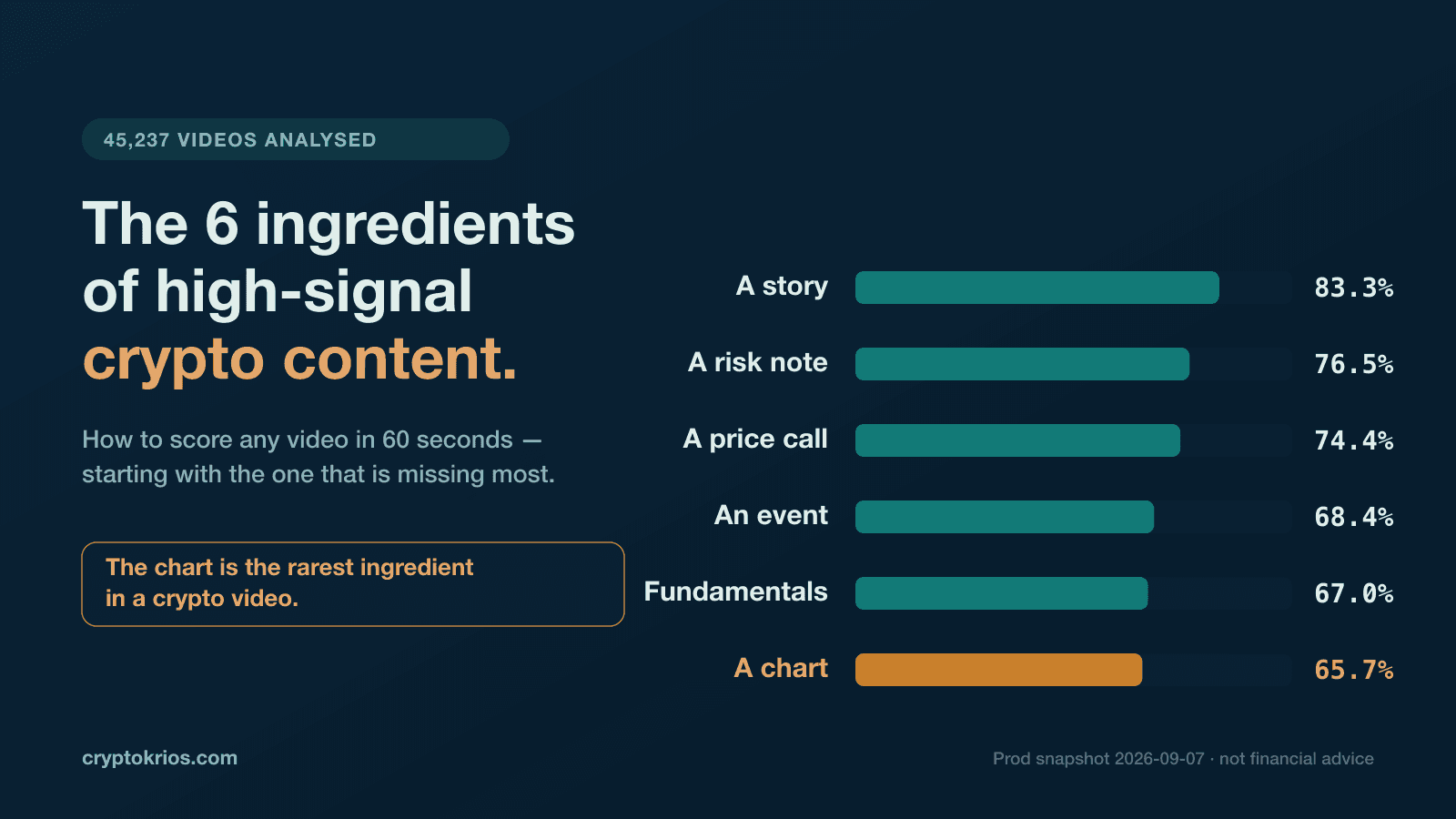
Crypto Content Checklist: The 6 Ingredients of High-Signal Crypto Content (And How to Score a Video in 60 Seconds)
A crypto content checklist you can run in 60 seconds. Learn the 6 ingredients of high-signal crypto videos, backed by analysis of 45,237 videos, plus a simple scoring framework to filter hype fast.

No Number, No Date, No Score: What a Crypto Prediction Target Date Actually Changes
Of 15,090 tracked crypto predictions with no target price, zero have ever been verified — even the ones that carried a date. Using the CryptoKrios database (2026-08-26), we measure what a target price and a target date each actually change, and give you a ten-second audit.

Crypto Creator Correction Policy: A Transparent Template for Updating Forecasts (Without Rewriting History)
A crypto creator correction policy makes forecasts auditable: preserve originals, timestamp revisions, and publish final verdicts. Use this template and checklist to separate transparent analysis from hindsight edits.
Crypto Influencer Conflict of Interest Beyond #ad: 6 Structural Incentives That Aren’t Sponsorships
A crypto influencer conflict of interest often exists without #ad. Here are 6 non-sponsored structural incentives—plus simple public-info checks—to spot bias and predict which claims may disappear.