No Number, No Date, No Score: What a Crypto Prediction Target Date Actually Changes
No Number, No Date, No Score: What a Crypto Prediction Target Date Actually Changes
A crypto prediction target date is the least glamorous part of any call, and the part most likely to be missing. "BTC is going to run" is a mood. "BTC above 120K by December 31" is a claim you can grade. Everyone says they want the second kind. Our database says almost nobody publishes it.
At CryptoKrios we extract predictions from crypto YouTube at scale and then check them against real price data. That means we can do something more useful than complain about vague calls: we can measure what actually makes a call verifiable — and what only looks like it does.
Data source: every figure below comes from the CryptoKrios production database, snapshot 2026-08-26: 35,835 predictions extracted from 22,007 videos across 199 channels.
The two-by-two that explains everything
A prediction has two closing conditions: a number (the target price) and a window (the target date). Split our whole dataset by which ones are present, and the picture is unusually clean:
| Target price | Target date | Predictions | Verified | Verified % | Expired % |
|---|---|---|---|---|---|
| No | No | 14,008 | 0 | 0.0% | 66.6% |
| No | Yes | 1,082 | 0 | 0.0% | 65.5% |
| Yes | No | 19,354 | 10,097 | 52.2% | 19.9% |
| Yes | Yes | 1,391 | 701 | 50.4% | 7.9% |
Three things fall out of that table, and only one of them is the thing people usually say.
1. The number is the entry ticket
Of the 15,090 predictions in our data with no target price, zero have ever been verified. Not a low rate — zero. Two-thirds of them (10,045) have already run past their horizon and been marked EXPIRED, which in our schema means the window closed and there was nothing to check against.
This is not a quirk of our pipeline. It is arithmetic. Verification compares a stated target to an observed price. With no stated target there is no comparison to make, so the call sits open until its horizon lapses, then quietly ages out. It never becomes a hit and it never becomes a miss.
That is the whole trick, and it does not require anyone to be dishonest. A creator who says "this is going much higher" has said something that can be remembered as correct in a bull market and forgotten in a bear one. The record is written by whoever recalls it.
2. A date without a number saves nothing
Here is the part that surprised us, and the reason this article isn't the one we planned to write.
There are 1,082 predictions in our data that carry a target date but no target price. Their verification rate is 0.0% — exactly the same as calls with no date at all. Their expiry rate (65.5%) is statistically indistinguishable from the no-date-no-price group (66.6%).
"When" without "what" is not a prediction. It is a schedule for an unspecified event. If you only demand a deadline from the calls you follow, you will get deadlines — and you will be no better off. Ask for the number first.
3. What the date actually does: it stops the call from aging out
Once a number is on the table, the date earns its place, and the effect is large.
Among calls with a target price but no date, 19.9% expire before they can be graded. Among calls with both a price and a date, only 7.9% do — a 2.5× reduction. The verification rate barely moves (52.2% vs 50.4%), but the failure mode changes completely: with a date, far fewer calls die of old age instead of receiving a verdict.
That is the honest case for a crypto prediction target date. It does not make a call more likely to be right. It makes it much more likely to be resolved.
4. A deadline makes the test harder — that's the point
One more number from the same rows, and it is the one worth sitting with.
Among verified calls that had a price but no date, 1,615 of 10,097 came back as hits — 16.0%. Among verified calls that had both a price and a date, 37 of 701 came back as hits — 5.3%.
Read that carefully, because it is easy to misread. It does not mean creators who post deadlines are worse analysts. It means a deadline converts a loose claim into a strict one. "BTC to 120K" is satisfied by any moment in an open-ended future. "BTC to 120K by December 31" has to be true on a specific day, at a specific level. The same underlying view, tested strictly, scores lower — everywhere, for everyone.
So when someone attaches a real date to a real number in public, take note. They have volunteered for the hard version of the test, and the scoreboard treats them accordingly.
5. The vocabulary of vagueness
If dates are so useful, why are they so rare? Because the language of crypto commentary is built to avoid them. Sorted by the horizon we extract from what was actually said:
- Short term — 18,916 calls (52.8%)
- Medium term — 9,039 calls (25.2%)
- Long term — 7,224 calls (20.2%)
- Specific date — 656 calls (1.8%)
Fewer than two in a hundred predictions name a specific date. "Soon," "this cycle," "in the coming months" and "long term" cover the other 98%. Those phrases are not lies. They are simply unfalsifiable, and unfalsifiable claims cannot build a track record — in either direction. The careful analyst gets no credit for being right, either.
Why dates are avoided, without assuming bad faith
Three reasons show up again and again, and only one of them is cynical.
The first is honest uncertainty. Markets are path-dependent, and a good analyst genuinely does not know whether a level arrives in March or in September. Naming a date feels like false precision, so the date gets dropped and the conviction stays.
The second is format. Most of these calls are made live, in a forty-minute video, in response to a chat question. Nobody drafts a falsifiable statement in real time. The looseness is a property of the medium before it is a property of the speaker.
The third is incentive, and it is the one to watch. A dateless call is an asset that never depreciates. It can be re-shared during every rally and never has to be reconciled during a drawdown. The creator does not have to do anything dishonest for that to pay off — the audience does the upgrading on its own, remembering the calls that landed and forgetting the ones that never closed.
You cannot tell these three apart from the outside, and you do not need to. The fix is the same for all of them: ask for the number, ask for the window, and score what you get.
6. Four formats that close a call, two that never do
You do not need a spreadsheet to apply this. You need a habit. These four formats give a call a closing condition:
- Absolute — "above 120K by December 31." A level and a calendar date.
- Relative window — "within 90 days." A level and a duration from a stated start.
- Event-bound — "before the next halving." A level and a scheduled event everyone can see.
- Conditional + window — "if we hold 3.2K for two weeks, then 4K by March." An entry condition, a level, and a deadline.
And two phrases that guarantee the call never closes:
- "Eventually" / "in this cycle" — no window, so nothing can lapse and nothing can be scored.
- "It's inevitable" — confidence with no clock attached, which is the most expensive kind.
Both sound authoritative. Neither can be graded. A useful test: if you cannot picture the post where this call is publicly proven wrong, it is commentary, not a prediction.
7. How we grade, so the rules can be checked
Transparency about method matters more than any single number, so here is ours in full. When a prediction has a target price and its horizon arrives, we compare the observed price to the target:
deviation        = |actual − target| / target
directionCorrect = (bullish → actual ≥ baseline × 0.95)
                   OR (bearish → actual ≤ baseline × 1.05)

VERIFIED_HIT     = direction correct AND deviation ≤ 5%
VERIFIED_PARTIAL = direction correct AND 5% < deviation < 20%
VERIFIED_MISS    = direction wrong OR deviation ≥ 20%
EXPIRED          = horizon passed AND (no target price OR no price data)
Two consequences are worth stating plainly. A partial is not a hit — direction right, number wrong is its own category, and it stays there. And expired is not a miss: it means the call could not be tested, which is a statement about the call's construction, not about the creator's judgment.
8. The ten-second audit
Before you file any call as part of someone's track record — including a call you agree with — write down four things:
- What price? If there is no number, stop. Nothing downstream matters.
- By what date? Absolute, relative, or event-bound. All three count.
- What would prove it wrong? The invalidation level, stated up front.
- Where is it timestamped? A link, a video, a date. Memory is not a source.
If you cannot fill in 1 and 2 in ten seconds, you are looking at commentary. Enjoy it — plenty of good analysis is commentary — but do not let it be scored as a forecast later.
What these numbers do not say
A few limits, because a piece about rigour should hold itself to some.
Our figures describe what creators said on camera, as extracted by our pipeline. A creator may have stated a target in a chart, a pinned comment, or a paid newsletter that we never see; those calls appear here as "no target" when they were nothing of the sort. The 199 channels we track are not the whole of crypto media. And the dataset moves: it grew by more than a hundred predictions while this article was being written.
Nothing above ranks or names an individual creator, and nothing above is a claim about anyone's honesty. Loose language is the default register of live commentary, not evidence of bad faith. The problem starts one step later — when loose language gets counted as a record of accuracy, by the audience or by the creator.
Ask for the number, then ask for the date
If you take one habit from 35,835 tracked calls, take this one: ask for the number first, then ask for the date. The number is what makes a prediction checkable at all. The date is what makes sure the check actually happens instead of the call quietly aging out.
CryptoKrios timestamps and grades predictions automatically, so "still early" comes with an expiry date attached. You can see how the calls you follow actually score.
Data is descriptive, not predictive. Nothing here is financial advice.
Discover what crypto influencers really say
Get AI-verified analysis of top crypto content creators — free.
Try CryptoKrios FreeRelated Articles
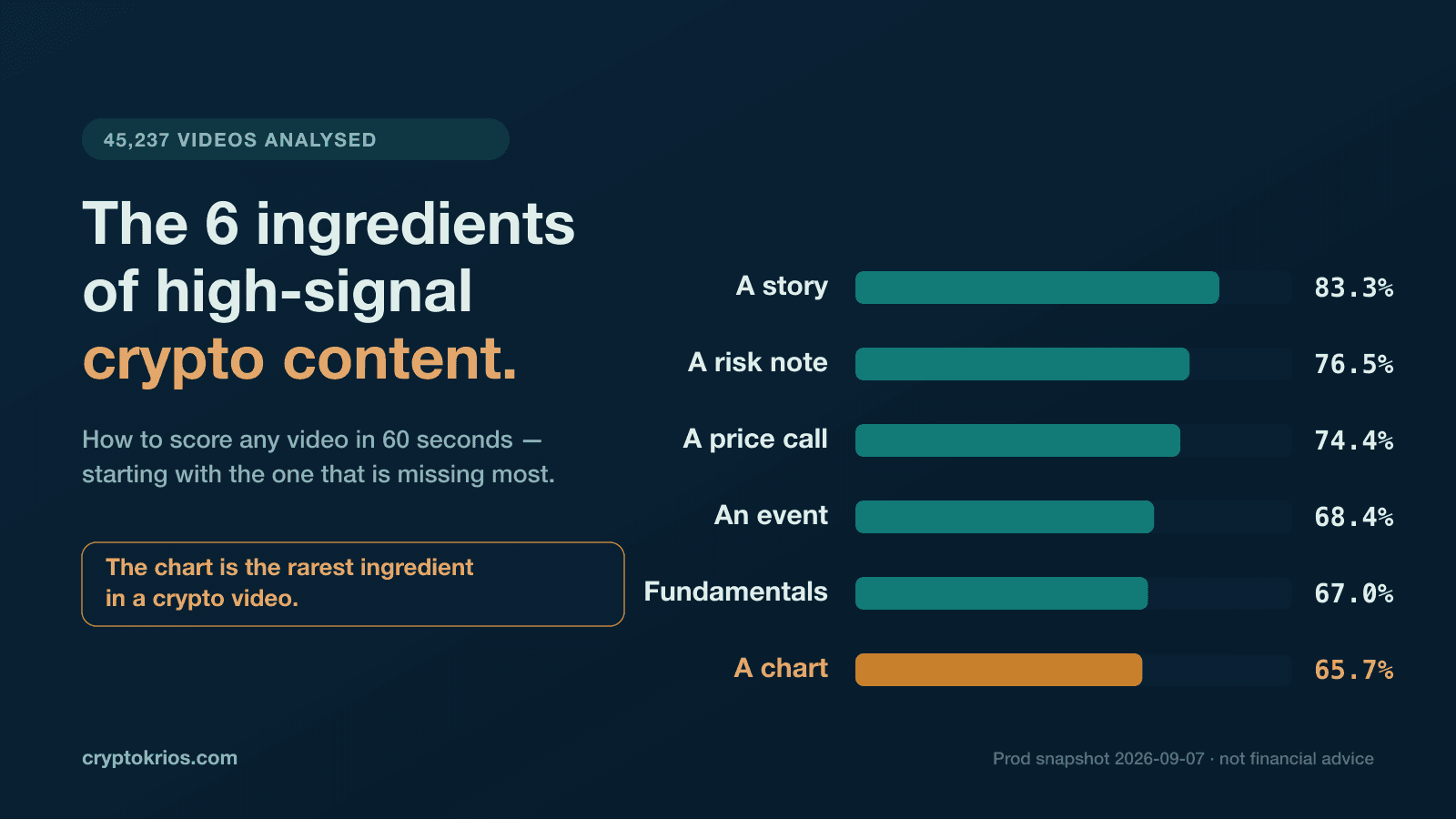
Crypto Content Checklist: The 6 Ingredients of High-Signal Crypto Content (And How to Score a Video in 60 Seconds)
A crypto content checklist you can run in 60 seconds. Learn the 6 ingredients of high-signal crypto videos, backed by analysis of 45,237 videos, plus a simple scoring framework to filter hype fast.

Crypto Creator Correction Policy: A Transparent Template for Updating Forecasts (Without Rewriting History)
A crypto creator correction policy makes forecasts auditable: preserve originals, timestamp revisions, and publish final verdicts. Use this template and checklist to separate transparent analysis from hindsight edits.

Crypto Influencer Due Diligence Checklist (2026): A Practical, Data-Driven Guide for Retail Investors
This crypto influencer due diligence checklist helps retail investors verify claims, assess track records, and spot bias in 2026. Built with real creator-claim data (33,921 tracked claims) and a repeatable scoring system you can use weekly.
Crypto Influencer Conflict of Interest Beyond #ad: 6 Structural Incentives That Aren’t Sponsorships
A crypto influencer conflict of interest often exists without #ad. Here are 6 non-sponsored structural incentives—plus simple public-info checks—to spot bias and predict which claims may disappear.