Which Coins Do Crypto YouTubers Call Best? 17,062 Checked Predictions, Coin by Coin
Which Coins Do Crypto YouTubers Call Best? 17,062 Checked Predictions, Coin by Coin
We have now checked 17,062 price predictions from crypto YouTube against the real price, across 175 assets and 191 channels. Most articles on the subject stop at one global number. Ours is 16.1%: that is the share of calls that landed within 5% of the target.
That single number hides a large gap. A bitcoin call lands far more often than a call on almost anything else, and the further out a call looks, the less likely it is to land at all.
This is not a view on any of these coins. It is a measure of how well the people talking about them hit their own targets.
How a call gets graded
Each prediction carries an asset, a direction, a target and a horizon. When the horizon arrives, it receives one of three verdicts:
- HIT: right direction, within 5% of the target.
- PARTIAL: right direction, between 5% and 20% off.
- MISS: wrong direction, or 20% or more off.
Across the 17,062 calls: 2,748 HIT (16.1%), 3,911 PARTIAL (22.9%) and 10,403 MISS (61.0%). Calls with no numeric target cannot be graded and are not in these figures, and neither are the 12,584 predictions still open.
The table, coin by coin
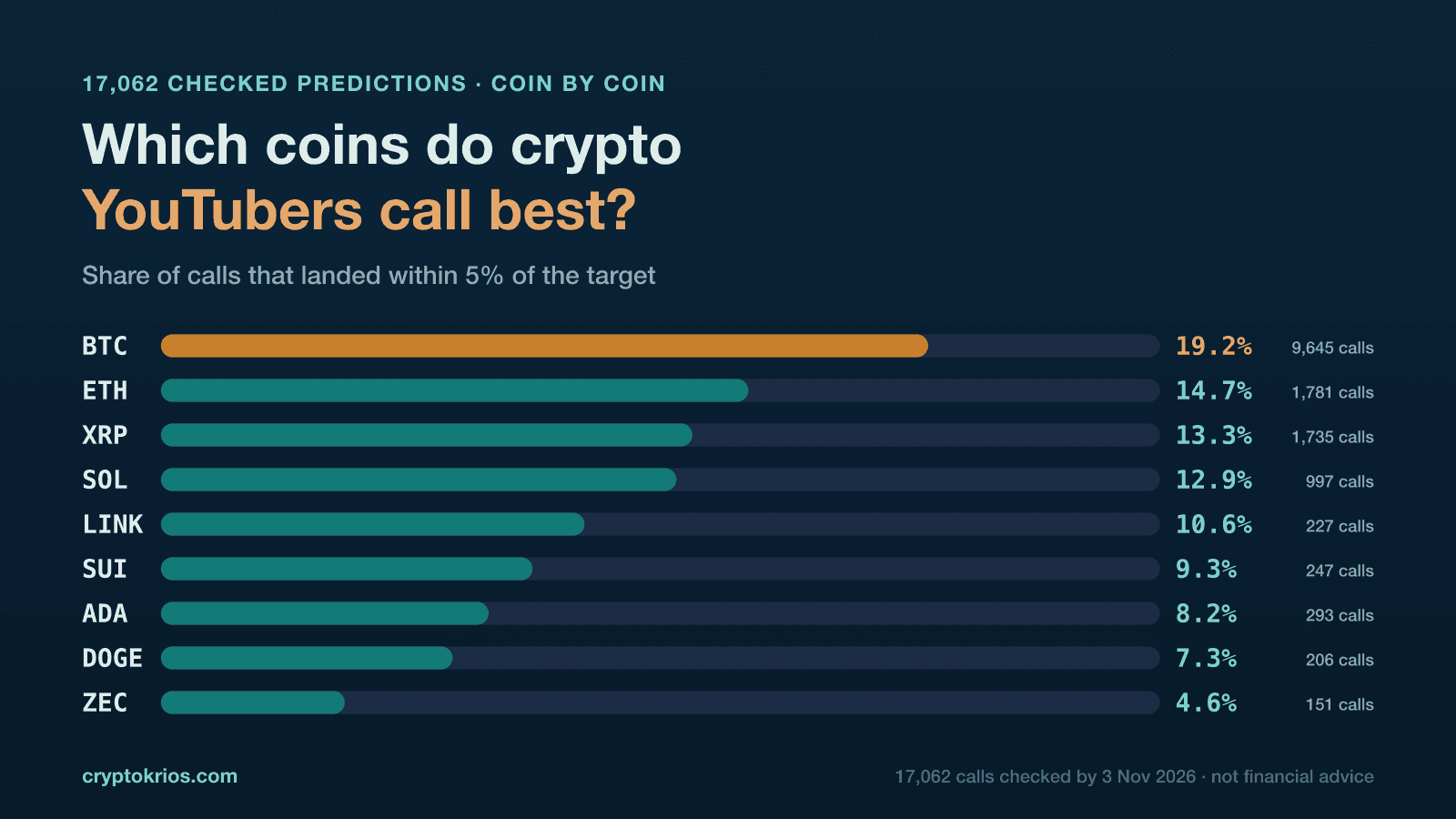
These are the nine assets with at least 150 checked calls.
| Coin | Checked calls | HIT rate | MISS rate | HIT rate, short-term calls only |
|---|---|---|---|---|
| BTC | 9,645 | 19.2% | 53.6% | 24.7% |
| ETH | 1,781 | 14.7% | 64.1% | 19.4% |
| XRP | 1,735 | 13.3% | 72.5% | 17.9% |
| SOL | 997 | 12.9% | 64.3% | 15.6% |
| LINK | 227 | 10.6% | 78.0% | 14.9% |
| SUI | 247 | 9.3% | 74.9% | 12.2% |
| ADA | 293 | 8.2% | 74.4% | 11.7% |
| DOGE | 206 | 7.3% | 71.4% | 9.5% |
| ZEC | 151 | 4.6% | 80.8% | 5.0% |
The 166 smaller assets with under 150 checked calls add up to 1,780 calls, with a 10.3% HIT rate and a 75.4% MISS rate.
All predictions checked by 3 November 2026.
What stands out
Bitcoin is more than half the record
Bitcoin alone accounts for 9,645 of the 17,062 checked calls, or 56.5%. Every other asset together makes 7,417, with a 12.1% HIT rate against 19.2% for bitcoin. So the global 16.1% is largely a bitcoin number. On an altcoin, the honest starting assumption is lower.
The gap survives when you compare like with like
Bitcoin calls could simply be shorter, and short calls do better. That is not the explanation. The right-hand column keeps only short-term calls, and the order barely changes: 24.7% on BTC, 19.4% on ETH, 9.5% on DOGE, 5.0% on ZEC.
Why would that be?
This part is our reading, not a measurement. A 5% band is a much harder target on a coin that can move 15% in a day. Bitcoin also has more liquidity and far more attention, which leaves fewer ways for a price to behave strangely. Size of coverage may play a part too, since experienced analysts spend most of their time on BTC. We have not separated these effects.
Whatever the cause, the practical point holds. The same creator, with the same confidence, is probably giving you a less reliable number when the conversation moves from bitcoin to a small asset.
XRP is the outlier among the large coins
XRP has about as many checked calls as ETH, and a similar HIT rate. Its MISS rate is much higher: 72.5% against 64.1%. Fewer of its calls end up close without landing. Horizon does not explain it: among short-term calls alone, 63.5% of XRP calls missed against 52.3% for ETH. We do not have a cause yet, so we will not guess at one here.
Time matters more than the coin
The horizon of a call changes the odds more than anything else in our data.
| Horizon | Checked calls | HIT rate | MISS rate |
|---|---|---|---|
| Short term | 11,975 | 20.8% | 51.5% |
| A specific date | 244 | 10.2% | 77.9% |
| Medium term | 3,852 | 5.8% | 80.4% |
| Long term | 991 | 0.8% | 95.8% |
Out of 991 long-term calls that have reached their date, 8 landed within 5% of the target, 34 came within 20%, and 949 missed.
The grade is strict, and the sample is not everyone's long-term call: it only holds those that were specific enough to grade and old enough to come due. Still, it is the sharpest figure we have. When someone gives you a price for two years from now, you are hearing a story with a number in it. That can still be a useful story. The number is the part to hold loosely.
How to use this
- Adjust for the coin. A creator's overall record is mostly a bitcoin record. Check how they do on the asset you care about before you trust a call on it.
- Adjust for the horizon. Treat a next-week target and a 2028 target as two different claims, even from the same person.
- Look at the MISS rate too. A PARTIAL still got the direction right. A high MISS rate tells you the call was far off or wrong, which is what actually costs money.
- Ask what happens if it fails. The most useful videos we score say what would prove them wrong. Our Q3 2026 leaderboard shows who has held up best, and The Checkability Gap explains why so many calls can never be graded.
On CryptoKrios, every creator's page shows their prediction record. Create a free account to look up the channels you watch.
CryptoKrios provides analytics and insights for informational purposes only. This is not financial advice, and nothing here is a view on the future price of any asset. Always do your own research before making investment decisions. Analysis is based on publicly available data. AI extraction is imperfect, and figures change as predictions come due. Data as of 3 November 2026.
Discover what crypto influencers really say
Get AI-verified analysis of top crypto content creators — free.
Try CryptoKrios FreeRelated Articles
Crypto Influencer Accuracy Tracker: How to Build a Receipts-First Watchlist (with 3 Scoring Rules)
A crypto influencer accuracy tracker only works if it’s receipts-first. Learn 3 scoring rules—falsifiability, normalization, and sample-size weighting—to build a watchlist you can defend with data.
Crypto Influencer Trust Score: 13 Indicators That Predict Reliability (2026)
CryptoKrios breaks down the crypto influencer trust score (0–10) using 13 explainable indicators. Learn how to read reliability signals, avoid hype targets, and pair trust scoring with verified prediction tracking in 2026.
DeFi Basics for Crypto Twitter: Liquidity, Fees, and Why “TVL Up” Can Mislead
DeFi basics for Crypto Twitter: learn what liquidity and fees really measure, and why “TVL up” can rise from price moves, double-counting, or mercenary incentives. Use a fast reality-check framework to avoid hype-driven decisions.
Crypto Portfolio Risk Basics: Position Sizing, Correlation, and Drawdown (For People Who Follow Accounts Online)
If you follow crypto accounts online, risk discipline matters more than the next “10x” call. Learn crypto position sizing, correlation traps, and drawdown math—plus a simple weekly routine to stay consistent.