
Which Crypto Assets YouTube Talked About Last Week, and Which It Dropped
Which Crypto Assets YouTube Talked About Last Week, and Which It Dropped
Two weeks ago, 41 crypto YouTube channels talked about Quant (QNT). Last week, 16 did. Nothing in our data says what QNT is worth, and this article will not either. What the data does show is how fast attention moves on crypto YouTube, and how little of the market it actually moves through.
This is crypto narrative rotation seen from the coverage side: which assets the channels talked about, week after week, and which ones they let go.
How we count
Every time a creator names an asset and takes a stance on it, we record one asset call. We group calls by the week the video was published and compare three weeks:
| Videos published | Asset calls | Channels | Different assets |
|---|---|---|---|
| 21–27 September | 2,547 | 142 | 429 |
| 28 September – 4 October | 2,208 | 137 | 358 |
| 5–11 October | 2,050 | 132 | 357 |
The last week is still being analysed, so its totals will rise a little over the next days (they already did between Monday and today). The movements below are large enough that this does not change them.
The core does not rotate
Four assets take about two calls in five, every week:
| 21–27 Sep | 28 Sep – 4 Oct | 5–11 Oct | |
|---|---|---|---|
| BTC | 411 | 337 | 332 |
| XRP | 273 | 227 | 209 |
| ETH | 217 | 174 | 174 |
| SOL | 162 | 135 | 132 |
| Share of all calls | 41.7% | 39.5% | 41.3% |
When people talk about narrative rotation, they usually mean something is replacing Bitcoin and Ethereum in the conversation. On crypto YouTube, that is not what happens. The top four hold their share almost to the decimal point. The rotation happens in the next tier down, and it is fast.
The spike: QNT
| 21–27 Sep | 28 Sep – 4 Oct | 5–11 Oct | |
|---|---|---|---|
| QNT calls | 26 | 96 | 37 |
| Channels | 14 | 41 | 16 |
The peak came on a single day: on 28 September, 21 channels named QNT. By the end of that week the daily count was back to about eight, and the week after it settled around five.
Titles that week led with how far QNT had already moved, and a second wave of videos asked which coin would follow. Most of that coverage was reporting a move that had already happened.
Then it left. Of the 41 channels that named QNT in the spike week, 27 did not name it the following week. And 23 of those 27 were still publishing and still making calls on other assets. They did not go quiet. They moved on.
The passengers: HBAR and friends
A spike does not stay on one asset. The "which coin is next" videos carry other names with them, and those names rise and fall on the same rhythm:
- HBAR: 24 calls → 55 → 22
- AAVE: 5 → 22 → 10
- XLM: 33 → 42 → 30
HBAR is the clearest case. In its busy week, only 12 of its 55 calls came from a video with HBAR or Hedera in the title. Most of the time it was named in passing, in a list of what might run next. Last week, five channels made 77% of the calls it still got.
Not everything that faded was a passenger. NEAR (71 → 59 → 39), ZEC (64 → 57 → 39) and LINK (47 → 53 → 35) slid more slowly, over two weeks rather than one.
The return: ADA
The largest gain last week was Cardano: 45 calls from 22 channels, up from 20 calls the week before. Two weeks earlier it had 33, so this looks more like a return than a new story.
The title test matters here too. Only 5 of ADA's 45 calls came from a video with ADA or Cardano in the title. Most came from Bitcoin and market-update videos that ran through a list of coins. Compare Bitcoin itself: 206 of its 332 calls came from videos that named it in the title.
A call count does not tell you whether an asset was the subject of a video or one name in a list.
The long tail
Last week, 357 different assets were named. 202 of them were named exactly once. 234 were named by a single channel. The rotation we can see happens among about twenty assets, and almost everything else is a one-off.
That matters when a video tells you "everyone is talking about" a coin. In each of these three weeks, everyone was talking about Bitcoin, XRP, Ethereum and Solana, and a handful of channels were talking about one other asset at a time.
How to read a rotation
1. Check the channel count, not the call count. Fifty calls from ten channels is a few voices repeating themselves. Fifty calls from forty channels is a real shift in the conversation.
2. Check whether it is in the title. An asset in the title is the subject of the video. An asset in a list of "what's next" is a passenger, and passengers leave first.
3. Look at the week before and the week after. QNT's spike lasted about a week. If you only see the busy week, it looks like the start of something. Seen across three weeks, it looks like every other spike.
4. Ask whether the coverage reports a move or predicts one. Most of the QNT videos came after the move. A wave of coverage often tells you what already happened, not what will.
What this does not say
- It is not a view on any asset. A drop in calls says the channels moved on. It says nothing about the asset itself, and we do not make price predictions.
- It does not judge the channels. Covering what is moving is what most market channels do. This article names no channel, on purpose.
- It is a snapshot. Figures cover videos published from 21 September to 11 October, as analysed by 14 October. Later analysis will move the last week slightly.
- It is AI extraction. Calls are read from transcripts by a model. A passing mention can be recorded as a call, and a hedged one can be tagged neutral.
Try CryptoKrios free to see which assets the channels you watch are calling this week, how many channels are behind each one, and how their videos score. https://cryptokrios.com/free
Trust scores, video scores and call extractions are AI analyses of public content. They describe what was said, not what will happen next. Nothing in this article is financial advice. Always do your own research.
Discover what crypto influencers really say
Get AI-verified analysis of top crypto content creators — free.
Try CryptoKrios FreeRelated Articles
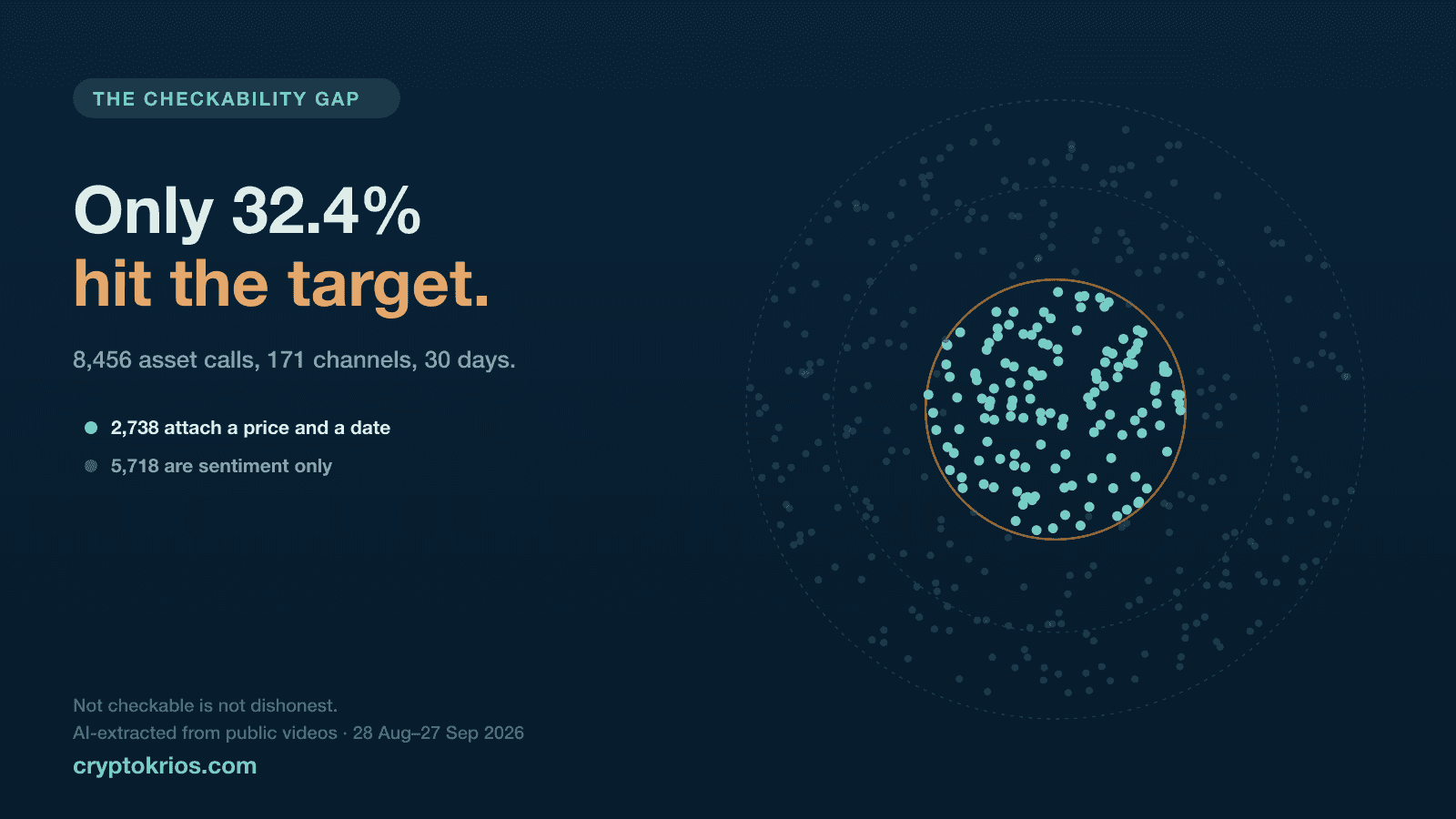
The Checkability Gap: Why Most Crypto Calls Can Never Be Graded
Of 8,456 crypto asset calls in 30 days, only 32.4% attach a target price and a target date — the two things that make a claim checkable. Here's what that gap means, and doesn't.
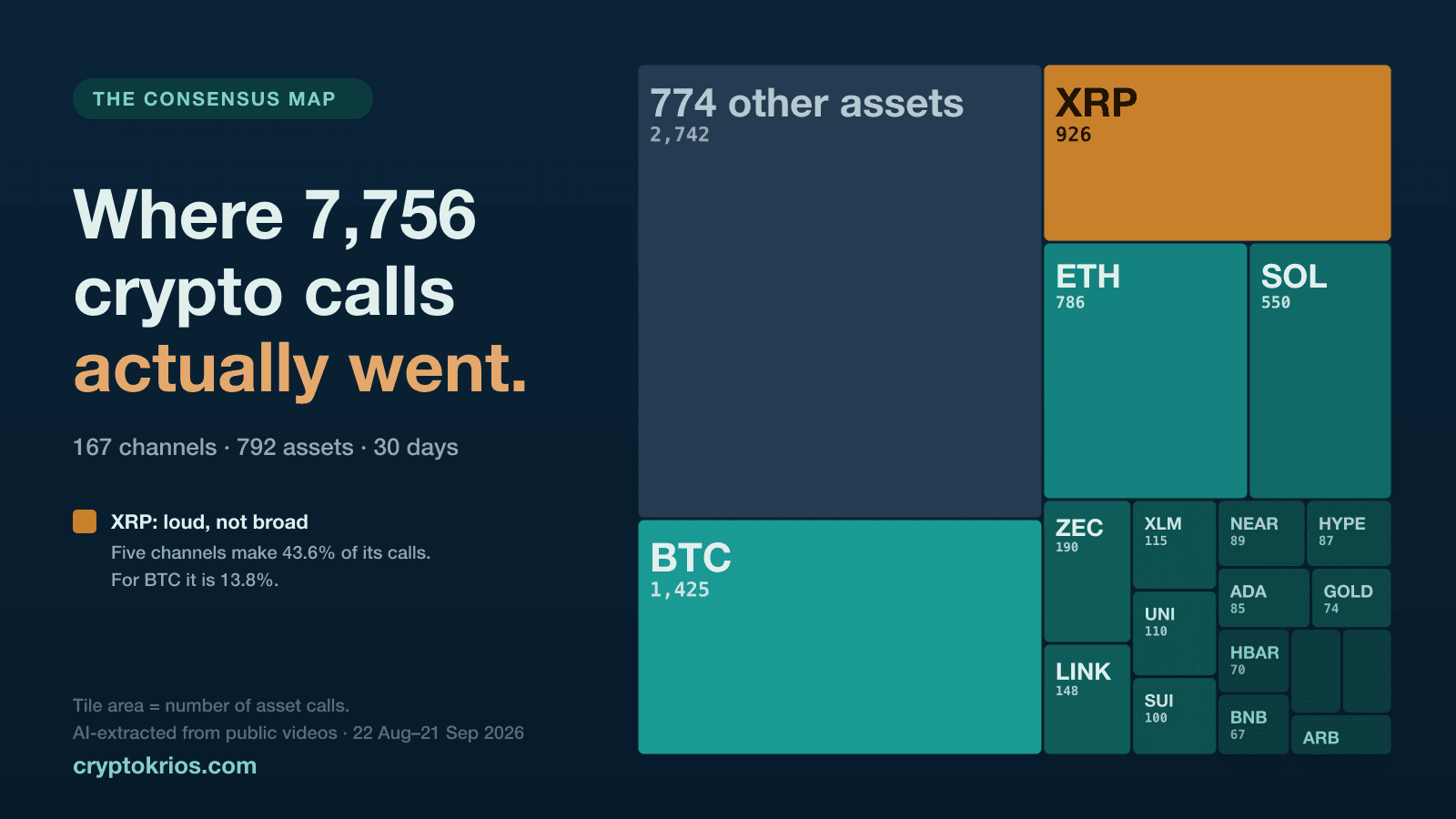
The Consensus Map: What 167 Crypto Channels Actually Recommended in 30 Days
We extracted 7,756 asset recommendations from 167 crypto YouTube channels in 30 days. Four assets take 47.5% of the calls, 478 were named once, and bullish outnumbers bearish 15.7 to 1.
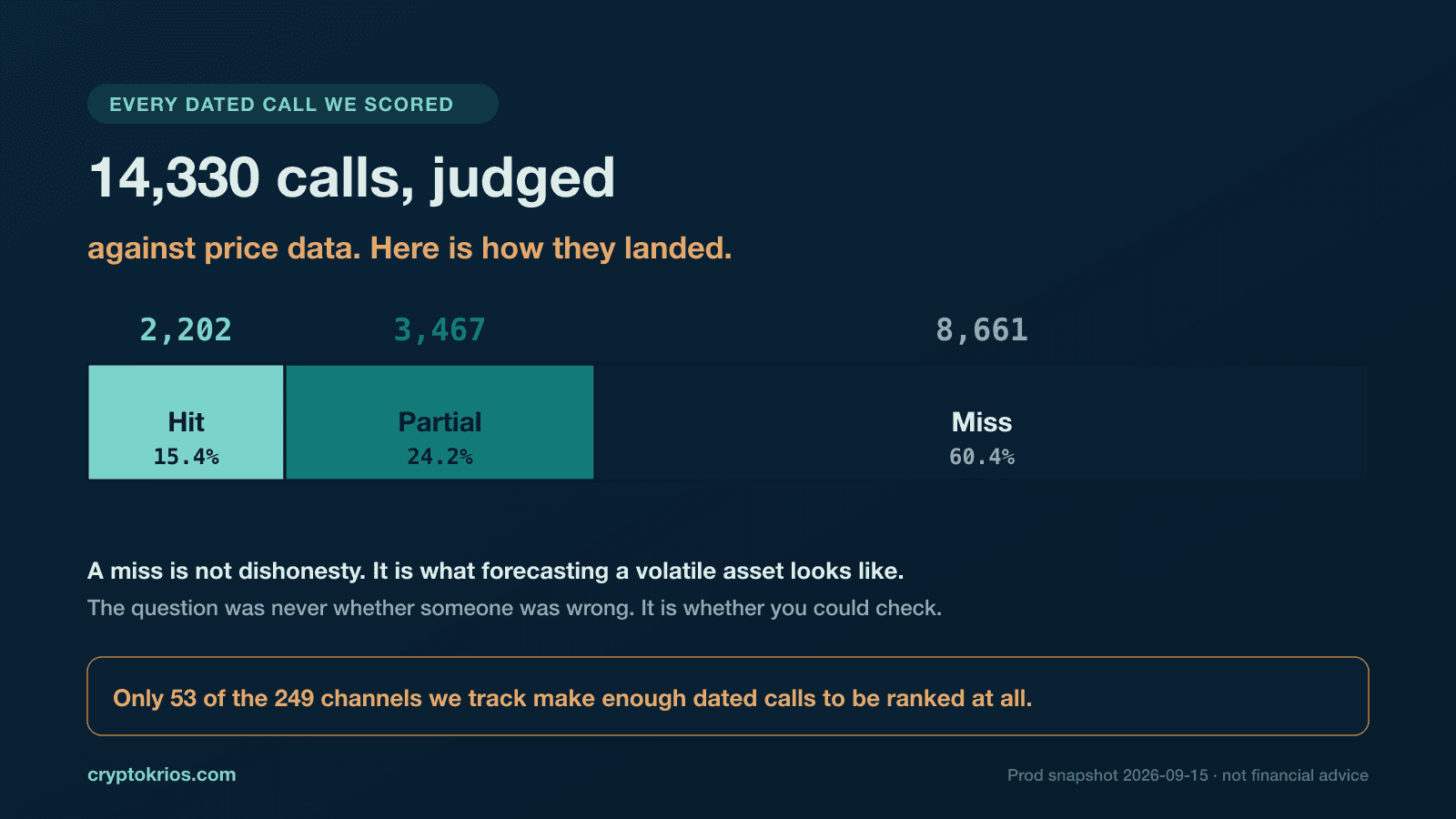
What 14,330 Judged Crypto Predictions Say About Following Anyone's Calls
We judged 14,330 crypto predictions against price data. The best creator hits 32.3%—remarkable vs a 15.4% baseline. The real finding: only 53 of 249 channels make enough dated calls to be rankable.