How We Score a Crypto YouTuber: The 13 Indicators Behind a Trust Score
How We Score a Crypto YouTuber: The 13 Indicators Behind a Trust Score
A crypto youtuber trust score should help you answer one question: “Is this creator worth my attention?” Not “what should I buy,” and not “is this person a saint.” Just: how reliable is their content based on what they’ve publicly published?
At CryptoKrios, we built our scoring system because investors don’t have time to watch everything, cross-check every claim, and decode every sponsorship angle. We track 244 YouTube channels, and 236 currently have a completed AI rating. Across those 236, the average overall trust score is 7.60/10, and the combined tracked audience is 70.6 million subscribers.
This article explains the 13 indicators behind the score (and what they do not mean), using verified platform-level stats from CryptoKrios production data as of 2026-09-13.
What a “crypto youtuber trust score” is (and what it isn’t)
A crypto youtuber trust score is an AI judgement of a creator’s public content—primarily video transcripts, channel metadata, and engagement patterns. It’s designed to summarize quality signals that matter when you’re deciding who to listen to.
Here’s what it is not:
- Not an audit. We don’t verify wallets, bank statements, private trades, or off-platform deals.
- Not a fraud finding. A low score isn’t an accusation.
- Not a guarantee of future performance. Even high-quality creators can be wrong.
We also don’t treat the score as a permanent label. Ratings are versioned—each re-evaluation creates a new row with an incremented version number. That means the score is a snapshot that can move as the channel’s behavior changes.
Why 13 indicators instead of one “vibe check”
Influencer trust isn’t one-dimensional. A creator can be technically sharp but overly promotional. Another can be educational but inconsistent. So we score multiple indicators and roll them into an overall trust score.
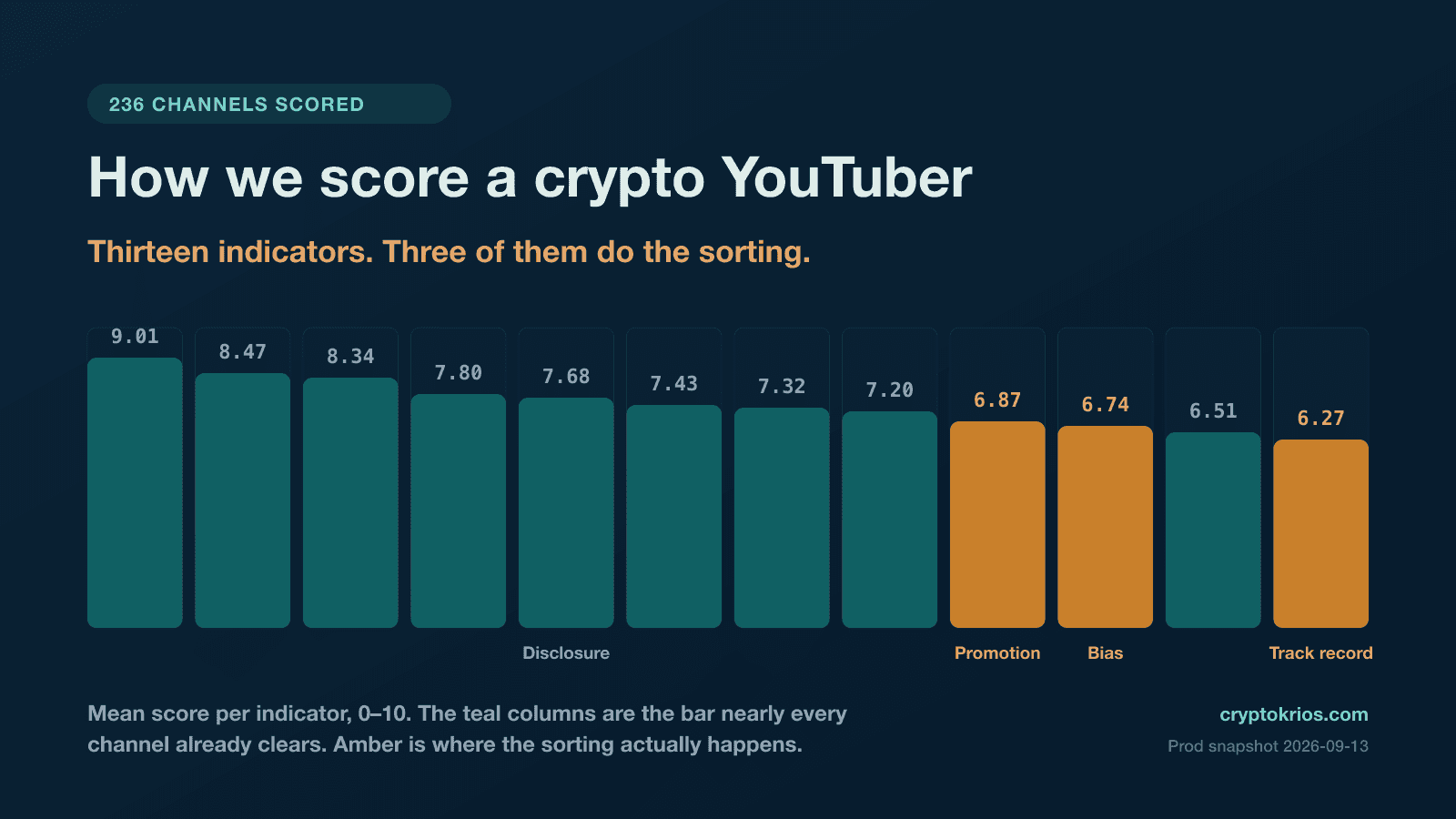
Across the 236 latest ratings, these are the mean scores (0–10) per indicator (higher is better):
- contentConsistency: 9.01 (only 2 of 236 score ≤5)
- marketKnowledge: 8.47 (8 at ≤5)
- educationalValue: 8.34 (12 at ≤5)
- technicalExpertise: 7.80 (18 at ≤5)
- disclosurePractices: 7.68 (24 at ≤5)
- videoQuality: 7.43 (10 at ≤5)
- researchQuality: 7.32 (28 at ≤5)
- fundamentalExpertise: 7.20 (35 at ≤5)
- promotionPractices: 6.87 (50 at ≤5)
- biasLevel: 6.74 (48 at ≤5)
- viewVideoPerSubscribers: 6.51 (33 at ≤5)
- trackRecord: 6.27 (43 at ≤5, of which 15 score ≤5 on a stricter 0–5 band)
- channelDescription: 4.41 (we exclude this from ranking; more on that below)
Those numbers tell a story. The “craft” and “knowledge” indicators trend high. The hardest areas—on average—are track record, bias, and promotion practices. That aligns with reality: it’s much easier to sound smart than to be consistently accountable.
The 13 indicators: what we measure, what “good” looks like, and where channels struggle
A crypto youtuber trust score is only useful if it’s explainable. Below is what each indicator aims to capture, and how to interpret it.
1) Content consistency (mean 9.01)
This looks at publishing regularity and sustained activity. Consistency matters because sporadic posting can lead to cherry-picked hindsight content.
- Platform signal: only 2 of 236 channels score ≤5, meaning most tracked creators are reliably active.
- Important caveat: consistency can reward volume. A high score doesn’t automatically mean high insight.
2) Market knowledge (mean 8.47) and 3) Educational value (mean 8.34)
These measure whether content reflects real market awareness and whether the creator teaches clearly.
- Only 8 channels score ≤5 for market knowledge.
- Only 12 score ≤5 for educational value.
Interpretation: viewers generally get decent “market literacy” from the YouTube ecosystem—at least in presentation and framing.
4) Technical expertise (mean 7.80) and 5) Fundamental expertise (mean 7.20)
We separate these because TA fluency and fundamentals are different skills.
- Technical expertise: charting concepts, structure, risk tools, and technical language.
- Fundamental expertise: token mechanics, business models, on-chain narratives, macro linkages.
The spread matters. Fundamentals are harder to do well at scale, which matches the lower mean (7.20) and higher count of low scores (35 at ≤5) compared to technical expertise (18 at ≤5).
6) Research quality (mean 7.32)
This captures whether claims are backed by reasoning, sources, or verifiable context—versus pure assertion.
- 28 channels score ≤5, which is a meaningful chunk.
In plain English: a creator can sound confident and still be light on evidence.
7) Video quality (mean 7.43)
This is about clarity, structure, and production basics. It’s not about cinematic editing; it’s about whether the content is understandable.
- Only 10 channels score ≤5.
8) Disclosure practices (mean 7.68)
This measures whether risks, affiliate relationships, and sponsorships are disclosed.
- 24 channels score ≤5.
- The relatively healthy average (7.68) is important because it supports a key point: commercialization isn’t automatically bad if it’s transparent.
Mandatory honesty note: A low promotionPractices score is not evidence of dishonesty. Many strong channels take sponsorships and disclose them—exactly why disclosurePractices is scored separately (and averages 7.68).
9) Promotion practices (mean 6.87) and 10) Bias level (mean 6.74)
These are separate by design.
- Promotion practices focuses on how aggressive and frequent monetization calls-to-action are.
- Bias level estimates how commercial incentives may shape coverage—what gets featured, how alternatives are framed, and whether content feels steered.
This is where the ecosystem struggles most often:
- 50 channels score ≤5 on promotion practices.
- 48 score ≤5 on bias level.
And you can see how the AI explains it in real-world language. Here are live examples from a rating explanation (verbatim):
- promotionPractices 5: “Promotion is frequent and aggressive, with most content encouraging affiliate link usage for access to courses, indicators, and bonuses. While not scammy, this commercial push is a concern for impartiality.”
- biasLevel 6: “moderate commercial bias due to the frequent, incentivized promotion of [exchanges]. Access to tools and courses is gated behind affiliate actions and trading volume.”
- disclosurePractices 8: “Risks are disclosed, especially regarding leverage and futures. Affiliate relationships are clear, but the heavy promotion could be more balanced.”
Notice what this does and doesn’t say. It doesn’t claim fraud. It highlights incentive pressure.
11) Views per video per subscribers (mean 6.51)
This is an engagement efficiency signal. It helps detect channels with inflated subscriber counts relative to current attention.
- 33 channels score ≤5.
This is not a moral judgement. It’s a signal about how “alive” the audience is.
12) Track record (mean 6.27)
Track record is hard. It’s easy to make predictions; it’s harder to revisit them transparently.
- 43 channels score ≤5, and 15 score ≤5 on a stricter 0–5 band.
A high score can still be nuanced. Example AI explanation (verbatim):
- trackRecord 8: “The creator references personal trading history and decisions, explaining past actions and outcomes. There is transparency in discussing mistakes, but no formal audited track record is presented.”
That’s the point: we can reward transparency without pretending it’s audited.
13) Channel description (mean 4.41) — why we exclude it from ranking
This indicator measures channel metadata completeness and clarity. It’s useful for UX and context, but it’s not editorial behavior.
We also exclude it from ranking because several ratings carry -1 placeholders, and the signal can penalize strong creators who simply don’t optimize their “About” section.
So: we track it, but we don’t treat it as a trust-defining factor.
The “size myth”: big audiences don’t protect you from bias or aggressive promotion
A common investor mistake is outsourcing trust to subscriber counts. “They have a huge channel, so they must be legit.” Data doesn’t support that.
In our tracked set of 236 rated channels, 38 channels score at or below 5 on both promotionPractices and biasLevel.
Here’s the key insight: those 38 channels are not “tiny unknowns.” Their audience sizes are similar to everyone else.
- Median subscribers (low promo + low bias group): 102,650
- Median subscribers (other 198 channels): 105,500
- Mean subscribers (low promo + low bias group): 246,310
- Mean subscribers (other 198 channels): 289,285
- Average trust score (low promo + low bias group): 5.97
- Average trust score (other 198 channels): 7.91
- Largest channel within the low promo + low bias group: 1,400,000 subscribers
That’s the “size myth” in one table: subscriber count isn’t a safety filter.
What should you do instead?
- Use subscriber count for reach context, not credibility.
- Look at how the creator monetizes (promotionPractices), and how much the monetization shapes the narrative (biasLevel).
- Cross-check whether disclosures are clean (disclosurePractices) even when promotion is heavy.
This is exactly why a crypto youtuber trust score needs multiple indicators. A single metric will always be gamed.
How the scoring actually works (versioned ratings, public evidence, and explainable outputs)
CryptoKrios ratings come from AI analysis of publicly available content:
- Video transcripts
- Channel metadata
- Engagement patterns
Each channel can also be tagged by specialties, so comparisons stay fair (e.g., TA-heavy creators vs macro educators). The goal is not to force everyone into one “style.” It’s to score quality within the style they publish.
Versioned snapshots: trust is dynamic
Every time we re-evaluate a channel, we store a new rating row with an incremented version number. That means:
- A creator can improve and see it reflected.
- A creator can drift into heavier promotion or lower research quality, and the score can decline.
- Users aren’t stuck with a label from six months ago.
This matters because influencer behavior changes fast in crypto—especially when markets heat up.
Explainability: the “why” behind the number
A score without reasons is just authority theater. So our system produces indicator-level breakdowns and explanation text like the examples shown earlier.
The objective is transparency: you should be able to look at the score, see which indicator is dragging it down (trackRecord vs promotion vs research), and then decide what you personally can tolerate.
How to use the trust score in your own workflow
A practical way to use a crypto youtuber trust score is to treat it as a triage system:
- Start with overall trust score to shortlist creators.
- Check the lowest 2–3 indicators to see the “failure mode.”
- Decide your personal red lines (for example, low disclosure is a hard no; low video quality is tolerable).
- Diversify your inputs: follow multiple creators with different strengths instead of relying on one voice.
Important: none of this claims that higher indicator values cause better investment outcomes. It’s about improving the information environment you make decisions in.
Limits of the method (what we can miss, and how to interpret edge cases)
If you’re going to rely on a crypto youtuber trust score, you deserve the limitations up front.
1) AI judgement is fallible
Even good models can misread sarcasm, context, or creator intent. They can also overweight repeated patterns in transcripts.
That’s why we emphasize indicator breakdowns and explanation text—not just a single number.
2) Versioned scores move (and they should)
Because scores are snapshots, a channel can look better or worse depending on recent content. That’s a feature, not a bug—but it means you should treat the score as “current read,” not a permanent certificate.
3) Small channels have thinner evidence
New or small creators may have fewer transcripts and fewer patterns to evaluate. That can reduce confidence in certain indicators—especially ones like trackRecord that require time.
4) Consistency scoring rewards volume
A creator who posts frequently has more opportunities to look “consistent.” Meanwhile, a thoughtful creator who posts less often could score lower on consistency even if their research is excellent.
That’s why you should never use a single indicator alone.
5) No causation claims
We do not claim that any indicator (or the overall score) causes better returns or better investment outcomes. We’re measuring content quality signals, not predicting your PnL.
Conclusion: trust comes from signals, not vibes
The crypto content space is huge: CryptoKrios alone tracks 244 YouTube channels, with 236 already AI-rated and a combined audience of 70.6M subscribers. In that environment, “just follow the biggest creator” is not a strategy.
A crypto youtuber trust score is our way of turning messy, time-consuming qualitative judgement into a transparent, explainable system—built from 13 indicators, with clear tradeoffs between education, research, promotion intensity, bias risk, and track record transparency.
If you want to filter noise faster and follow creators with more confidence, create a free account and explore the indicator breakdowns yourself.
Try CryptoKrios for free: https://cryptokrios.com/free
Discover what crypto influencers really say
Get AI-verified analysis of top crypto content creators — free.
Try CryptoKrios FreeRelated Articles
Story vs Charts in Crypto YouTube: When Narrative Helps (and When It Replaces Analysis)
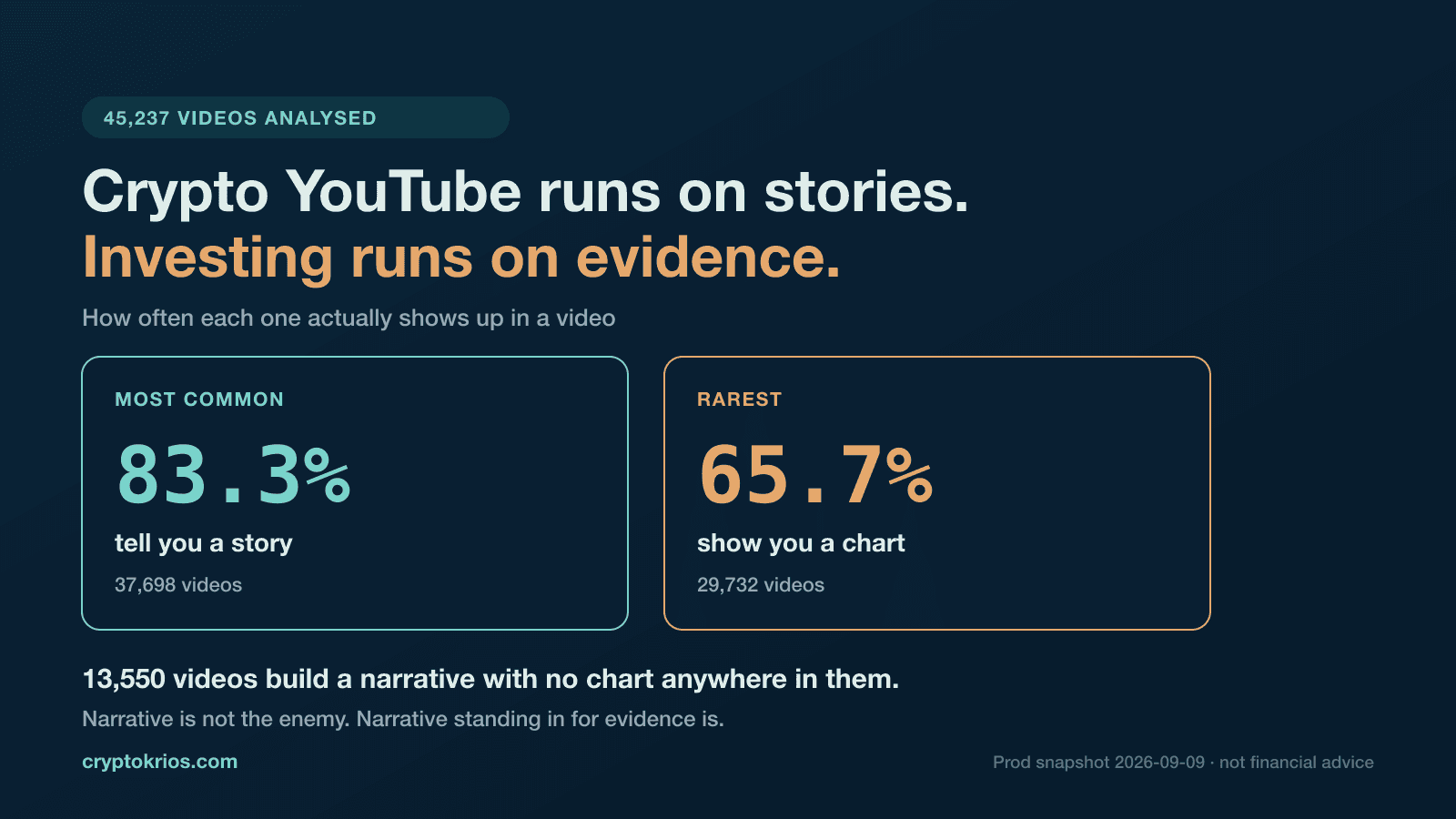
CryptoKrios analyzed 45,237 crypto videos: stories appear in 83.3%, but crypto youtube technical analysis (charts) shows up in only 65.7%. Learn a simple test for when narrative supports a thesis—and when it replaces evidence.

The Partial Crypto Prediction Playbook: How Grey-Zone Calls Become “Wins” (and How to Audit Them)
A partial crypto prediction means the direction was right but the target price was wrong. Using CryptoKrios data (2026-08-24), we show how partials get marketed as wins—and a practical audit you can apply to any creator.

Crypto Influencer Sponsorship Disclosure: Sponsored vs Organic Crypto Content (A Practical Bias Checklist + Examples)
A practical, example-driven crypto influencer sponsorship disclosure checklist to spot sponsored bias fast. Includes red-flag vs responsible wording, what disclosures miss, a 2-minute verification protocol, and a before/after script rewrite.

Crypto Influencer Bias Detection: 7 Content Patterns That Correlate With Low Accuracy
Crypto influencer bias detection helps you separate analysis from incentives. Learn 7 bias patterns that correlate with lower accuracy—and the self-checks you can run to vet any creator fast.