
The Partial Crypto Prediction Playbook: How Grey-Zone Calls Become “Wins” (and How to Audit Them)
The Partial Crypto Prediction Playbook: how grey-zone calls become “wins” (and how to audit them)
A partial crypto prediction is the most common grey zone in influencer-style crypto analysis: the direction was right, but the number was not. That sounds harmless—until a near-miss gets packaged as a clean “called it ✅” win.
At CryptoKrios, we track predictions at scale so you don’t have to rely on vibes, editing, or selective memory. This article is a playbook for understanding how partials happen, why they get over-credited, and how to audit them fairly (including creators you genuinely like).
Data source: Every figure below comes from the CryptoKrios production database, snapshot 2026-08-24.
The reality check: what our database says about verified hits vs partial crypto prediction outcomes
Crypto debates often treat “being right” as binary. Our data shows it’s not—especially once you separate target price accuracy from directional accuracy.
Across CryptoKrios we’ve tracked 35,597 predictions from 199 YouTube accounts. Their current status split is:
- PENDING: 10,945 (30.7%)
- EXPIRED: 13,854 (38.9%)
- VERIFIED: 10,798 (30.3%)
The audit starts with the 10,798 verified predictions, because only those can be scored against an outcome. Here’s the verified breakdown:
- VERIFIED_HIT: 1,652 (15.3% strict hit rate)
- VERIFIED_PARTIAL: 2,634 (24.4%)
- VERIFIED_MISS: 6,512 (60.3%)
Now zoom in on the core of this article: the partial crypto prediction bucket.
In our verification notes, all 2,634 partial rows are “Direction: correct.” But they missed the stated target price by 5.0% to 20.0%, with an average deviation of 10.7%.
So a partial is precise:
- Direction was right ✅
- Target price was wrong ❌
- Missed by 5%–20% (avg 10.7%)
This is not a moral judgment. A partial can be an honest near-miss. The problem starts when the marketing treats a partial crypto prediction like a strict hit.
Why does that matter? Because the “direction-only” story is much easier to sell than “I nailed the number.”
The direction trap: why “called the move” inflates wins (and why partial crypto prediction marketing works)
If there’s one pattern that converts grey-zone outcomes into perceived wins, it’s what we call the direction trap: audiences are encouraged to grade a call on up vs down even when the creator explicitly stated a target price.
Our database quantifies that trap.
Among the 6,512 verified misses, there are 1,881 that also had the direction right—they just deviated by more than 20%.
Combine those 1,881 with the 2,634 partials:
- Direction right (verified): 6,167 of 10,798 (57.1%)
- Target price hit (strict): 1,652 of 10,798 (15.3%)
That’s a 41.8-point gap between being directionally right and being right.
This gap is the space where a partial crypto prediction gets turned into a “win.” It usually happens through one (or several) of these reframes:
- Target amnesia: the audience remembers “up soon” and forgets “to $X.”
- Screenshot selection: a chart moment near the target is captured, even if the target was never reached.
- Language drift: “I said we’d push toward $X” becomes “I called $X.”
- Goalpost nudging: the original target is later described as “conservative,” “first level,” or “one of the scenarios.”
Here’s the key statistical reason this works: direction alone is weak evidence. An asset can only go up or down, so direction can trend toward a coin flip. Directional correctness (57.1%) can look impressive in a montage, but it is not the same as target accuracy (15.3%).
That doesn’t mean directional analysis is worthless. It means directional correctness should not be marketed as price-target correctness—and you shouldn’t internalize it as such when choosing who to trust.
If you want a quick mental model:
- A creator who is often “right on direction” may still be unreliable on actionable levels.
- A creator who rarely specifies levels may still look “right” in hindsight.
- A creator who uses precise targets and timeframes makes themselves easier to audit (which is a good sign).
A partial crypto prediction is not necessarily bad. But if partials are consistently presented as hits, the audience is trained to overestimate skill.
The unresolved-call loophole: how open-ended predictions stay PENDING and avoid losing
Auditing partial crypto prediction outcomes is only half the battle. The other half is recognizing when calls never resolve at all.
In our data, PENDING predictions are not a small edge case. They are 10,945 predictions, or 30.7% of everything we track.
The bigger issue is why they remain pending.
- 9,999 of 10,945 PENDING predictions (91.4%) carry no target date at all.
That means they can’t expire against a deadline, so they can’t be scored on timeliness. And this creates a hidden scoring reality:
- Exactly zero PENDING calls are overdue because almost none have a deadline to be overdue against.
This doesn’t prove bad faith. Many creators genuinely prefer thesis-based, longer-horizon commentary. But from an accountability standpoint, open-ended calls create an incentive:
- If the market eventually moves your way, you can claim you were early.
- If it never moves your way, there’s no clear moment where the call “failed.”
This is the same mechanism that makes a partial crypto prediction easy to promote. Both rely on flexible grading:
- Partials rely on grading direction over target.
- Open-ended calls rely on grading “eventually” over time-bounded outcomes.
CryptoKrios also tracks prediction horizons across the whole dataset:
- SHORT_TERM: 18,807
- MEDIUM_TERM: 8,976
- LONG_TERM: 7,162
- SPECIFIC_DATE: 652
Notice how small the SPECIFIC_DATE bucket is relative to the rest. When a creator gives a specific date, they create a hard accountability boundary. When they don’t, the prediction becomes harder to falsify.
If you’re building a watchlist of voices you want to learn from, one of the highest-signal questions is:
Do they make claims that can cleanly resolve as hit, partial, miss, or expired?
A creator can be brilliant and still be vague. But vagueness makes trust harder to earn and easier to fake.
The Partial Call Playbook: a practical audit you can run on any creator you like
This section is designed to be creator-neutral. Don’t use it to “dunk” on someone. Use it to protect your attention and calibrate how much weight you give a partial crypto prediction.
1) Write down the call as stated (not as remembered)
Your brain will compress details into “bullish” or “bearish.” Don’t let it.
Capture:
- Asset
- Direction
- Target price
- Time horizon or date (if any)
- Conditions (“if BTC holds X,” “if volume returns,” etc.)
Why it matters: our verified data shows a wide gap between direction being right (57.1%) and target accuracy (15.3%). If you only record direction, you’ll accidentally grade like a highlight reel.
2) Demand a resolution rule before the outcome
Before price moves, define how you will score it:
- Hit: target reached within the stated time window
- Partial crypto prediction: direction correct, but target missed by 5%–20% (CryptoKrios definition)
- Miss: direction wrong, or target missed beyond the partial threshold
CryptoKrios data shows partials are common: 2,634 verified partials (24.4%). That’s not rare. So treat “partial” as a real category, not a footnote.
3) Watch for the “direction-only upgrade”
A classic conversion looks like:
- Original: “BTC to $X”
- Later recap: “I called BTC up”
That recap may be directionally true, but it’s not the same claim. Our data supports why this is tempting: direction can be right far more often than targets.
If you hear “called it” ask one question:
Called what—direction or target?
4) Check whether the creator uses deadlines (and how often)
Open-ended calls are hard to grade. In our dataset:
- 91.4% of pending calls have no target date
When there’s no date, you can’t distinguish “wrong” from “not yet.” If you’re evaluating a creator’s track record, give extra credit to calls that include a clear expiration condition.
5) Separate analysis quality from scorekeeping quality
A creator can produce valuable education and still present scorekeeping in a biased way. The audit is not “is this person smart?” It’s:
- Do they track their own outcomes consistently?
- Do they highlight misses as clearly as wins?
- Do they label partial crypto prediction outcomes as partials?
Trust is built less by perfection and more by consistent accounting.
6) Use sampling, not cherry-picking
Don’t judge off one viral clip. Sample a window.
CryptoKrios tracks prediction volume over time:
- 734 new calls in the last 7 days
- 19,592 in the last 30 days
With that level of volume, it’s easy for anyone to find a few winners. Your audit should look at batches, not anecdotes.
7) Context-check what they focus on (asset concentration)
What gets covered most becomes what gets “remembered” most. In the last 30 days, our tracked asset concentration is:
- BTC: 10,005
- XRP: 2,754
- ETH: 1,358
- SOL: 549
High concentration can create the illusion of dominance (“I’m always on the right trade”) simply because there are many more chances to clip a favorable moment. It’s not automatically bad, but it matters when you interpret a partial crypto prediction montage.
Conclusion: treat partial crypto prediction outcomes as signal—just not the signal they’re sold as
A partial crypto prediction is often a genuine near-miss: direction correct, target wrong by 5%–20% (avg 10.7%). The real problem is presentation. When partials get marketed as strict hits, audiences overestimate accuracy—especially given the 41.8-point gap between being directionally right (57.1%) and actually hitting targets (15.3%) in our verified dataset.
If you want to follow influencers with confidence, you don’t need perfection. You need accountability you can audit: targets, timeframes, resolution rules, and consistent scorekeeping.
CryptoKrios is built for that. We track predictions at scale, verify outcomes, and separate strict hits from partials and misses—so you can filter out hype and keep the signal.
Try CryptoKrios free: https://cryptokrios.com/auth/login
Disclaimer: This article is descriptive, not predictive, and is not financial advice. Crypto is risky. Always do your own research and use risk management.
Discover what crypto influencers really say
Get AI-verified analysis of top crypto content creators — free.
Try CryptoKrios FreeRelated Articles
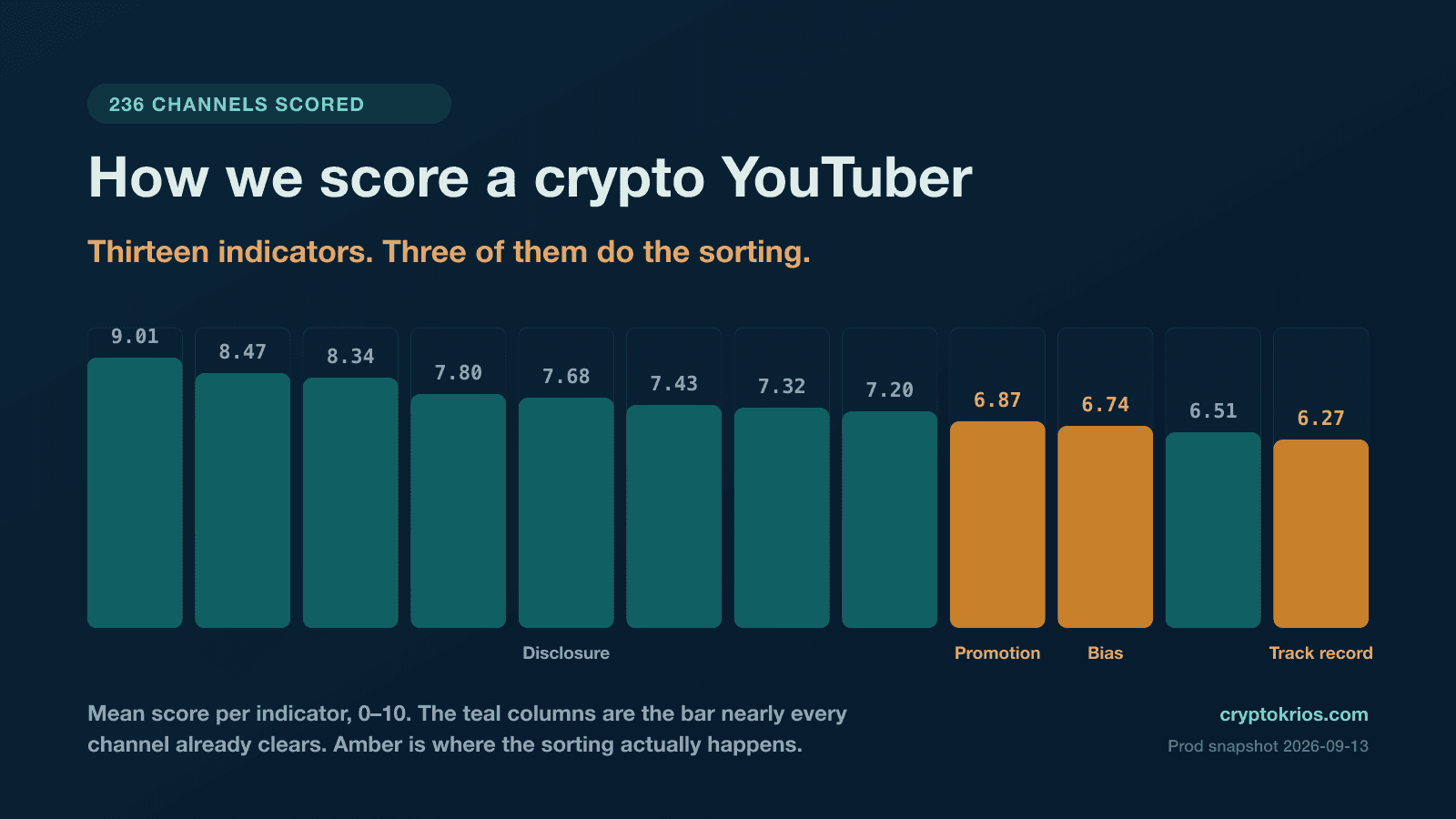
How We Score a Crypto YouTuber: The 13 Indicators Behind a Trust Score
A crypto youtuber trust score shouldn’t be a vibe check. This guide breaks down CryptoKrios’ 13 indicators (with verified platform averages) and explains what the score means, what it doesn’t, and how to use it responsibly.
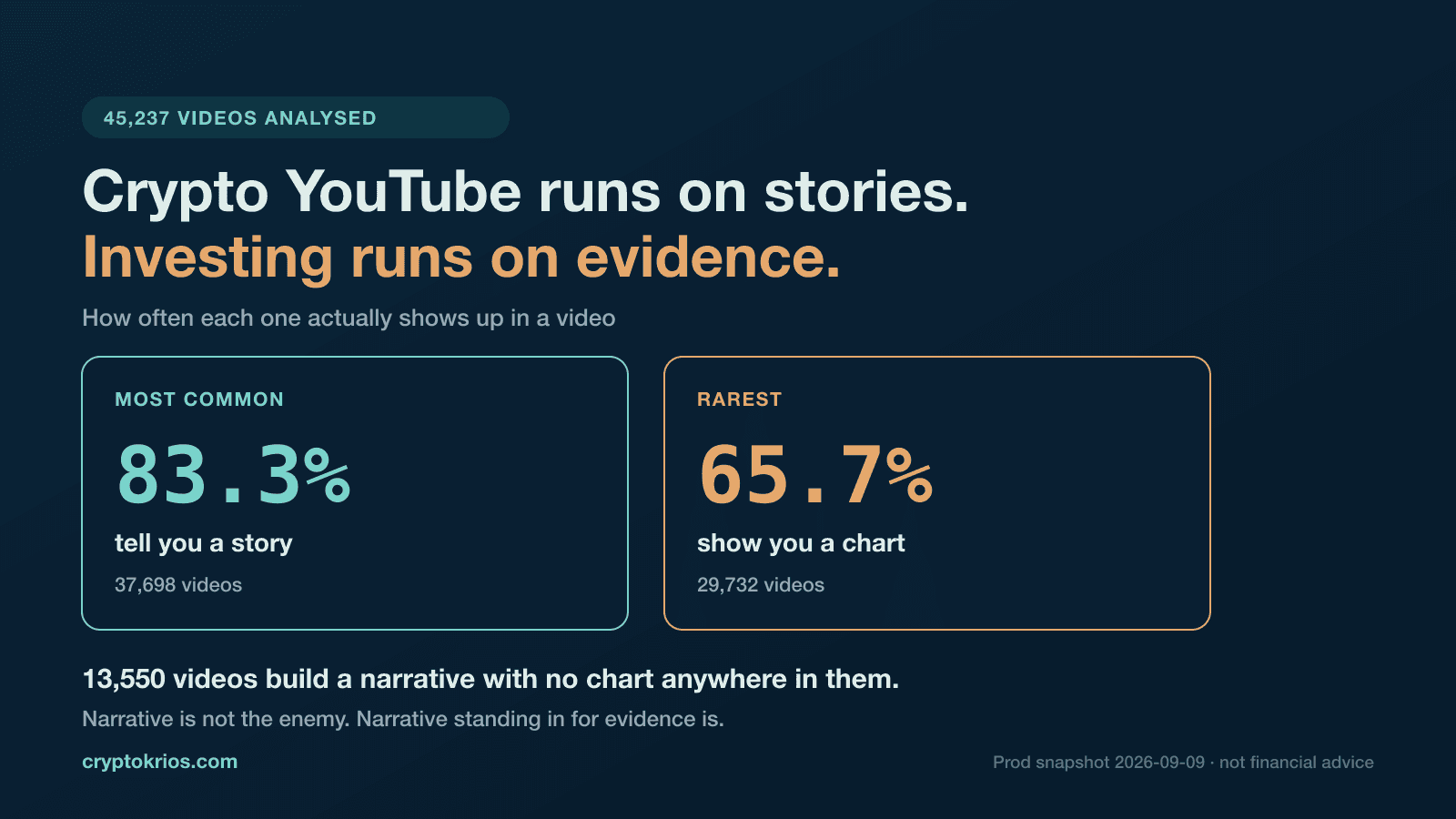
Story vs Charts in Crypto YouTube: When Narrative Helps (and When It Replaces Analysis)
CryptoKrios analyzed 45,237 crypto videos: stories appear in 83.3%, but crypto youtube technical analysis (charts) shows up in only 65.7%. Learn a simple test for when narrative supports a thesis—and when it replaces evidence.

Crypto Influencer Sponsorship Disclosure: Sponsored vs Organic Crypto Content (A Practical Bias Checklist + Examples)
A practical, example-driven crypto influencer sponsorship disclosure checklist to spot sponsored bias fast. Includes red-flag vs responsible wording, what disclosures miss, a 2-minute verification protocol, and a before/after script rewrite.

Crypto Influencer Bias Detection: 7 Content Patterns That Correlate With Low Accuracy
Crypto influencer bias detection helps you separate analysis from incentives. Learn 7 bias patterns that correlate with lower accuracy—and the self-checks you can run to vet any creator fast.