Bullish by Default: How to Read One-Sided Crypto Coverage
Bullish by Default: How to Read One-Sided Crypto Coverage
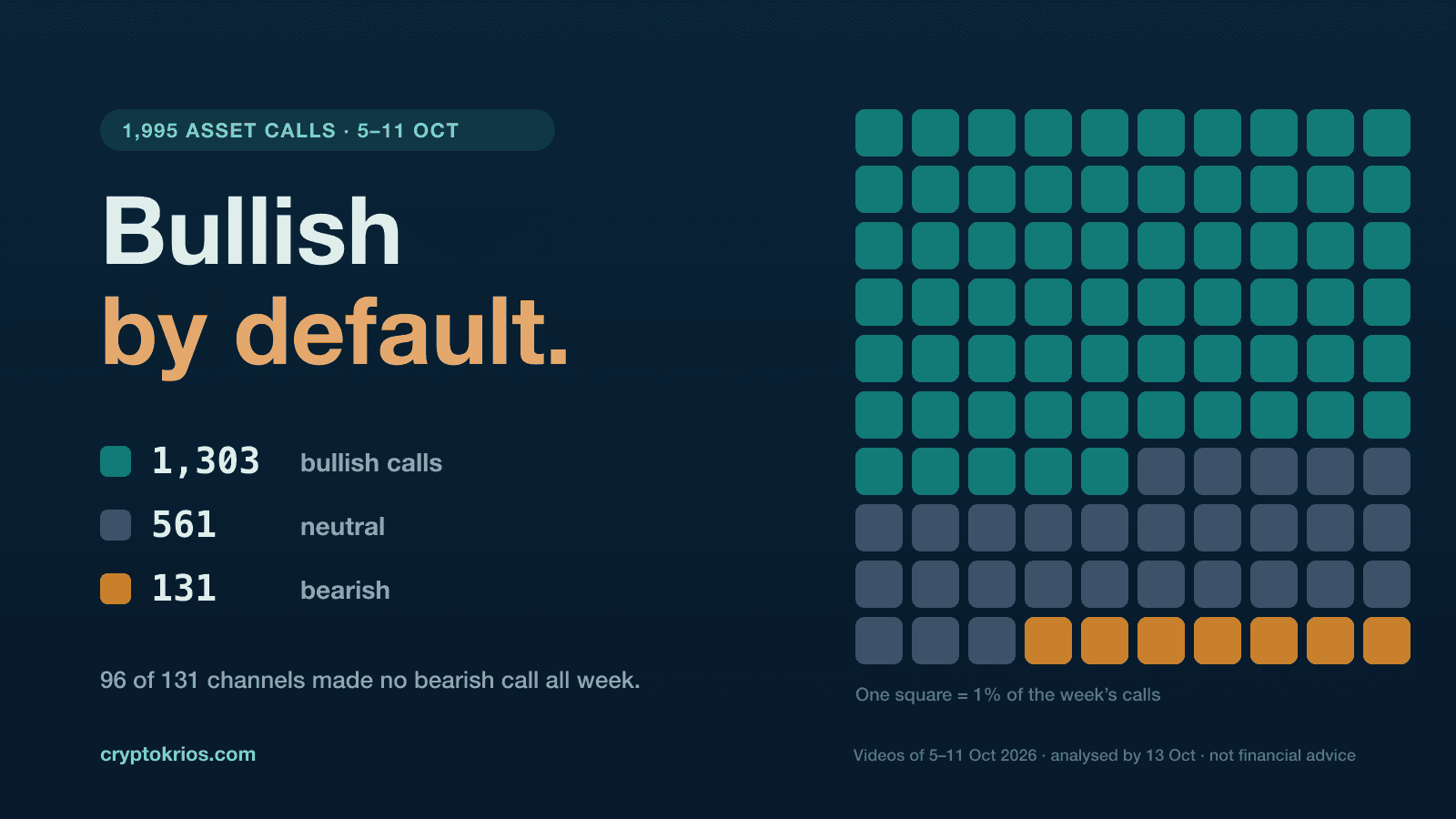
Last week, crypto YouTube made ten bullish calls for every bearish one. We posted that number on Tuesday. This article is the long version: where the number comes from, how far the one-sidedness goes, and what to do with it as a viewer.
One thing first, because it shapes everything below. One-sided coverage is a fact about the coverage. It says nothing about the assets, and it does not make any creator wrong.
The number
We extract every asset call from the videos we analyse. A creator names an asset and takes a stance on it, and that becomes one record, tagged bullish, neutral or bearish.
For videos published from 5 to 11 October, that gives 1,995 asset calls from 131 channels, across 694 videos and 355 different assets:
- Bullish: 1,303 (65.3%)
- Neutral: 561 (28.1%)
- Bearish: 131 (6.6%)
That is 9.9 bullish calls for every bearish one. When we first ran the query on Monday, with fewer of the week's videos analysed, it was 1,257 to 123, or 10.2 to 1. The ratio held as the dataset filled in.
It was not an unusual week either. For the week before, the same query returns 1,521 bullish calls against 99 bearish: fifteen to one.
It is not a few loud channels
A lopsided total could come from a handful of very active, very optimistic channels. It does not.
96 of the 131 channels made no bearish call at all during the week. Ten made exactly one. Twenty-five made two or more.
You might expect the 96 to be small channels that named two or three assets and happened to like them. Some are. But among the 64 channels that made ten or more calls during the week, 38 still made no bearish call. Bullish by default is the norm, including among the channels that talk the most.
Where nobody disagrees
Sixteen assets drew twenty or more calls during the week. Five of them drew no bearish call from anyone:
- SUI: 40 calls from 23 channels
- QNT: 36 calls from 15 channels
- ONDO: 22 calls from 15 channels
- HYPE: 21 calls from 17 channels
- HBAR: 20 calls from 9 channels
Tuesday's card showed three names on this list, out of fourteen assets. HYPE and HBAR crossed the twenty-call line as more of the week's videos were analysed. We would rather show you the list moving than pretend a snapshot is final.
At the other end, the assets where creators disagreed most were LINK (4 bearish calls out of 35, or 11.4%), ZEC (4 of 39, 10.3%) and UNI (2 of 21, 9.5%). Ethereum sits at 8.8% and Bitcoin at 5.0%.
So even for the most contested asset of the week, close to nine calls out of ten were not bearish. Disagreement, where it exists, is thin.
Bullish is not the same as low quality
It would be easy to read all this as "bullish videos are bad". The scores say otherwise.
We score every video out of 10 on thirteen indicators. Among last week's videos that made asset calls:
- videos with only bullish calls: 362 videos, average score 7.28
- videos with at least one bearish call: 72 videos, average score 7.34
Six hundredths of a point. A creator can be bullish and careful, and many are.
The difference shows up at the bottom. 35 of the 854 videos we scored last week came in under 5, and 25 of those 35 made only bullish calls. What the 35 share is pressure more than optimism: 30 were rated 3 or lower out of 10 on FOMO, 29 on urgency, 28 on emotional tone, and 20 of 34 on disclosing a conflict of interest. Only one scored low on clarity.
That is the distinction worth keeping. A bullish call tells you the creator likes an asset. A deadline, a feeling being sold and an undisclosed sponsor tell you something about the video.
How to read one-sided coverage
This is what crypto influencer bias looks like in aggregate: nobody has to say anything false for the total to lean one way. Four habits help.
1. Count the disagreement, not the calls. "Everyone is talking about it" usually means many bullish calls. Ask how many channels said the opposite. For five of last week's sixteen most-covered assets, the answer was none.
2. Ask what would make the creator wrong. A careful bullish video names the scenario in which its thesis fails. If you cannot find that sentence, you have heard half of an analysis.
3. Check for pressure. Is there a deadline? Is the video selling a feeling? Who gets paid if you act? Those three questions map to the indicators that sank last week's lowest-scored videos.
4. Go and find the risk videos. They exist, and they score well. Three of the eleven videos that scored 9.0 or above last week were about what can go wrong:
- Cryptotechtoday, "Crypto Delisted? How to Withdraw Tokens & Check Real Liquidity", video score 9.2: watch on YouTube
- Crypto Tips, "$93M Drained From Ledger Wallets: Is Yours Safe?", video score 9.1: watch on YouTube
- Crypto Flash, "10 ans dans la cyber m'ont appris ça sur la crypto" (in French), video score 9.2: watch on YouTube
What this does not say
- It is not a view on any asset. Zero bearish calls on an asset describes what creators said last week. We do not make price predictions.
- It is not an accusation. Most channels with no bearish call are covering what they find interesting. This article names no channel on that side, on purpose.
- It is a snapshot. These figures cover videos published from 5 to 11 October, as analysed by 13 October. Videos analysed later will move them slightly, as they already did between Monday and Tuesday.
- It is AI extraction. Stances are read from transcripts by a model. A hedged "I like it, but" can land as bullish or as neutral.
Try CryptoKrios free to see what each channel you watch actually called, how one-sided its coverage is, and how its videos score. https://cryptokrios.com/free
Trust scores, video scores and call extractions are AI analyses of public content. They describe what was said, not what will happen next. Nothing in this article is financial advice. Always do your own research.
Discover what crypto influencers really say
Get AI-verified analysis of top crypto content creators — free.
Try CryptoKrios FreeRelated Articles

Which Crypto Assets YouTube Talked About Last Week, and Which It Dropped
QNT went from 14 channels to 41 and back to 16 in three weeks, while Bitcoin, XRP, Ethereum and Solana held about 41% of all calls throughout. What crypto narrative rotation looks like from the coverage side, and four ways to read it.
The Checkability Gap: Why Most Crypto Calls Can Never Be Graded
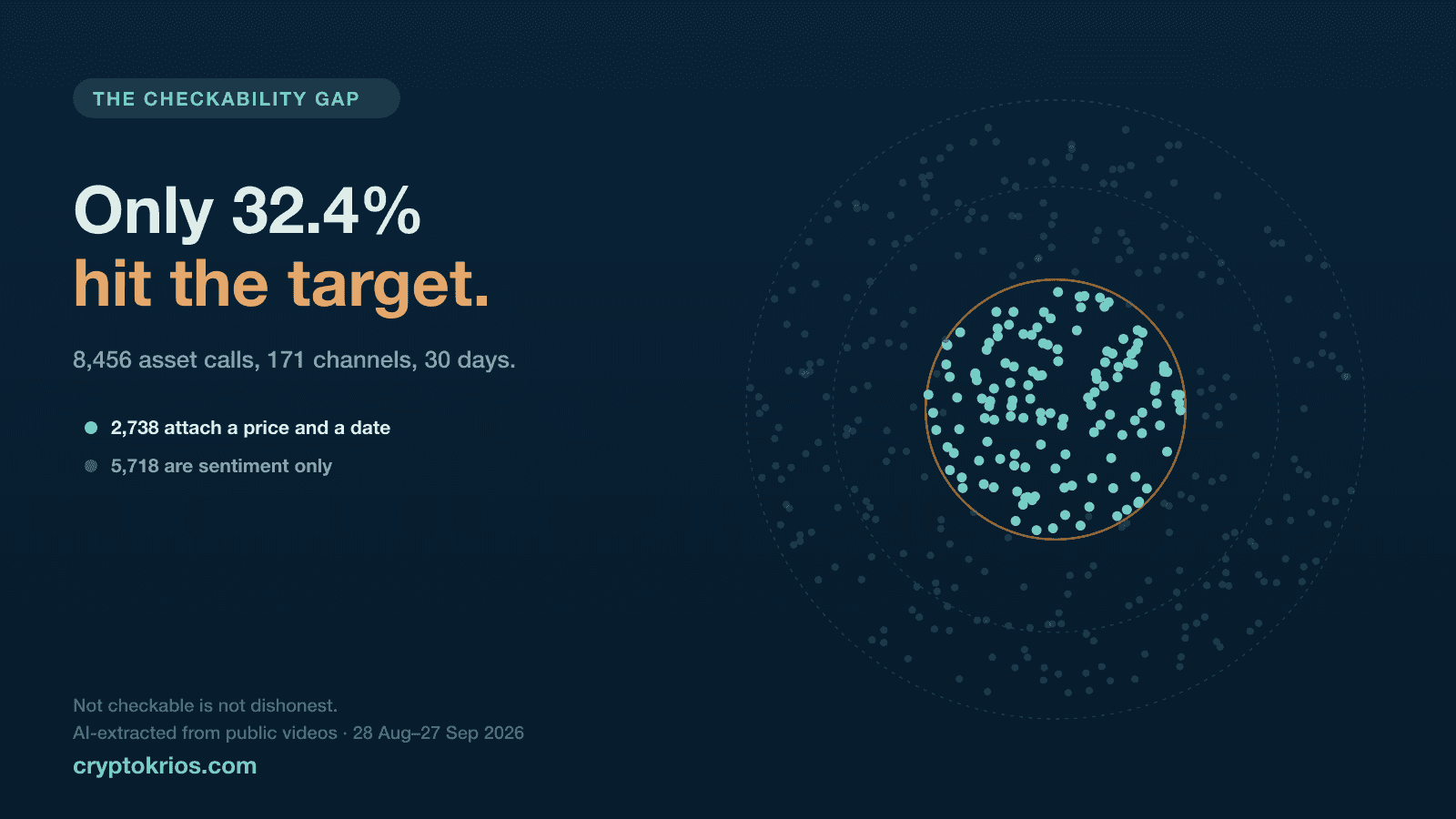
Of 8,456 crypto asset calls in 30 days, only 32.4% attach a target price and a target date — the two things that make a claim checkable. Here's what that gap means, and doesn't.
The Consensus Map: What 167 Crypto Channels Actually Recommended in 30 Days
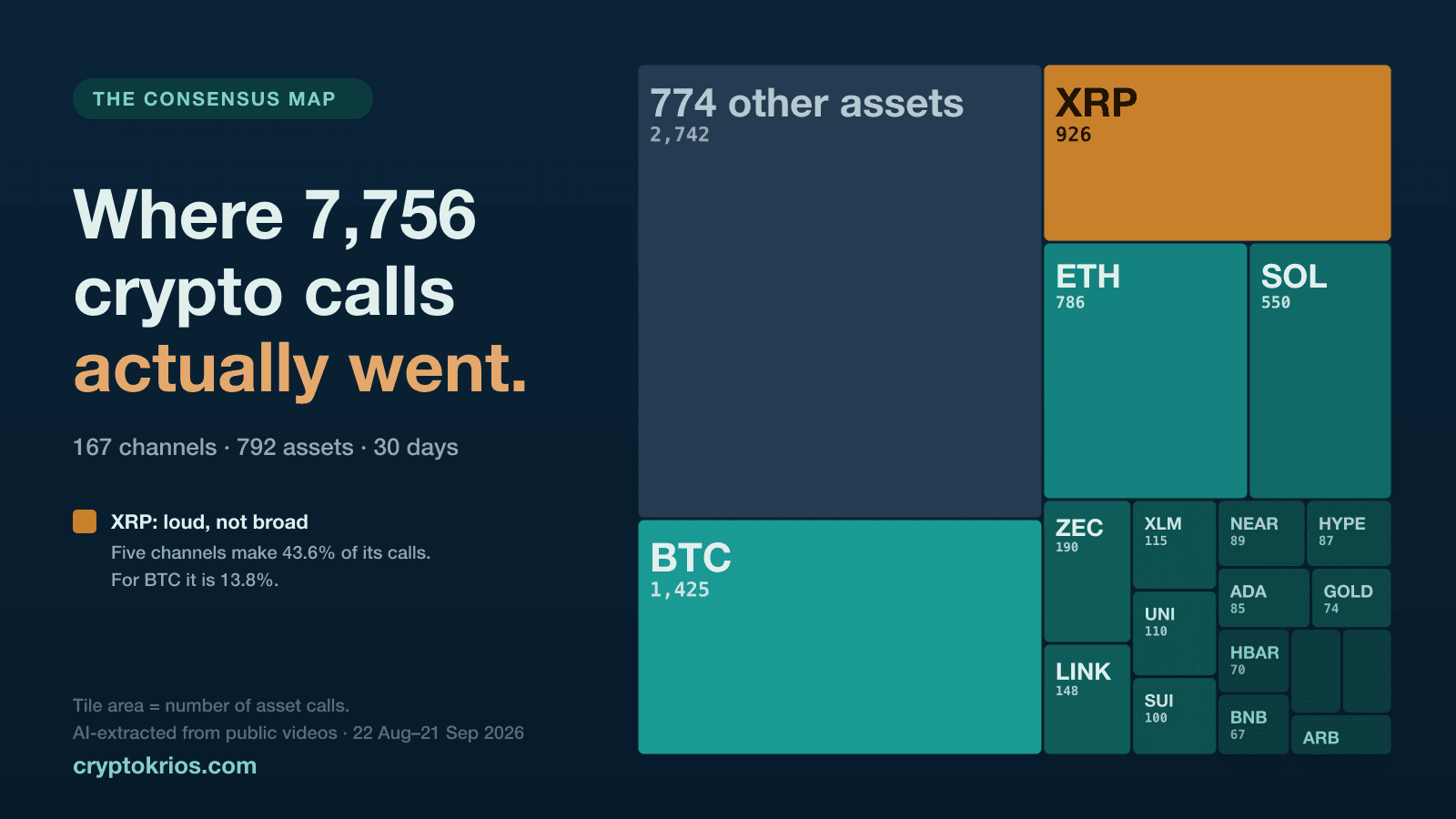
We extracted 7,756 asset recommendations from 167 crypto YouTube channels in 30 days. Four assets take 47.5% of the calls, 478 were named once, and bullish outnumbers bearish 15.7 to 1.
What 14,330 Judged Crypto Predictions Say About Following Anyone's Calls
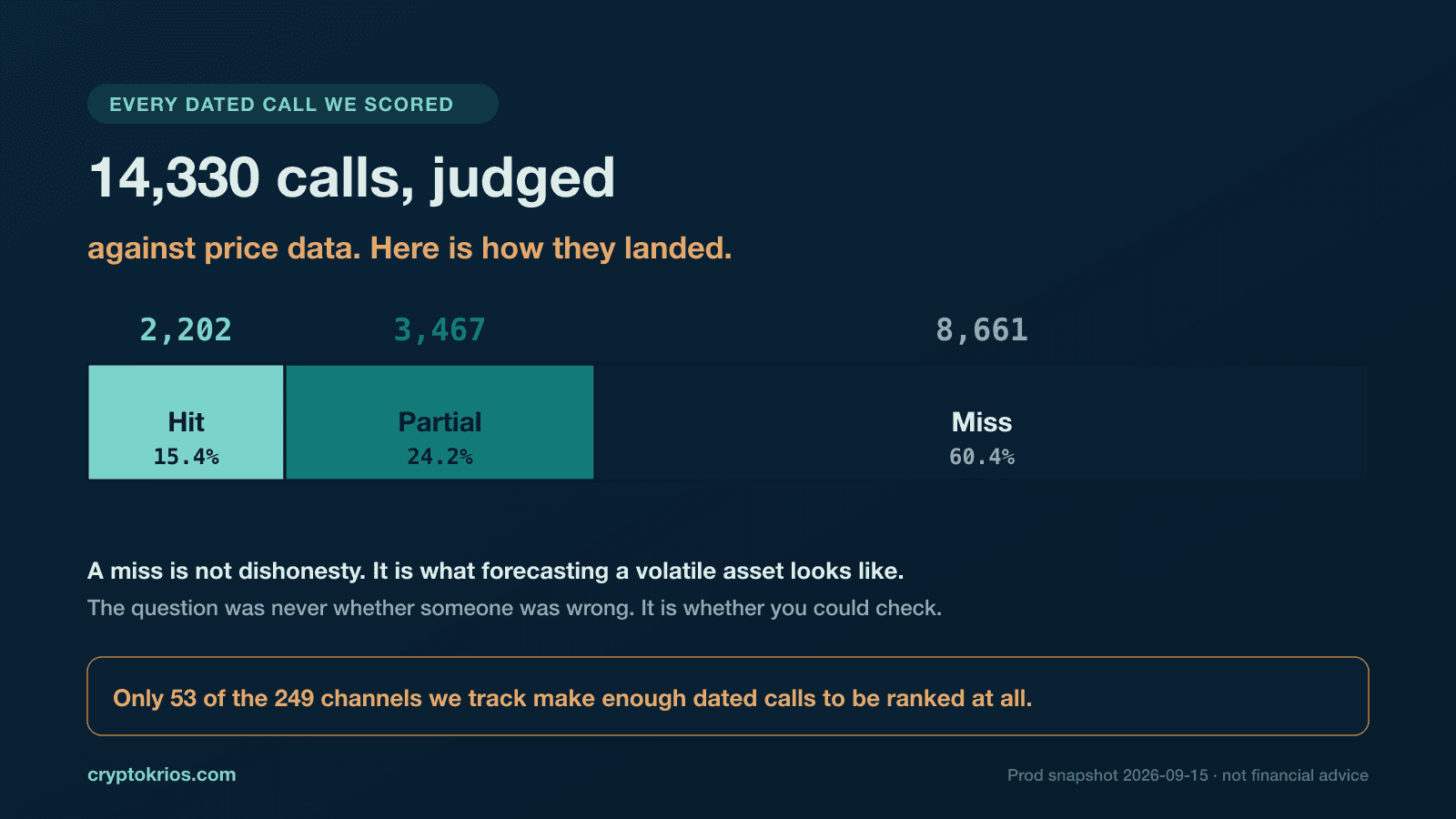
We judged 14,330 crypto predictions against price data. The best creator hits 32.3%—remarkable vs a 15.4% baseline. The real finding: only 53 of 249 channels make enough dated calls to be rankable.